Are You a Parent… or Your Kid’s Sports Manager?

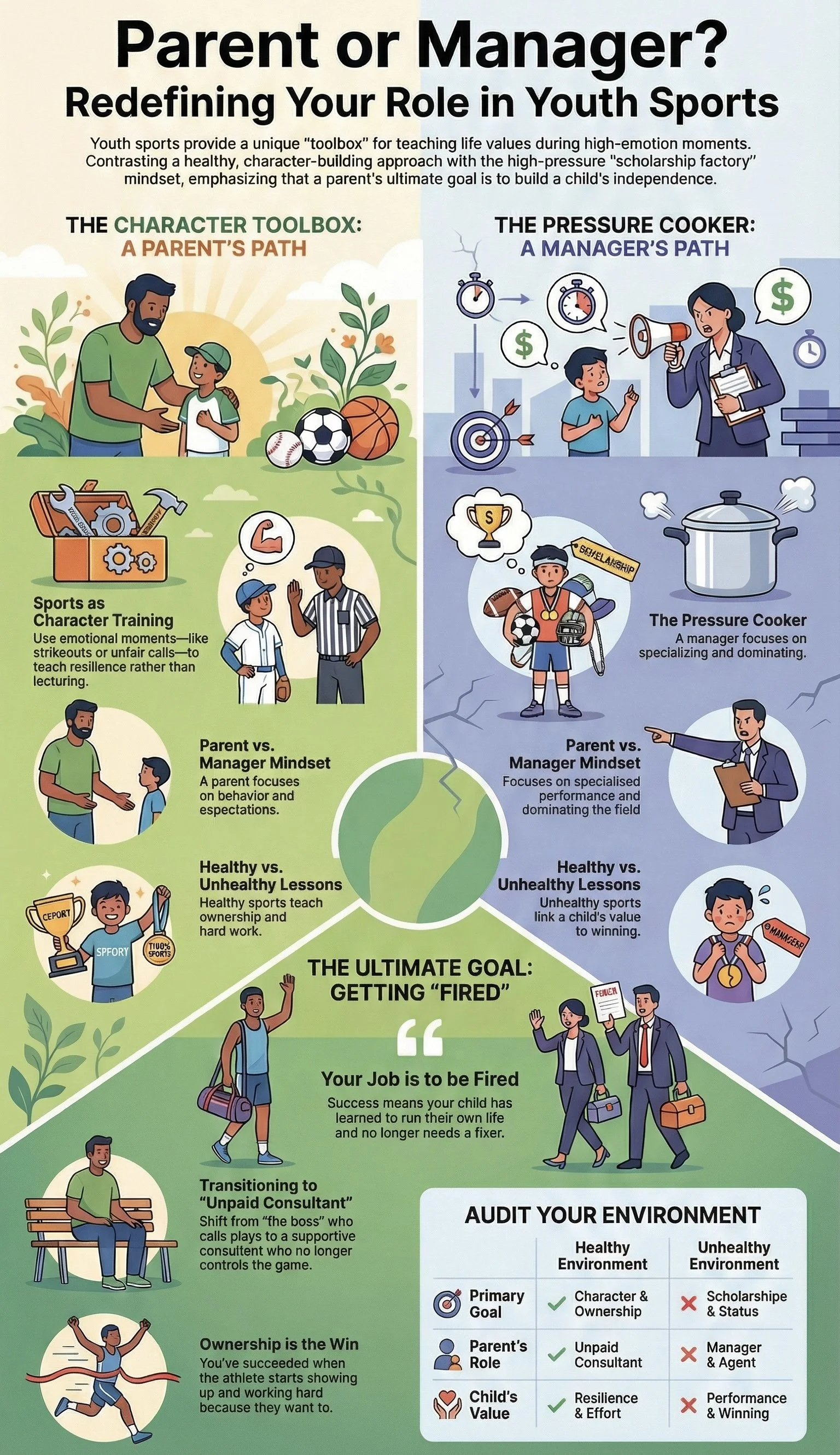
I don’t think I would have known how to be a parent without sports.
I would have been a dad either way, obviously. I love my kids. I would have shown up. I would have cared. But sports handed me something I didn’t know I needed: a toolbox.
It gave me real-life moments—small, emotional, high-stakes (to a kid)—where I could teach values without turning the kitchen table into a lecture hall. Because here’s the truth: most parenting “lessons” don’t land when you schedule them. They land when your child strikes out and wants to cry, when they miss the shot and feel embarrassed, when the ref makes a call they think is unfair, and when they’re tired, frustrated, and their emotions are right at the surface. Sports gives you those moments over and over, and if you handle them well, those moments become character training.
What matters (and what doesn’t)
This is one of the best parts of sports: it’s totally fine if you win or lose. It’s totally fine if you struck out or hit a home run. Those things matter in the game… but they don’t matter in the long game. What matters is how you respond.
It does matter if you threw your helmet. It does matter if you blamed your teammate. It does matter if you quit the second it gets hard. It does matter if you lied, pouted, or disrespected a coach.
Sports gives parents a clean way to talk about behavior without making it personal. You don’t have to say, “You’re being rude.” You can say, “We don’t throw helmets.” Now the standard is clear. It’s not about shame. It’s about expectations. That’s parenting gold.
Where it goes off the rails
Here’s where I feel conflicted. My family got a lot out of sports. A lot. But I’m not sure our experience is typical. Because I also see what happens when sports turns into a scholarship factory.
That’s when things start to break. When the message becomes: “You better be the best.” “You better specialize early.” “You better dominate or you’re falling behind.” “You better impress the right coach.” “You better turn your childhood into a résumé.”
That’s when sports stops being a teacher and starts being a pressure cooker. And pressure changes the parent-child relationship. Now you’re not just Dad. You’re the manager. You’re the critic. You’re the agent. You’re the one who “knows what it takes.” And your kid feels it. Even if you never say it out loud, they can feel the weight.
The hardest parenting truth I’ve ever heard
Here’s the line that hits like a brick: “Your job is to be fired.”
If you’re doing it well, your child eventually doesn’t need you to run the show. They don’t need you to solve every problem. They don’t need you to fight every battle. They don’t need you to be the voice in their head. They need your help less because they’ve learned to help themselves more. That’s the goal.
And it’s hard—because being needed feels good. Being Dad-Coach feels important. You’re the helper. The driver. The fixer. The planner. The “we’ve got this” guy. Then one day, without warning, you get demoted. Not because they hate you. Because they’re growing up.
The “unpaid consultant” phase (and the valet phase)
At some point, parenting changes shape. You go from being “the boss” to being “the consult.” You’re still on the team. But you’re not calling the plays anymore.
You’re an unpaid consultant. And sometimes… you’re a valet. You still show up. You still support. But you don’t control.
And this is where a lot of parents panic. Because control feels like love when you’re afraid. But control is not love. Love is building a kid who can stand on their own two feet.
How to know if sports is helping your family
Here’s a quick check.
Sports is healthy when it teaches your child: How to work hard. How to handle disappointment. How to be coachable. How to be a great teammate. How to manage emotions. How to take ownership. How to bounce back.
Sports is unhealthy when it teaches your child: “I’m only valuable if I win.” “Mistakes mean I’m a failure.” “Adults’ approval is everything.” “My parent’s mood depends on my performance.” “I can’t stop, even if I hate it.”
The difference isn’t the sport. It’s the environment.
The Mighty Oak Athletic message
At Mighty Oak Athletic, we use training to build athletes. But even more, we use training to build people.
Because training is one of the best places on earth to practice the skills that parenting is trying to build: discipline, confidence, resilience, self-control, responsibility, leadership.
And the best part? When the system works, the athlete starts owning it. They start showing up because they want to. They start working because they care. They start improving because they take pride in it.
That’s when you know you’re doing it right. Not because they won. Because they’re growing.
A simple goal for parents
If you want one job description that’s actually useful, here it is: Build a kid who can run their own life.
Sports can help. Training can help. But only if we keep the mission clear: Not scholarships. Not status. Not “keeping up.”
Character. Ownership. Confidence. And yes—eventually, getting fired.
Because if your child can “fire” you in a healthy way… it means you built something strong. Something that can stand.