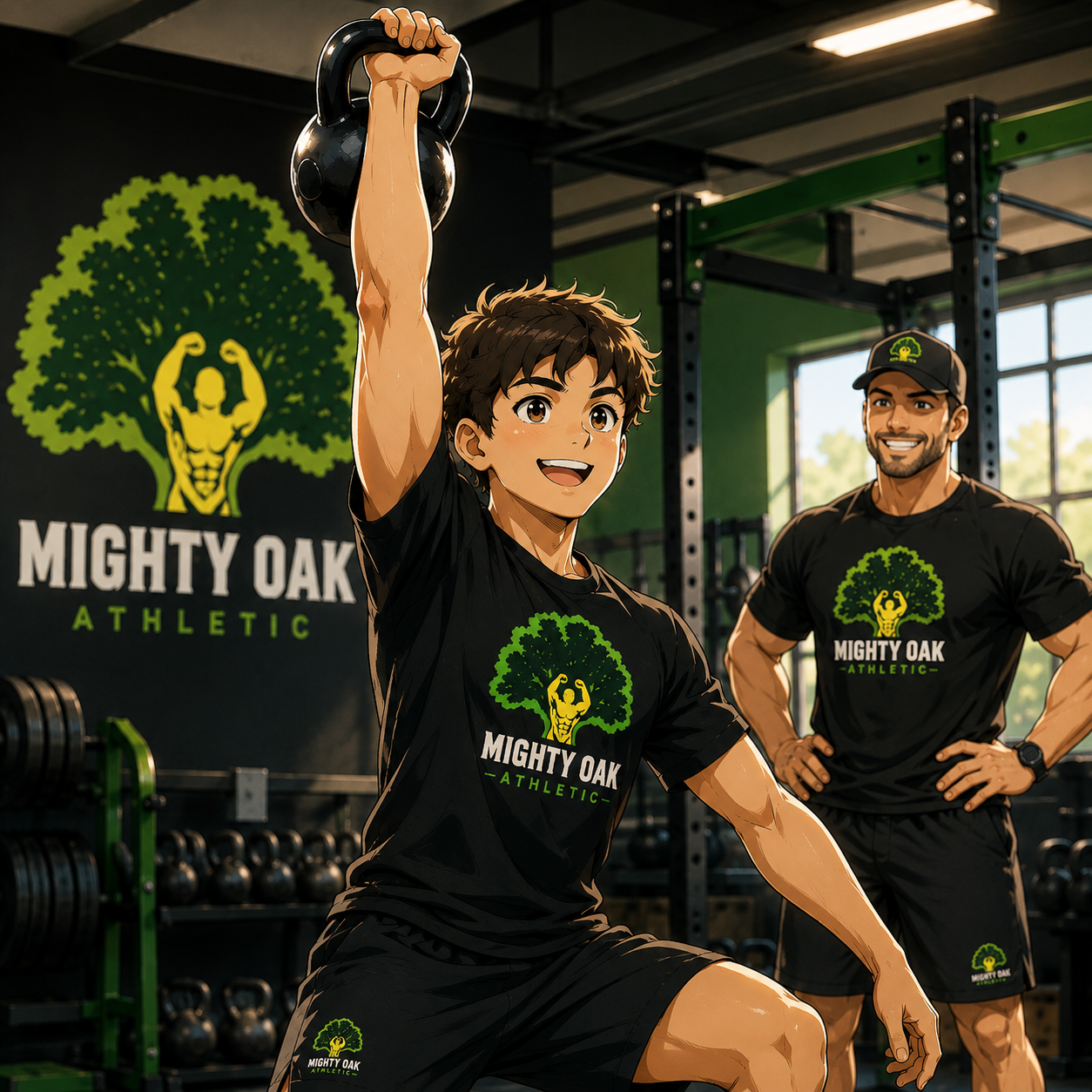
How to Use Kettlebell Clean and Press Ladder Training for Optimal Sports Performance
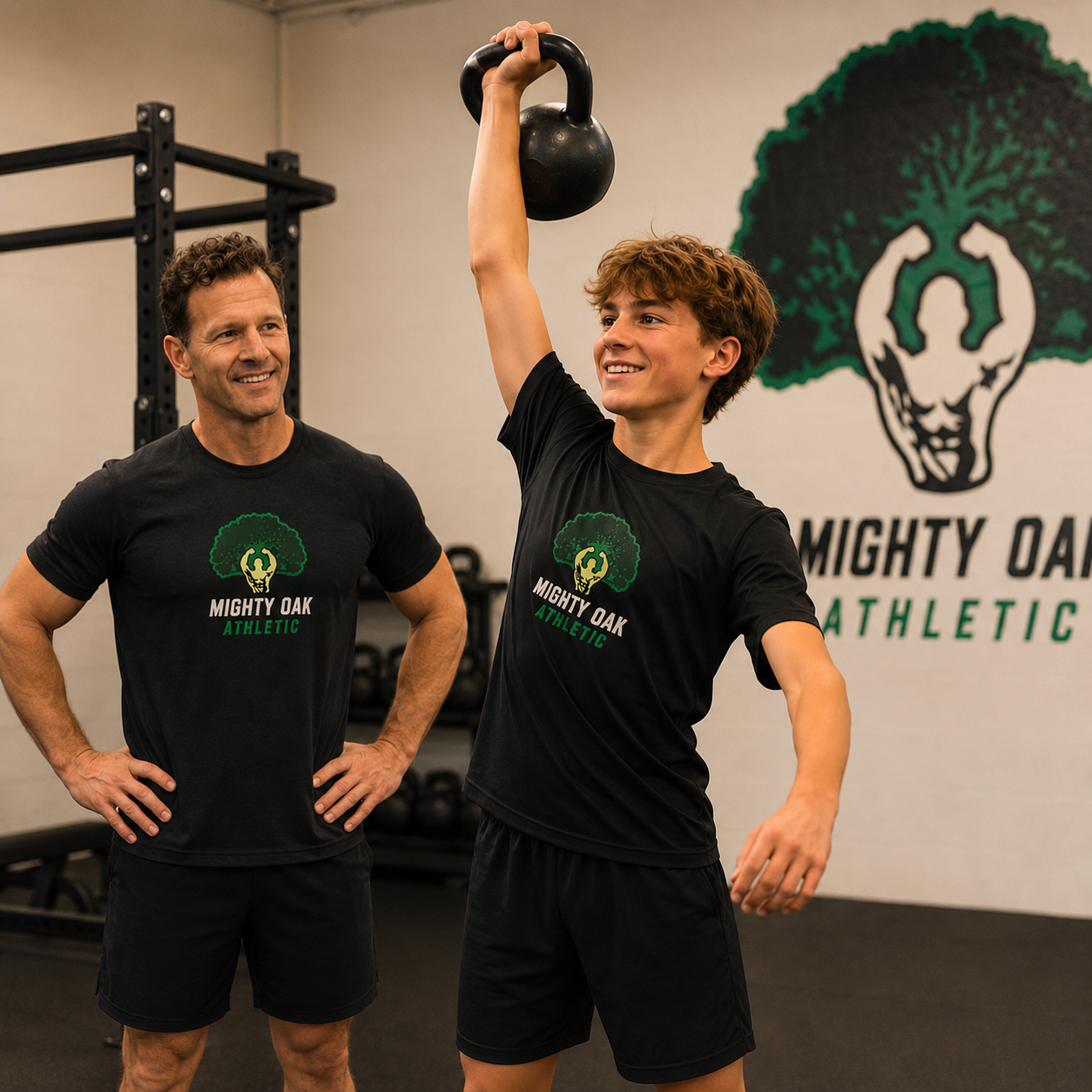
Key Takeaways (TL;DR)
The kettlebell clean and press ladder, from Dan John's Never Let Go, builds full-body strength, power, and endurance in one simple session.
The ladder format (1-2-3 reps per arm, paired with pull-ups, five rounds) creates progressive overload without heavy loads — ideal for teen athletes.
Alternating arms builds balanced strength and shoulder stability, which helps reduce common overuse injuries in throwing and overhead sports.
Kids as young as 6 can learn kettlebell fundamentals with coaching; the clean and press ladder as written is best for athletes 12+ who have mastered form with light weight.
At Mighty Oak Athletic in Westmont, IL, every athlete trains kettlebell, barbell, and bodyweight movements under CSCS-certified coaching — like having a personal trainer for kids, in a team setting.
The Kettlebell Clean and Press Ladder: A Simple Program That Builds Stronger, More Durable Young Athletes
Every parent of a student athlete faces the same balancing act: how do you help your child get stronger and faster without beating up their growing body? One of the best answers we use at Mighty Oak Athletic comes from legendary strength coach Dan John. His Clean & Press Ladder, featured in his book Never Let Go, is a masterclass in doing more with less — and it works beautifully for teen athletes.
What Is the Clean and Press Ladder?
The program pairs two of the highest-value movements in strength training: the single-arm kettlebell clean and press, and the pull-up. Instead of straight sets, the reps climb like a ladder:
Left arm: 1 clean and press
Right arm: 1 clean and press
1 pull-up
Left arm: 2 clean and presses
Right arm: 2 clean and presses
2 pull-ups
Left arm: 3 clean and presses
Right arm: 3 clean and presses
3 pull-ups
Rest briefly, then repeat for a total of five rounds
That's it. Five ladders, roughly 30 quality reps per arm and 30 pull-ups, done with crisp form and full attention. No machines, no gimmicks.
Why It Works for Sports Performance
Strength and endurance at the same time. The climbing rep scheme builds muscular strength on the low rungs and work capacity on the high rungs — exactly the blend needed for sports built on repeated bursts of power, like football, basketball, volleyball, and wrestling.
Total-body coordination. The clean and press is not an arm exercise. Force starts at the floor, travels through the hips and trunk, and finishes overhead. That ground-to-overhead sequencing is the same kinetic chain athletes use to jump, sprint, throw, and hit.
Built-in progressive overload. Ladders let athletes accumulate volume without grinding reps. When five full ladders feel smooth, you move up a kettlebell size. Progress is obvious and measurable — something teen athletes love.
Why It Works for Injury Reduction
Balanced left-right development. Because every rung is done on each arm separately, the ladder exposes and corrects side-to-side strength gaps — a common contributor to overuse injuries in one-side-dominant sports like baseball, tennis, and volleyball.
Shoulder and core armor. Pressing a kettlebell overhead while standing demands trunk stiffness and shoulder stability on every rep. That's protective strength for the lower back and shoulders, two of the most commonly injured areas in high school sports.
Self-limiting by design. The ladder resets to one rep at the start of each round. Athletes are never forced to grind through fatigued, sloppy reps — the structure itself protects form.
Is This Appropriate for Kids?
Kettlebell training is safe and effective for young athletes when it's coached and scaled properly. At Mighty Oak Athletic, kids as young as 6 learn kettlebell fundamentals — deadlifts, goblet squats, carries — every session. The full clean and press ladder as written is best suited for athletes roughly 12 and up who have already mastered the clean and the press separately with light weight under a qualified coach.
If you're wondering how much weight is right for your child, we wrote a complete guide: How Much Weight Should My Child Lift?. And if you want the research on why supervised strength training is one of the safest things a young athlete can do, see our youth strength training safety page.
How We Use It in Westmont
At our facility in Westmont, Illinois, student athletes from across DuPage County — Downers Grove, Darien, Clarendon Hills, Hinsdale, Woodridge, and beyond — train movements like the clean and press ladder under the eye of a CSCS-certified coach. Every session is coached like personal training for kids, delivered in a small-team environment: individual attention on form, individualized loading, and a program that scales from a 6-year-old learning to hinge to a varsity athlete chasing a stronger overhead press.
Want to see how your athlete responds to this style of training? Book a free training session and we'll put them through a scaled version, live.
Dan John's ladder proves a point we make every day: young athletes don't need complicated programs. They need simple, proven movements, coached well, progressed patiently. That's how you build not just better athletes, but stronger, more durable kids.
-
It's a strength program from Dan John's book Never Let Go that pairs single-arm kettlebell clean and presses with pull-ups in climbing rep ladders (1-2-3 per arm), repeated for five rounds. It builds strength, power, and endurance in one session.
-
Yes, with proper coaching and scaling. Kids as young as 6 can learn kettlebell fundamentals; the full ladder program is best for athletes about 12 and older who have mastered the clean and press with light weight under a certified coach.
-
Most teen athletes start the ladder with a kettlebell they can press 5–8 times fresh with perfect form — commonly 8–12 kg for beginners. Form and consistency matter more than load. Our guide on how much weight kids should lift covers this in depth.
-
Any sport built on repeated power output — football, basketball, volleyball, wrestling, baseball, and track. The single-arm work also corrects left-right imbalances common in one-side-dominant sports.
-
Mighty Oak Athletic at 6424 S. Cass Ave. in Westmont coaches kettlebell, barbell, and bodyweight training for athletes ages 6–18 across DuPage County. Every session includes personal-trainer-level attention in a small-group setting, and the first session is free.