
Mighty Oak Athletic Is Now a Special Olympics Illinois Agency
Key Takeaways — Mighty Oak Athletic is an official Special Olympics Illinois agency. Starting in November we train a free powerlifting team for athletes with intellectual disabilities: ages 14 and up compete at Regionals on March 20–21, 2027; ages 8–13 train in a development group. Sessions are Mondays at 7:30 PM and Saturdays at 8:30 AM in Westmont. No cost, no membership. Tell Coach Mike about your athlete at mightyoakathletic.com/special-olympics.
For a couple of years now, some of the strongest kids in our gym have been athletes with intellectual disabilities. They show up, they chalk up, and they pull. Nobody treats them differently because nobody has to. A barbell does not know who is lifting it. What they have not had is a team to lift for. As of this month, they do. Mighty Oak Athletic is an official Special Olympics Illinois agency, and in November we start training a powerlifting team.
Here is what that means in plain terms. Special Olympics Illinois is open to any athlete age 8 or older with an intellectual disability. That covers Down syndrome, autism with a cognitive delay, cerebral palsy with a cognitive delay, global developmental delay, and any level of intellectual disability. If your child has an IEP for an intellectual disability or a developmental delay, they almost certainly qualify. There is no upper age limit, and you do not need a diagnosis letter in hand to ask. If you are not sure, fill out the form and I will call you and sort it out.
Powerlifting is three lifts: the squat, the bench press, and the deadlift. It is also the one Special Olympics sport with a minimum competition age of 14, so our team has two groups. Athletes 14 and up train for the Special Olympics Illinois Regionals on March 20 and 21 at Marmion Academy in Aurora. Win gold there and you go to Summer Games in Bloomington-Normal in June. Athletes 8 to 13 join our development group, learn the same lifts with the same coaches, and move up to the competition team the season they turn 14.
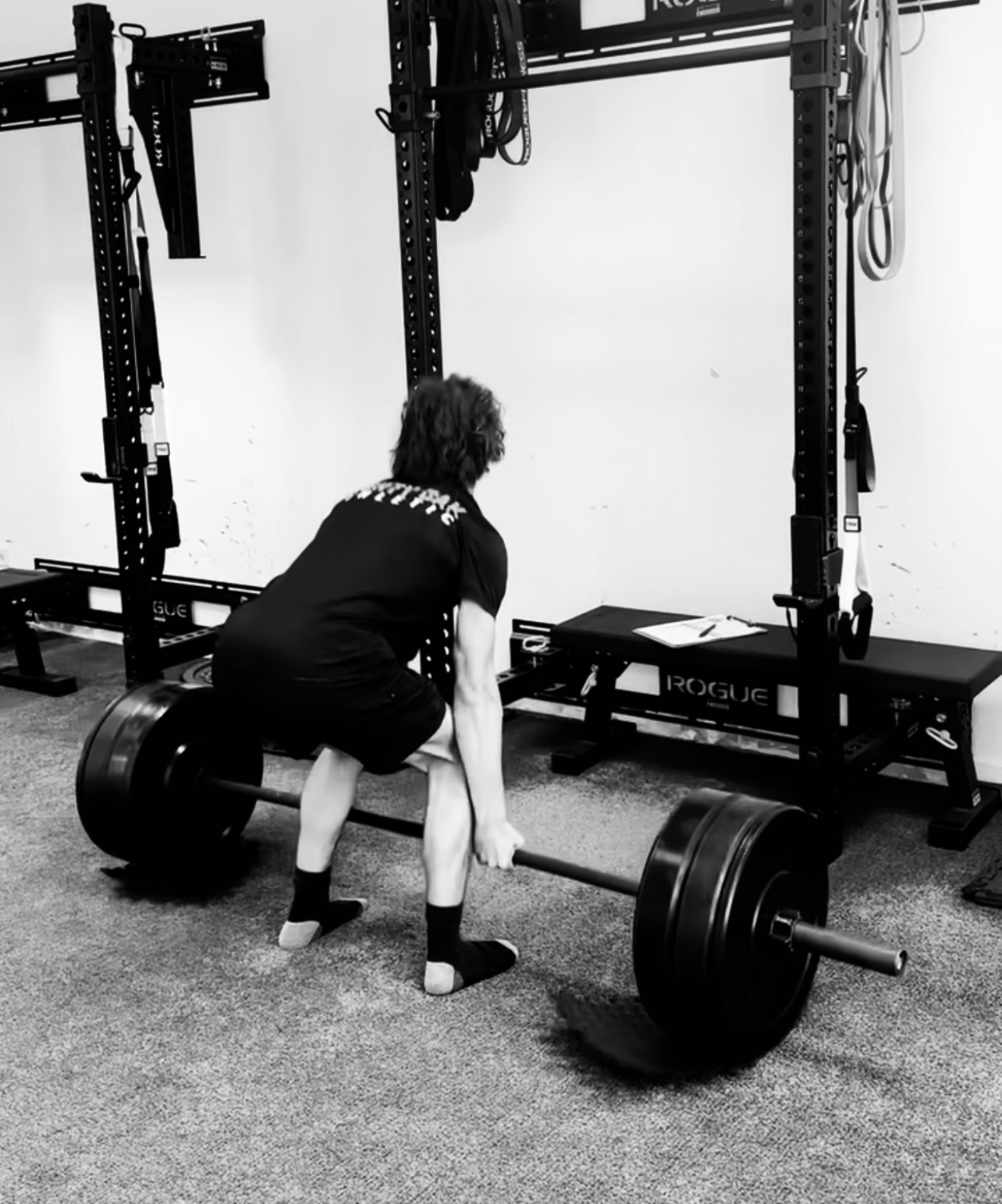
I have coached Special Olympics powerlifting with Marshall-Starke County in Indiana, and I can tell you what makes it work. Athletes compete against lifters of the same gender, age group, weight class, and strength level, so a 15-year-old who benches 65 pounds is not lifting against a 30-year-old who benches 300. Most athletes medal in their own division, and they earn it. The meet runs on the same commands and the same rules as any powerlifting meet, so we train that way from the first session. Every athlete starts with the bench press and deadlift. Squats begin after each athlete completes the Special Olympics Illinois squat safety training.
Sessions are Mondays at 7:30 PM and Saturdays at 8:30 AM at our gym, 6424 S. Cass Ave. in Westmont, with no more than 12 athletes on the floor. Every coach who works with the team completes Special Olympics Illinois Class A certification: a background check, Protective Behaviors training, and concussion training. Every squat and every bench press has spotters. We start light, we add weight slowly, and we coach one lift at a time.
It is free. Special Olympics does not allow fees for athletes or families, and I would not want to charge one anyway. You do not need a Mighty Oak Athletic membership. Athletes bring a T-shirt, flat athletic shoes, and knee-length socks for deadlift days. We supply the bars, plates, and racks, and we help with meet-day gear like singlets.
Joining takes three steps. Fill out the short form on our Special Olympics page. I call you, confirm your athlete qualifies, and invite them to a first session. Then you register your athlete with Special Olympics Illinois online, which is two forms with no doctor’s visit for most athletes, and we walk you through it. The entry paperwork for Regionals is due February 16, so the sooner an athlete starts, the more training weeks they get before March.
Two more doors are open. Athletes without an intellectual disability can lift as Unified Partners, side by side with Special Olympics athletes in the same meet. And our high school lifters, the ones who have been training here for years, are exactly who I want as spotters and loaders on meet day. If that is your kid, tell them to find me.
I started this gym in 2013 to build better athletes. This is the same job with a bigger team. If you know a family with an athlete who belongs on it, send them to mightyoakathletic.com/special-olympics or forward this post. That is the whole ask.
Be strong to be useful,
Coach Mike
The One Workout That Built Mighty Oak Athletic
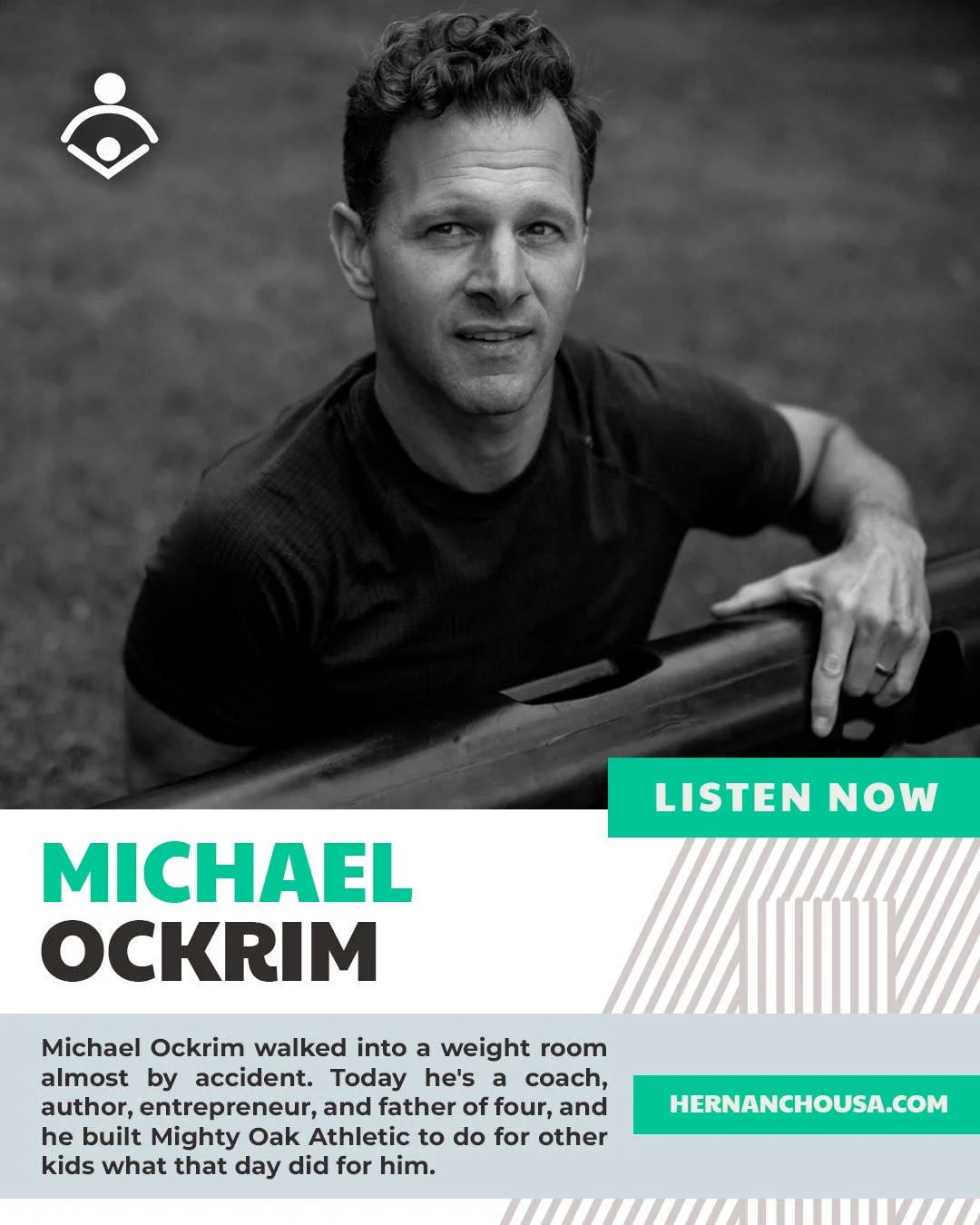
Listen to the full episode: Spotify · Apple Podcasts · Episode page
TL;DR: In the fall of 1992 I walked into the Fenwick weight room with nothing better to do, and a freshman fullback named Ray showed me 21 reps on the bench. Two days later I couldn't lift my arms, and I've been chasing that feeling ever since. Mighty Oak Athletic exists so every kid in the western suburbs gets that same moment: a real coach, a real barbell, and a place to get stronger away from screens.
Hernan Chousa had me on The Youth Sports Parenting Tribe this month, and he opened by asking me to go back to 1992. So here it is, because it's the reason your kid trains the way they train.
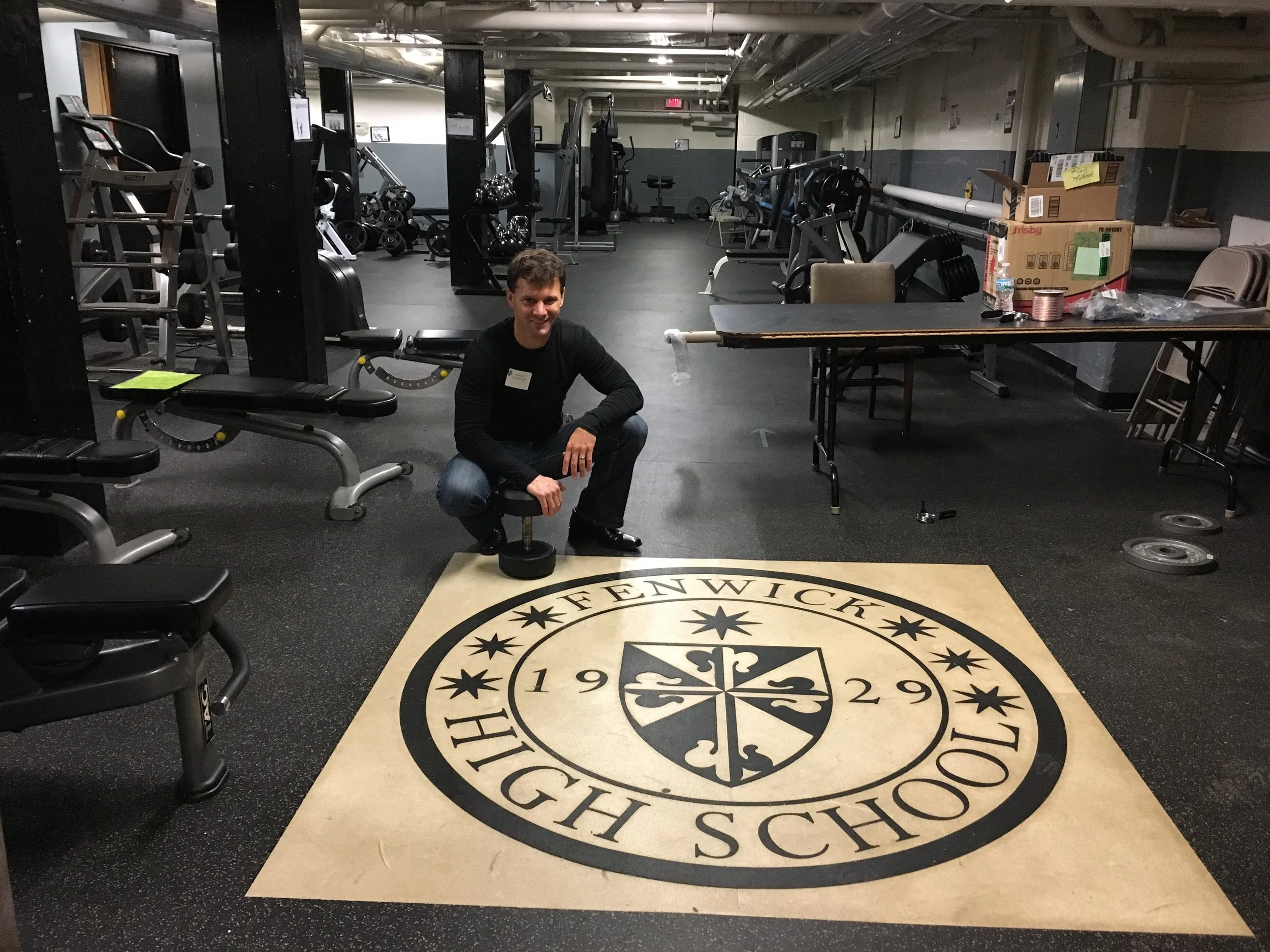
I was 13, a freshman at Fenwick, a little husky and short on confidence. Golf season had ended and winter sports hadn't started, so one afternoon I wandered into the weight room in the basement. It was a dungeon. Brick walls, old benches, nobody checking who belonged. I stood there not knowing what to do with my hands until a freshman fullback named Ray Molland looked up and said, come here, I'll show you some stuff.
He put me on the bench and ran me through 21s. Seven half reps from the chest, seven half reps from the top, seven full reps. I had never felt anything like it. The next morning I walked into gym class and told the teacher I physically could not raise my arms. She laughed and sat me out. And in that moment, sore and useless and a little embarrassed, I fell in love. For the first time in my life I had changed something about my own body with my own effort. I had agency. Everything since then, 30-plus years of coaching, studying and writing about health, traces back to that one afternoon.
Here's the part that still gets me. Ray grew up to be a school administrator. Teaching was in his nature at 14, and I was a kid who needed to be taught. When the student is ready, the teacher appears. My job at Mighty Oak is to be Ray for your kid. Wave them over, show them something simple, let them feel what it's like to move a weight and own the result, then watch them come back a little sore and a lot taller.
That's why we start kids at six, and why skill always comes before load. A six-year-old learning to hinge with a kettlebell is doing the same thing I did on that bench, just with better coaching and less soreness. Kids from 6 to 18 train with barbells, kettlebells and bodyweight every session, and the five movements we teach, squat, hinge, push, pull and carry, are the same ones they'll use at 45. Roughly half our kids are athletes in an off-season. The other half are on the math team, in the school play, at robotics. Life isn't happening in the basement on video games. It's happening out in the real world, and strength is how you show up for it.
Hernan and I also got into something I don't talk about enough: the parent who forgets themselves. I see it every week. A mom or dad who manages their kid's practice schedule, nutrition and recovery down to the minute while their own health quietly collapses. The warning signs aren't dramatic. Sleep goes first, then movement, then the diet slides to whatever's at the concession stand. The framework I lay out in Death Resistant is simple and the order matters: Recovery, then Movement, then Nutrition. Most people get it backwards and start with the diet. Death Resistant doesn't mean invincible. It means reducing the risk of the things that shorten a life, and your kid is watching how you do it.
That's the whole conversation, really. If you're raising an athlete, your example is part of the training. Four kids later, ages 15 to 21, I'm still learning that one. One of mine is coaching now, which tells me the thing Ray handed me in that basement is still being passed along.
The full episode is 36 minutes, which is about one drive to practice. If your kid has never had a Ray moment, their first session at Mighty Oak is free. Book it, and the whole plain-text rundown of who we are, hours and pricing is on our Facts page at mightyoakathletic.com/facts.
Be strong to be useful, Coach Mike
Listen: Spotify · Apple Podcasts · hernanchousa.com
Also this month: Coach Mike on The Ultimate Sports Parent with Lisa Cohn
Ford v Ferrari: Why a Superhero Body Still Needs the Right Fuel
Mighty Oak Athletic Podcast S3:E105 - Ford v Ferrari: Why a Superhero Body Still Needs the Right Fuel
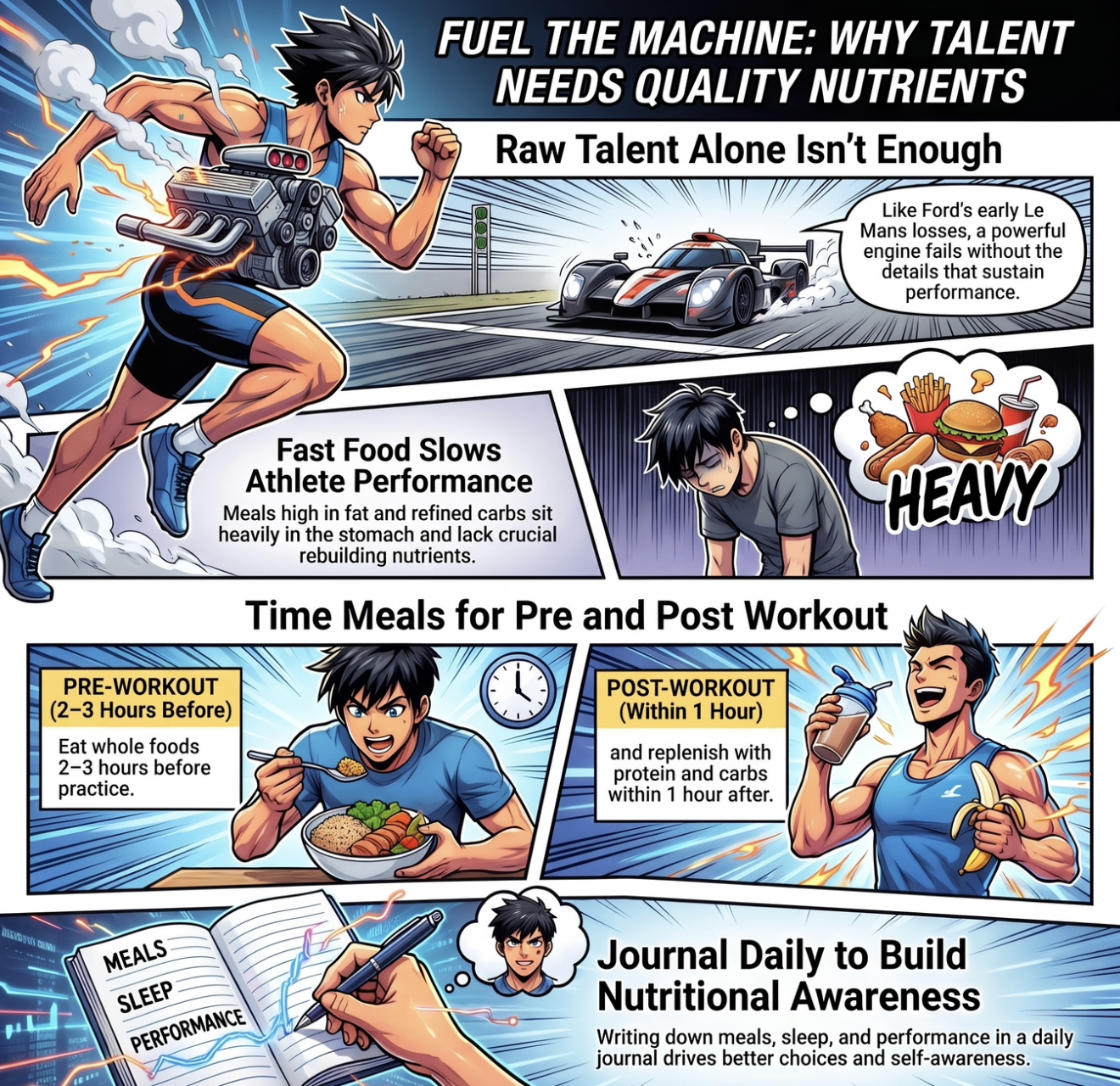
Your athlete may have the engine. Ford had the engine too — and lost Le Mans two years straight. A fit, high-metabolism kid can burn off a Big Mac, but fast food before practice is heavy fuel (sluggish on the ice) and empty fuel (no real protein, fiber, vitamins or minerals to rebuild with). Winning long seasons is about the details, not the horsepower: a real meal 2–3 hours before practice, protein and carbs within an hour after, water instead of neon, and a daily written food journal. Every MOA member gets the printed MOA Nutrition journal free, reviewed weekly with Coach Mike at the gym.
Last week one of my hockey players finished an off-ice strength session with me and walked straight back into the rink carrying a bag of McDonald's. He had maybe forty minutes before he hit the ice. I stopped him and said, what are you doing, man? You've got to fuel the machine. He grinned and said, it's okay, Coach, look at me. I'm built like a superhero. And here's the thing. He wasn't wrong about the body. He's lean, he's strong, and he burns calories like a hummingbird because he practices and plays more hours a week than most adults work out in a month. The fries were going to disappear. That was never the problem.
The problem is the one Ford ran into at Le Mans. If you've seen Ford v Ferrari, you know the setup. Ford had the money, the factory, and eventually the biggest engine on the grid, a seven-liter monster stuffed into the GT40. On paper it should have crushed Ferrari. In 1964 and 1965 it got crushed instead. Ferrari's cars were lighter, better balanced, and tuned by people who understood that Le Mans isn't a drag race. It's twenty-four hours. Horsepower gets you off the line. Everything else decides whether you're still running at dawn.
Ford didn't win in 1966 because it found more muscle. It won because Carroll Shelby and Ken Miles obsessed over everything that wasn't muscle: brakes that lasted, weight that came off, a setup that held together lap after lap. The engine was the superhero body. The details were what kept it on the track.
That's my hockey player. His engine is excellent. His fuel is garbage, and a Big Mac before practice is the wrong fuel twice over. First, it's heavy. A meal that's mostly fat and refined bread sits in the stomach, slows everything down, and makes a kid feel flat on the ice forty minutes later. Second, it's empty. It has calories, but almost none of what a growing athlete actually repairs and rebuilds with: real protein for muscle, carbs that release steadily, healthy fats, fiber, and the vitamins and minerals that keep him healthy through a long season. He's not short on gas. He's short on quality, and quality is what separates a kid who's good at fifteen from a kid who's still getting better at twenty.
In Death Resistant I wrote about health as three circles: recovery, movement, and nutrition. Most young athletes live entirely in the movement circle. They practice, they play, they lift. Then they try to recover on six hours of sleep and fuel on whatever is in the drive-thru window between school and the rink. The movement circle can't carry the other two. Eventually the car comes apart, and it usually comes apart at the worst time, in the third period of a game that matters, or in a tired knee that gives out in a season that should have been a breakout.
So here's what I told him, and what I'll tell your athlete. Eat a real meal two to three hours before practice: a lean protein, a slow carb like rice, potatoes, or oats, some fruit or vegetables, and a little fat. Keep it light on grease and heavy on food that came from a farm instead of a factory. Within an hour after practice, eat again, because that's when the body is begging for protein and carbs to rebuild. Drink water, not neon. And write it down.
That last part is why every Mighty Oak Athletic member gets our printed MOA Nutrition journal for free. It's a hundred-page book your athlete writes in every day, what they ate, how they slept, how they performed. No app, no notifications, just their own handwriting. I review it with them at the gym each week, and the conversation changes fast, because kids who can see the fast food on the page start making better choices on their own. Awareness comes before change.
Your son or daughter may already have the engine. Good. Ford had the engine too, and it lost two years in a row. Be strong to be useful. Then fuel the machine like you mean it.
FAQ
What should a young athlete eat before hockey practice? A real meal two to three hours before practice: lean protein (chicken, eggs, Greek yogurt), a slow carbohydrate (rice, potatoes, oats, whole-grain bread), fruit or vegetables, and a small amount of fat. Keep it light on grease and fried food so it digests before the athlete is on the ice.
Is fast food before practice bad if my kid is fit and burns it off? Burning the calories isn't the problem. A typical fast-food meal is heavy in fat and refined bread, which sits in the stomach and makes an athlete feel sluggish, and it's low in the protein quality, fiber, vitamins and minerals a growing athlete uses to recover and get stronger across a long season.
What should a student athlete eat after practice? Protein and carbohydrates within about an hour after practice or a game — a sandwich with real meat, chocolate milk and fruit, or a dinner of protein, rice or potatoes and vegetables. Water for hydration; sports drinks are rarely needed for a one-hour youth practice.
Do young athletes need protein powder or supplements? No. Mighty Oak Athletic's position, detailed in MOA Nutrition, is that student athletes ages 6 to 18 get everything they need from whole foods. The program teaches what to eat and when, not what to buy.
What is the MOA Nutrition journal? A printed 100-page nutrition book with daily journal pages where the athlete writes down what they ate, how they slept and how they performed. It's free for every current Mighty Oak Athletic member and reviewed with Coach Mike at the gym each week. Non-members can buy the Sports Nutrition Coaching program ($199: printed journal, ebook and four weekly coaching calls) at mightyoakathletic.com/programs.
What does Ford v Ferrari have to do with sports nutrition? Ford brought the most powerful car to Le Mans and lost in 1964 and 1965 before winning in 1966 — not with more horsepower, but by fixing the details that keep a car running for 24 hours. A strong young athlete is the engine; nutrition, sleep and recovery are the details that decide the end of a long season.
What to say when your kid wants to quit mid-season
Mighty Oak Athletic Podcast S3:E104 - What to say when your kid wants to quit mid-season
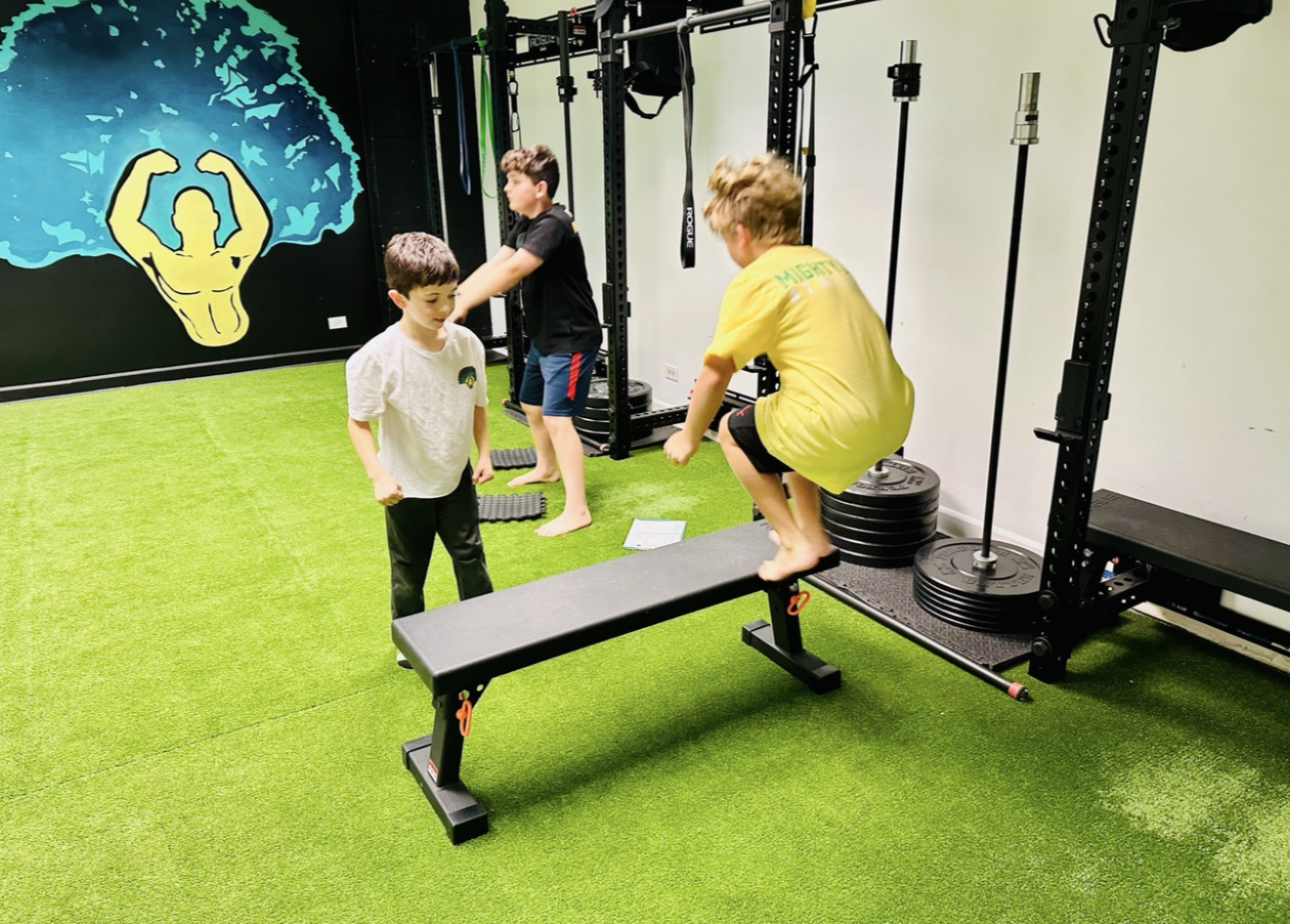
The short version: Kids rarely want to quit at the end of something. The urge shows up in the middle, right when the new wears off and the work starts, and it usually arrives dressed as a better idea: a different sport, a different instrument, the other gym. The rule for your house is simple. Every commitment comes with a finish line, the last game, the recital, closing night, the end of a six-week program. You finish to the finish line. Then you decide. Quitting stays on the table; it just moves to the one spot where it means something.
Kids rarely ask to quit at the end of something. The night after the recital, the ride home from the last game, the day the program sheet is full, those are not when the conversation happens. It happens in week four of a twelve-week season, in the practice room three weeks before the show, halfway through a six-week program, which is exactly when the new has worn off and what's left is the work.
That's when you get the speech from the back seat. I don't want to do this anymore. And it rarely comes alone. It comes with a plan. Lacrosse instead of soccer. Guitar instead of piano. The other gym, the one a friend goes to. The new thing sounds better, and it tends to sound best at the precise moment the current thing got hard. That is not a coincidence. Your kid hasn't discovered a passion. They're trying to buy back the feeling of week one.
What makes this hard is that the kid is half right. Maybe lacrosse is the better fit. Maybe piano really isn't their instrument. The problem is that you can't tell from the middle, because the middle of everything feels the same. Every sport, every instrument, every program has a stretch where the easy wins dry up and improvement goes quiet. If your kid learns that the urge to leave is the same as permission to leave, they'll feel that urge in every hard thing they ever start, and they'll always have a good-sounding reason to act on it.
So here's the rule. Every commitment comes with a finish line. The season ends at the last game. The instrument ends at the recital. Drama club ends on closing night. At MOA, a program is six weeks, and it ends when the sheet is full and the lift gets retested. You finish to the finish line. Then you decide. Nobody is telling your kid they can never quit. The quit just moves to the one spot where it's a real decision instead of an escape.
This is not tiger parenting. You didn't pick the sport. You didn't pick the instrument. You let them choose, and you'll let them choose again. The only thing you're holding is the distance between the start and the end of what they already chose. It's the speech most of us heard at some point and some of us have already given: I'm not going to tell you what to do, but once you commit to something, you see it through. The lesson was never soccer. The lesson is that the hard middle is not a signal to leave.
And here's what the kid gets at the finish line that they can't get anywhere else. They get the data. Some kids play out the season and never want to touch a soccer ball again, and that's a clean decision made with full information. Most of them hit a point somewhere in the back half where it turns. The recital goes fine. The play gets a laugh in the right spot. The deadlift that was 30 pounds in week one comes off the floor at 45 in week six and the shirt changes color. That feeling is the whole point, and it is only available on the far side of the middle. You cannot buy it in week one of something new.
Practically, it looks like this. When the back-seat speech comes, don't argue the merits of lacrosse. Ask one question: when's the finish line? Name the date. The last game, the recital, closing night, the end of the program. Write it on the fridge. Then give them the deal. We finish. After that, if you still want lacrosse, we'll talk about lacrosse. A lot of the time the conversation never comes up again, because what they wanted to escape was the middle, not the sport.
This is why we run MOA in six-week programs instead of open-ended memberships that drift. A kid who has finished one program, start to retest, knows something about themselves they didn't know before. They know the middle passes. That is a transferable skill. It shows up in the next season, the next recital, the next hard class, and eventually in the first job that gets uncomfortable in month three. The barbell was just where they practiced it first.
Be strong to be useful. The kid who finishes one hard thing learns he can finish the next one, and that's a lesson no amount of switching can teach.
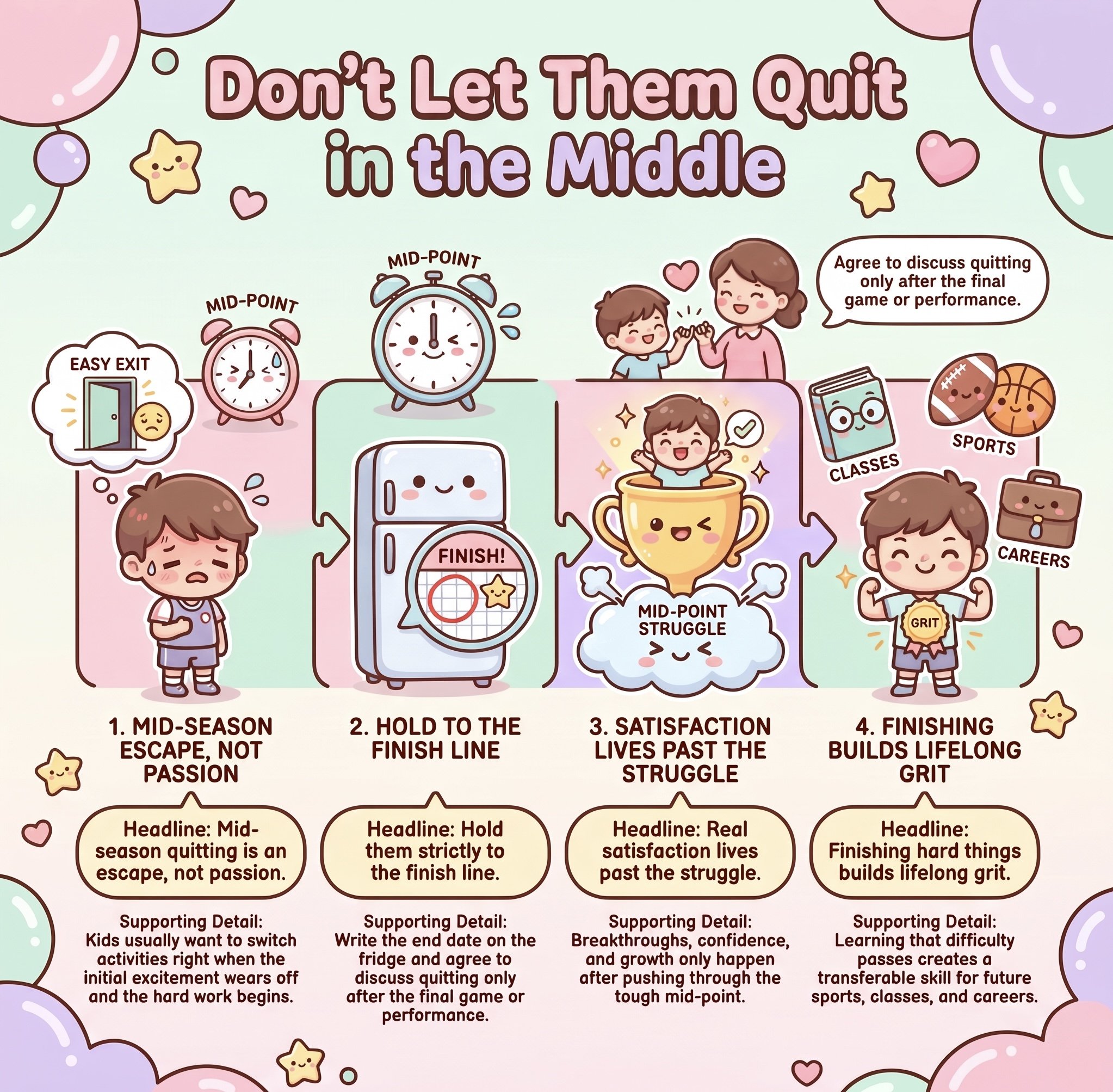
Off-Ice Training for Hockey Players: What Coach Mike Has Learned Training the DuPage Stars
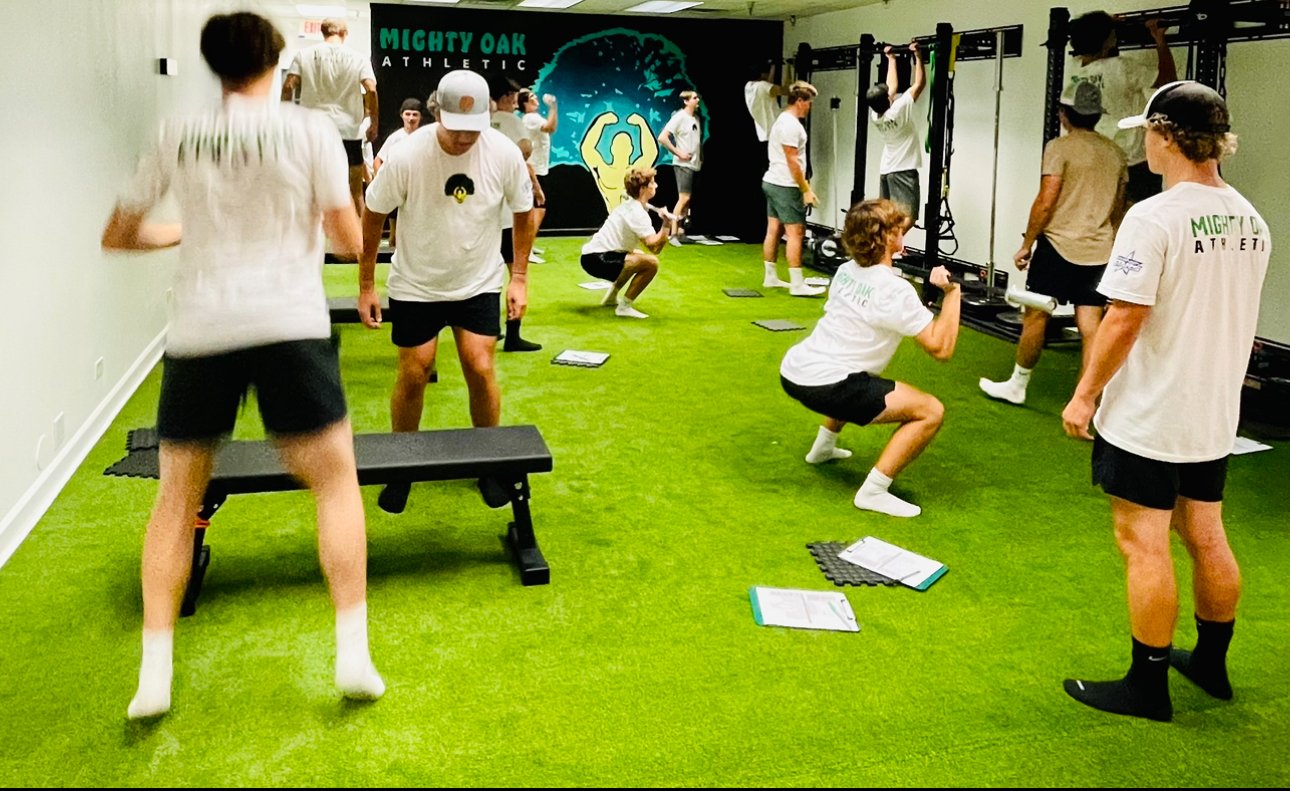
TL;DR: Coach Mike Ockrim, CSCS, founder of Mighty Oak Athletic in Westmont, IL, is the official strength and conditioning coach for DuPage Stars Hockey. Off-ice training builds the leg strength, hip power, and core control that skating alone does not. Stronger players skate faster, win more puck battles, and lower their risk of the hip and groin problems common in hockey.
On Tuesday and Thursday evenings during hockey season, Coach Mike Ockrim is not at Mighty Oak Athletic. He is at Seven Bridges Ice Arena in Woodridge, a few steps from the rink, coaching DuPage Stars players through squats, hinges, and carries in gym shoes instead of skates. Coach Mike is the official strength and conditioning coach for DuPage Stars Hockey, and after years in that role he explains the job to hockey parents in one sentence: the ice builds the hockey player, and off-ice training builds the athlete inside the gear.
That difference matters more than most families realize. Ice time is expensive and limited, so practice goes to skating, puck skills, and systems, which is exactly where it should go. But none of that work makes a kid much stronger. A skating stride is a one-leg push, driven by the hips and thighs, out to the side and back. The more force a player can put into the ice with that push, the longer the stride and the quicker the first three steps. Speed in hockey is strength used fast, and strength is built off the ice, where a player can load a squat or a clean in a way a pair of skates never will.
Then there is the posture. Hockey players spend hours bent at the hips with their knees flexed and their chest forward. It is a great position for skating and a hard one on a growing body. Hips get tight, and the groin muscles take a beating from thousands of side-to-side pushes, which is why hip and groin strains are among the most common complaints in the sport. Off-ice training is where players balance that out, with full-range squats, hinges, single-leg work, and loaded carries that strengthen the muscles around the hips and trunk. No program can promise a kid will never get hurt. A stronger player is a more durable one, though, and durable players stay in the lineup.
What does off-ice training for hockey players look like with Coach Mike? It looks a lot like every session at Mighty Oak Athletic. Players train the same five movement patterns our athletes train at every level: squat, hinge, push, pull, and carry. They use a barbell, a kettlebell, and their own bodyweight, with jumps and short sprints for power. There is no stickhandling on a wobble board and no workout built to look like hockey. Technique comes first, and the weight goes up only when every rep looks right. A hockey player does not need a hockey-shaped workout. A hockey player needs to be a strong, fast, well-coordinated athlete who happens to play hockey.
The timing matters too. Many families treat strength work as a summer project and drop it when the season starts. The Stars train off the ice during the season, because strength fades when it is not used, and the games that matter most come at the end of a long winter. One or two short sessions a week is enough to hold on to what a player built in the offseason, and often to keep building. We wrote more about that in our guide to in-season strength training for youth athletes. USA Hockey's American Development Model points the same direction, encouraging off-ice athletic development and playing more than one sport.
The lesson that repeats every season is consistency. The players who show up twice a week, with no game on the line, are the ones who feel the difference when the puck drops. That is true for a Stars player in Woodridge, and it is true for the hockey players from Downers Grove, Darien, Hinsdale, Willowbrook, and across DuPage County who train with us in Westmont.
If your son or daughter plays hockey, the first session at Mighty Oak Athletic is free. We train athletes ages 6 to 18 at 6424 S. Cass Ave. in Westmont, with a maximum of 12 athletes per session. Book a free training session here. Coaching a hockey team? Team strength and agility training is $10 per athlete per session with a 10-athlete minimum, at our facility or yours.
Be strong to be useful.
Coach Mike
FAQ
What is off-ice training for hockey players?
Off-ice training, also called dryland training, is the strength, power, and movement work hockey players do away from the rink. At Mighty Oak Athletic it means squats, hinges, pushes, pulls, carries, jumps, and short sprints, using a barbell, a kettlebell, and bodyweight.
Why is off-ice training important for youth hockey players?
Skating builds skill but does not build much strength. Off-ice training builds the leg and hip strength behind a powerful stride, the core control that helps in puck battles, and stronger muscles around the hips and groin, where hockey players are most often hurt.
At what age should hockey players start off-ice strength training?
Kids can start supervised strength training at age 6. Mighty Oak Athletic trains athletes ages 6 to 18. The National Strength and Conditioning Association and the American Academy of Pediatrics both support supervised strength training for children.
Should hockey players lift weights during the season?
Yes. Strength fades when it is not trained, and the biggest games come at the end of the season. One or two short strength sessions a week during the season helps players keep the strength and speed they built in the offseason.
How often should a youth hockey player do off-ice training?
Two sessions a week is a good target for most youth hockey players. During a heavy stretch of games, one session a week is enough to maintain strength.
Who is the strength coach for DuPage Stars Hockey?
Michael Ockrim, known as Coach Mike, is the official strength and conditioning coach for DuPage Stars Hockey. He is a Certified Strength and Conditioning Specialist (CSCS) and the founder of Mighty Oak Athletic in Westmont, IL.
Where can hockey players train near Westmont, Woodridge, and Downers Grove?
Mighty Oak Athletic is at 6424 S. Cass Ave. in Westmont, IL, a short drive from Woodridge, Downers Grove, Darien, Hinsdale, and Willowbrook. The first training session is free, and team training is $10 per athlete per session with a 10-athlete minimum.
In-Season Strength Training for Youth Athletes
Every August I get the same text from a dozen parents. Hockey's starting, or football, or club volleyball, and the kid has practice four nights a week now, so they're going to pause training until the season's over. I understand it. I also know what happens next, because I've watched it for thirteen years. The kid shows up in November weaker than he was in August, and the thing he spent all summer building is gone.
Here's what nobody tells parents about the sports season: it doesn't make kids stronger. It makes them tired. Practice is skill work and conditioning. Games are chaos. Neither one loads a kid's body the way a barbell does, and strength that isn't maintained fades in about three weeks. By mid-season the strongest kid on the team in August is just another kid, and the one who got hurt in week six is usually the one who stopped lifting.
The fix isn't training more. It's training less, on purpose. In-season strength work at Mighty Oak looks different from off-season work. Off-season, a kid comes three or four days a week and we build. In-season, a kid comes once or twice a week and we hold. The sessions are the same length and use the same tools, barbell, kettlebell, bodyweight, but the volume drops and the intensity stays. A handful of heavy, clean sets of the big lifts, some kettlebell work for the hips and shoulders, a bodyweight block, done. The goal is to leave the gym feeling better than when they walked in, not wrecked for Thursday's game.
That's the part parents are actually worried about, so let me say it plainly. We will not make your kid sore before a game. In-season training is scheduled around the sport, not on top of it. A kid who plays Saturday trains Tuesday, maybe Thursday if it's light. A kid with weeknight practices comes Saturday morning. We coach every one of these kids individually, so if a kid walks in Tuesday and says he's got a tournament Friday, the session changes. The sport comes first. The gym keeps the sport possible.
What you get for one or two hours a week is more than maintained strength. It's injury insurance. The research on youth athletes is consistent: strength training during the season reduces injury rates, and the biggest reductions show up in exactly the injuries parents fear most, the knees, the ankles, the shoulders. A kid who keeps deadlifting through hockey season has hamstrings that hold up in March. A pitcher who keeps rowing has a shoulder that lasts through the summer. The strength doesn't win the game. It keeps the kid on the field long enough to play in it.
The other thing it does is give a kid one place during the season that isn't about winning. Practice has a coach evaluating. Games have a scoreboard and a crowd. The gym has a journal, a bar, and a number that was theirs last week and is theirs to beat this week. Kids who are stressed about playing time or a bad game tend to get a lot out of an hour where the only opponent is themselves. We see it every season.
If your kid is a member, nothing changes except the schedule. Come once or twice a week instead of three or four, and tell us what the season looks like so we can plan around it. If your kid trains with one of our partner programs, like DuPage Stars Hockey or the Hinsdale South teams we coach, the in-season sessions are already built into that work.
And if your kid is new, the season is a fine time to start. The free first session is the same sixty minutes it always is, coached, with a training shirt to keep. We'll ask about the practice schedule before we ask about anything else.
Be strong to be useful.
— Coach Mike
Book a free first session: https://calendly.com/mightyoakathletic/youth-strength
A Parent's Guide to Youth Strength Training
Most parents who walk into Mighty Oak for the first time have the same picture in their head, and it's wrong. They picture a teenager grunting under a loaded bar, or a muscle-bound trainer barking at a nine-year-old. What they find is a room full of kids learning to squat with a kettlebell, a coach fixing one kid's grip while another one chalks up, and a seven-year-old in a white shirt grinning because she just did her first unassisted chin-up. This guide is the conversation I'd have with you at the front door if we had an hour.
Start with what youth strength training actually is. It's teaching a kid to move their own body and then external load through five patterns: squat, hinge, push, pull, and carry. That's it. Every sport, every playground, every box lifted into a dorm room at eighteen is some combination of those five. The tools are a barbell, a kettlebell, and bodyweight, and at the beginning the barbell is empty and the kettlebell is light. The weight is whatever lets a kid finish every rep with perfect technique. It is not bodybuilding, it is not CrossFit, and it is not an app with a workout of the day.
Now the question every parent actually wants answered: is it safe? Yes, when it's coached. The National Strength and Conditioning Association and the American Academy of Pediatrics both endorse supervised strength training for children. The injuries in the research came from kids lifting alone, maxing out, with nobody watching their form. The growth plate scare is a myth. The forces a child absorbs landing from a jump or getting tackled are higher than anything they'll see in a coached gym. Done right, strength training is the thing that makes those forces survivable.
Here's how to tell a good program from a bad one. First, who's coaching, and what's the credential? The standard is the CSCS from the NSCA. A weekend certificate is not the same thing. Second, how many kids per coach? A kid learning to deadlift needs eyes on every rep, and that doesn't happen with twenty on a turf. We cap sessions at twelve. Third, what's the equipment? Free weights and bodyweight teach a body how to move. Machines don't. Fourth, is there a progression? Your kid should know what they're working toward, and you should be able to see them get there. We use nine shirt levels, white through black, earned by completed sessions and demonstrated technique. And fifth, what's the phone policy? If kids are training while scrolling, nobody's coaching.
What does the first month look like? Your kid comes two or three times a week for an hour. They warm up, hit a barbell block, a kettlebell block, and a bodyweight block, and write it all down in a paper training journal. The first week they're sore and a little lost. The second week they know where things are. By the end of the first six-week program they've got a lift they're proud of and a shirt they earned, and you'll notice it before they say anything, because they'll start carrying the groceries without being asked.
What's your job in all this? Get them there and let the coaches coach. You're welcome to watch, and you're welcome to train alongside them if you want. The one thing I'd ask is that you not turn the lifts into homework at the dinner table. Let the gym be theirs.
How do you know it's working? Not by the number on the bar, at least not at first. You'll know by posture, by confidence, by a kid who stops avoiding the hard thing and starts asking for it. The strength shows up in how they carry themselves long before it shows up in their arms.
One last thing, because it's the question under all the other questions. Your kid doesn't have to be an athlete to belong here. About half the kids at Mighty Oak don't play on a team. They come to get strong, to put the phone down, and to be around other kids doing something hard. That's reason enough.
Every kid starts with a free first session. Sixty minutes, coached, with a training shirt to keep and a conversation with me at the end.
Be strong to be useful.
— Coach Mike
Book a free first session: https://calendly.com/mightyoakathletic/youth-strength
Your Kid Doesn't Need You at Every Game - They Need to Watch You Try Something Hard
Mighty Oak Athletic Podcast S3:E103 - It’s okay to miss the game - What your kid actually learns from watching you
TL;DR
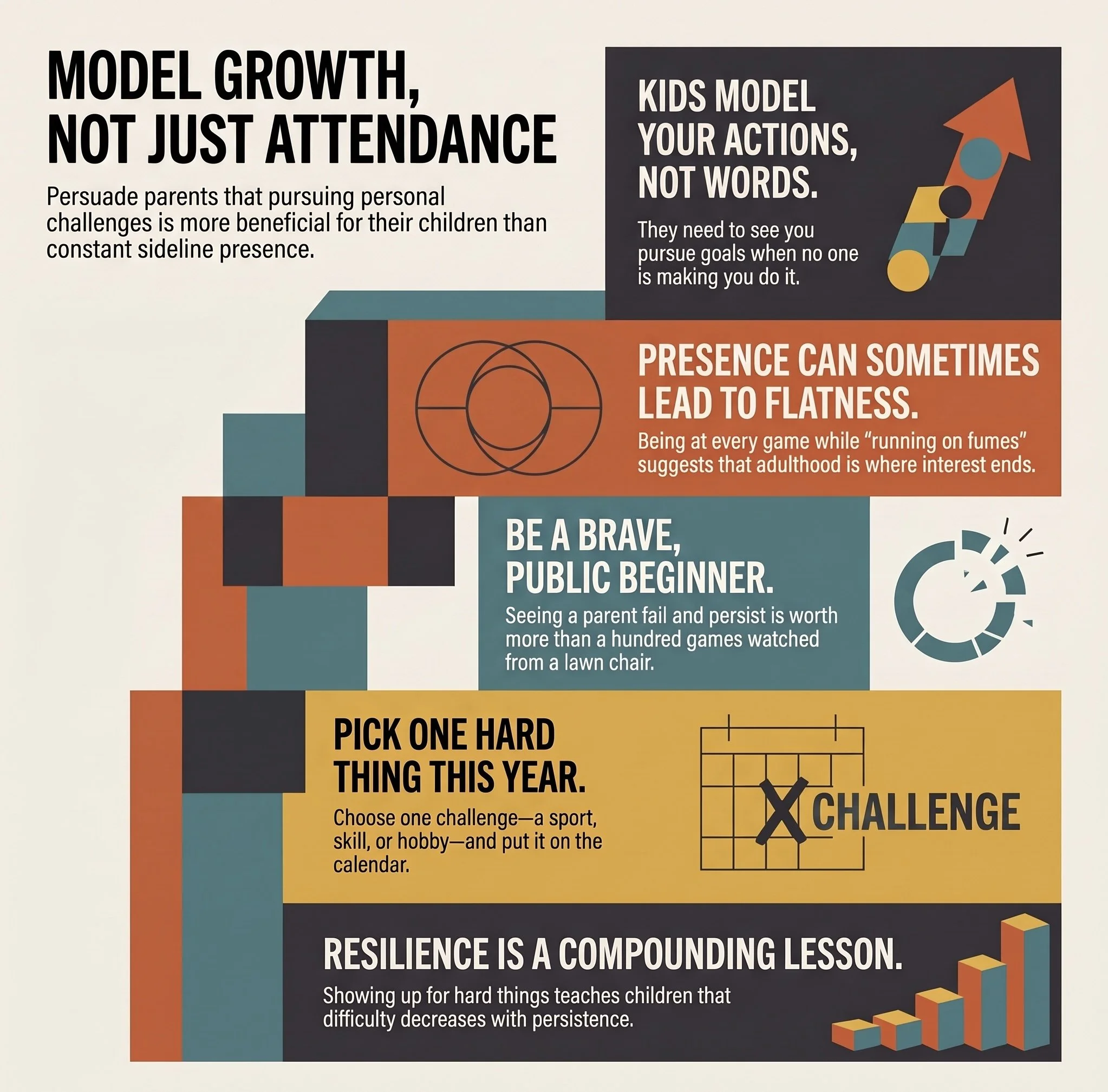
Your kids don't need you at every game. They need to watch you try something hard. A parent who is still learning, still a beginner at something, still a little bit ambitious, teaches a kid more about hard things than a parent who attends everything on fumes. Pick one hard thing for the next year, put it on the calendar next to their practices, and let them see you go.
Your Kid Doesn't Need You at Every Game - They Need to Watch You Try Something Hard
Every fall I hear a version of the same sentence from a parent in the MOA lobby. It goes something like this: I'd love to get back in shape, or take that class, or finally learn the thing I've been talking about for ten years, but right now I have to be about the kids. It always sounds responsible. It usually gets nods from the other parents. And I think it's one of the most quietly damaging ideas in modern parenting.
Here's the problem. Kids don't learn who to become from what you tell them. They learn from watching what you do with your own life when nobody is making you do anything. If what they see is a parent who set down every ambition the day they were born, the lesson isn't "my parents love me." The lesson is "adulthood is where interesting stops." And then we act surprised when a fourteen-year-old boy doesn't want to try anything he isn't already good at.
I've watched this from the other side too. Some of the most present parents I know, the ones who never miss a practice, are running on fumes. They show up, they sit in the car or in the folding chair, they scroll, they drive home. Their kid feels the presence, but they also feel the flatness. A kid can absolutely tell the difference between a parent who is there because they want to be and a parent who is there because there's nowhere else they're allowed to be.
Now flip it. Picture a kid who knows Dad missed the second half of the game because he was at a class he'd been nervous about for months. Or Mom skipped the tournament because she had her first race. That kid doesn't feel abandoned. That kid gets a story. They get proof that a grown adult can still be a beginner, can still fail at something in public, can still care about getting better. That is worth more than a hundred games watched from a lawn chair.
This is the same argument I make for putting a six-year-old under a barbell. Not because the weight matters at six. Because the reps teach a kid that hard things get easier when you keep showing up, and that lesson compounds for the rest of their life. The catch is that it doesn't land if the person driving them to the gym has quietly stopped believing it. Kids have very good radar for hypocrisy. You cannot ask them to be brave about hard things while you've retired from all of them.
There's a marriage piece too, and nobody talks about it. Your spouse didn't marry a settled person. They married somebody who was going somewhere, who had plans, who was a little bit dangerous in the good way. Routine is fine. Routine is how strong households run. But a routine with nothing new inside it is just a rut with better scheduling. The partner who comes home from a hard workout, or a language lesson, or a kitchen disaster they're determined to fix next week, has a certain glow to them. Ask any long-married couple. That glow is a big part of what keeps things alive at 45 and 55.
So the question isn't whether you have time. Almost nobody has time. The question is what you pick and how you fit it inside the life you already run. Pick one hard thing for the next twelve months. One. Make it something that spills over onto the family: learning to cook real food for them, getting strong enough to hike with them, picking up the instrument that's been in the basement since college. Put it on the calendar the same way you put in their practices. Tell your kids what it is and why it scares you. Then let them see you go.
You will miss some things. That's the cost. But the parent your kids need isn't the one at every single game. It's the one who is still becoming somebody. Be strong to be useful, and remember that useful includes being someone worth watching.
Why I'd Rather Sponsor a Sixth-Grader Than Buy an Ad

Mighty Oak Athletic gives free gear to student-athletes ages 6–18 in the western suburbs who post one short video moving in it. No membership, no cost. It's a scholarship for effort, and it puts the kids who show up out front where other kids can see them.
We're Putting Our Name on the Kids Who Earn It
Every gym has a shirt. Most of them end up at the bottom of a drawer, or on somebody's dad while he mows the lawn. I decided a long time ago that the Mighty Oak Athletic shirt would mean something different. At our gym in Westmont, a kid doesn't buy the shirt. He earns it. Nine levels, white through black, and every one of them is a promotion you can see from across the room. The shirt is the whole scoreboard.
So when I tell you we're giving gear away for free, understand that I didn't arrive at that decision lightly. The Mighty Oak Athletic Ambassador Program is not a merch drop. It's the same idea as the level-up shirt, pointed outward at the kids we haven't met yet.
Here's how it works
Any student-athlete between 6 and 18 in the western suburbs applies with a short form. Parents fill it out with their kiddo. If we pick you, we mail free Mighty Oak Athletic gear to your house. You post one short video wearing it while you do your thing, whether that's a hockey practice in Darien, a volleyball tournament in Naperville, a dance recital, or a bike ride down the Prairie Path. Tag us, use the hashtag, and you're an ambassador. No membership required. No purchase. That's the entire deal.
The obvious question is why a local gym would hand out free clothes to kids who may never walk through the door. The honest answer is that I don't think of it as marketing. I think of it as a scholarship for effort.
I've spent thirteen years coaching kids and families, and the pattern I see over and over is that the kids who are doing well are hiding in plain sight. They're the ones who get to practice early and stay late. They do the extra reps nobody asked for. They don't have a highlight reel because they're not the star, and they don't post much because nobody told them their work was worth posting. Those are exactly the kids I want wearing our name. Not because they'll sell memberships, but because a twelve-year-old scrolling through her phone needs to see a kid who looks like her, from a town near hers, sweating through a training session and not apologizing for it.
That's the ambassador job. Be visible doing the work. That's it.
I've written about this in Death Resistant, and I say it at the gym every day: be strong to be useful. Strength isn't a number on a bar. It's the capacity to show up for the people who need you, at fifteen and at fifty. An ambassador in a Mighty Oak shirt is a kiddo announcing, in public, that showing up is what he does. When his teammates see it, some of them will decide that's who they want to be too. Culture spreads through kids far faster than it spreads through any ad I could buy.
There's a selfish reason too, and I'll own it. The best coaching I've ever gotten was watching my athletes. Every video that comes in with our hashtag on it teaches me something about what kids in this area are actually doing on a Tuesday afternoon, what sports are growing, what they're excited about. That's worth more to me than the cost of a shirt.
If you're a parent reading this, here's my ask. Don't apply for the kid who already has a sponsorship pitch. Apply for the one who does the boring, unglamorous, get-up-and-go-again stuff without being told. Apply for the one who's a little quiet about it. That's the kid I want to put a Mighty Oak shirt on, and that's the kid I want to introduce to the rest of the western suburbs.
And if the shirt shows up and your kid decides to come see where it came from, the first session at our Westmont gym is free. That part's always been true.
Be strong to be useful.
Coach Mike
2026 Thanksgiving Strength Camp is Open
TL;DR
Thanksgiving break is five days most kids spend on a couch. Mighty Oak Athletic's Thanksgiving Week Camp turns one hour of each of those days into a real training block: five CSCS-coached sessions, ages 6–18, $50, shirt included, Nov 23–28 in Westmont. It's the lowest-friction way a new family will ever try strength training.
The Five Days Nobody Trains
Thanksgiving break is the easiest week of the year to get stronger — because nothing else is competing for it
Every November I watch the same thing happen. School lets out Tuesday or Wednesday. Practices stop. The travel team takes the week off. And for five straight days, a kid who normally moves for two hours a day moves for none.
Nobody plans it. It's just what a week with no schedule looks like.
Then the following Monday, that same kid shows up to practice and everything feels heavy. Coaches call it "coming back slow." Parents call it "he needs to get back in the groove." What actually happened is simpler: a growing body went five days without a reason to be strong, and it responded exactly the way bodies do.
Here's the thing most parents don't realize. Five consecutive days is also a real training block. It's the same number of sessions a serious athlete gets in a full month of once-a-week training, compressed into one week when there's nothing in the way. No homework at 8 p.m. No game on Saturday. No coach asking for rest days. For a kid who's never lifted, five days in a row is enough to learn the squat, hinge, press, and pull well enough that they never forget them. For a kid who already trains, it's a week of progress instead of a week of decline.
That's the whole reason Thanksgiving Week Camp exists.
What one hour a day looks like
A twelve-year-old I'll call Owen came to camp two Novembers ago because his mom wanted him off the Xbox. He'd never touched a barbell. Monday he learned to squat with a kettlebell held at his chest. Tuesday he hinged with the same bell. Wednesday he pressed a light bar overhead and rowed it from the floor. Friday he put all four together. Saturday morning he did the full session without being told what came next.
Five hours. That's the entire investment. He left with a shirt, a squat, and a picture of himself doing something he didn't know he could do. He's a green shirt now — level four of nine — and he still comes on Saturdays.
Owen is a composite of a lot of kids, but the arc is the one I see every year. The first day is awkward. The third day something clicks. By the fifth, the kid is pushing himself.
Why this is the right week to start
If you've been thinking about strength training for your athlete and haven't pulled the trigger, the honest reasons are usually cost, commitment, and not knowing whether they'll like it. Camp answers all three.
It's $50. A month of membership is $199, so the week is a quarter of the price with nothing recurring.
It's five days. Not a season, not a contract. If it isn't the right fit, you've lost nothing but a few afternoons that would have been screen time anyway.
And it's the same coaching members get. Same coach, same four movement patterns, same twelve-athlete cap. You're not buying a watered-down preview; you're buying the real thing for a week.
The details
Camp runs Monday, November 23 through Saturday, November 28. We're closed Thursday. Sessions are one hour; book any open slot Monday through Wednesday and Friday from 3:30 to 7:30 pm, and Saturday from 9:30 am to 12:30 pm. Ages 6 through 18. Every athlete gets a training shirt.
Buy the week on the camp page, then book your five sessions on the training calendar. Bring athletic clothes and water. We'll take care of everything else.
Five days. Five hours. The strongest kid at practice the following Monday is the one who used them.
Book the Thanksgiving Week Camp
Coach Mike Ockrim, CSCS, is the founder and head strength coach of Mighty Oak Athletic in Westmont, Illinois.
-
For a first-time lifter, yes. Five consecutive sessions is enough to learn the squat, hinge, press, and pull with correct positions, and those patterns stick. For an athlete who already trains, a week off during a growth spurt shows up as lost strength the following Monday; a week on shows up as progress.
-
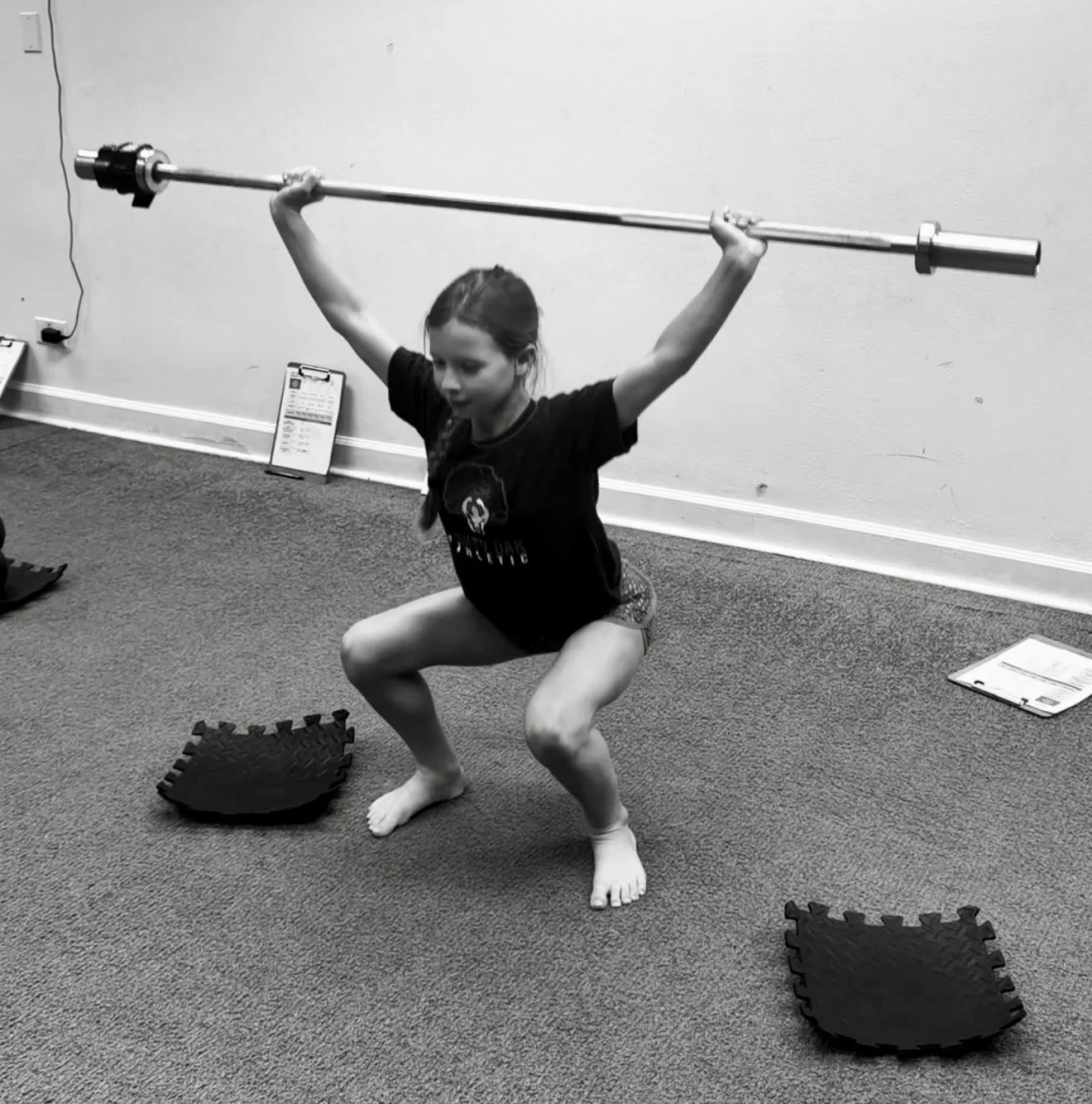
Athletes at Mighty Oak start with bodyweight and a kettlebell and earn the bar by technique, not age. The girl in the photo above is squatting an empty bar overhead because she demonstrated the position first. The NSCA and the American Academy of Pediatrics both endorse supervised resistance training for children.
-
Yes. Every session is capped at 12 athletes and coached by a CSCS, and every athlete works at their own level. Beginners learn the movements; returning athletes progress through the nine-level system. Nobody is asked to match anyone else's weight.
-
Athletic clothes, water, and shoes they can take off — much of the training is barefoot. The shirt is on us.
-
Buy the camp on the program page, then pick any open one-hour slot each day on the training calendar: Monday through Wednesday and Friday 3:30–7:30 pm, Saturday 9:30 am–12:30 pm. Closed Thanksgiving Day.
Your Kid Has Access to Good Food. So Why Isn't He Eating It?
Mighty Oak Athletic Podcast S3:E102 - Your Kid Has Access to Good Food - So Why Isn’t He Eating It?
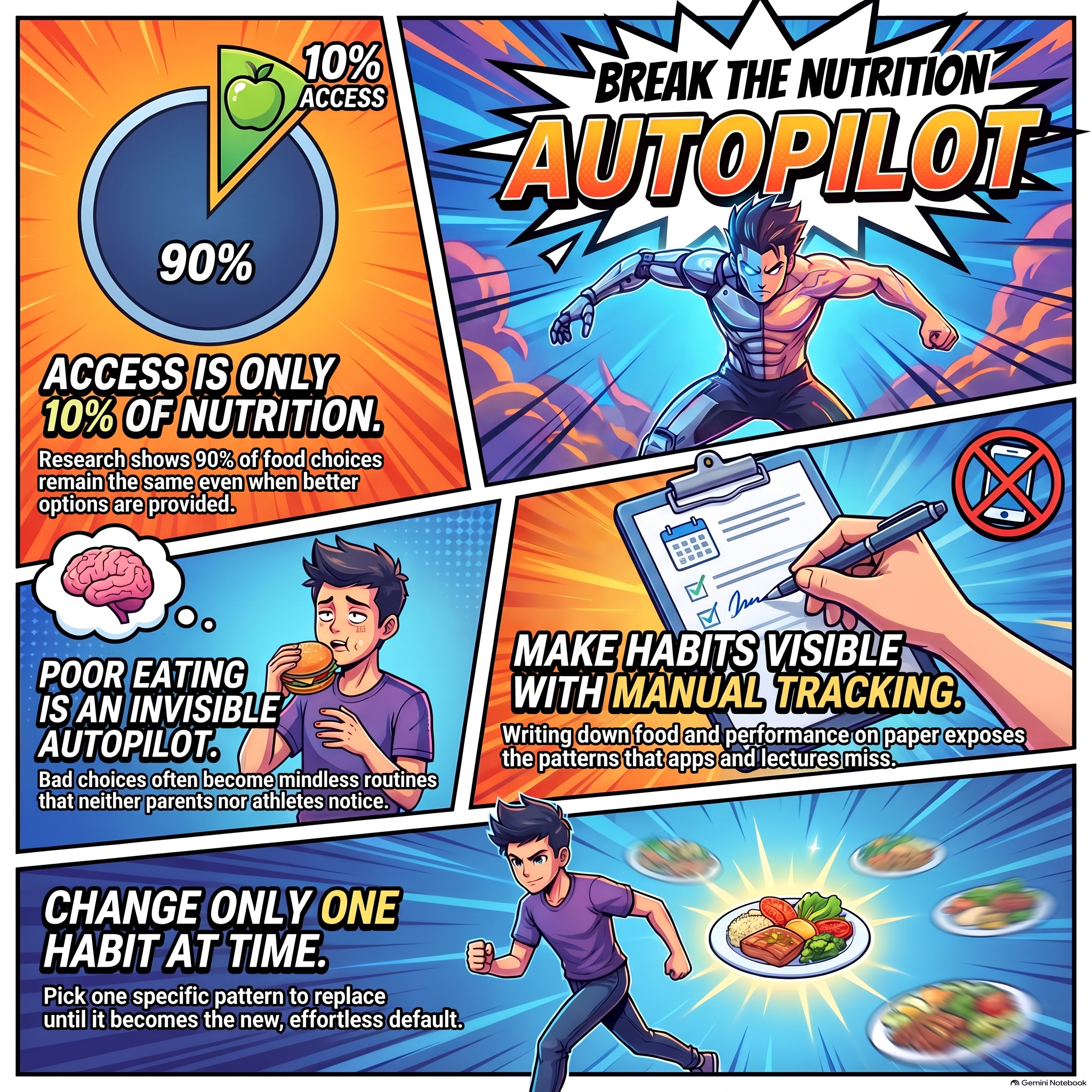
TL;DR: A landmark 2019 Quarterly Journal of Economics study found that giving families better access to healthy food closes only about 10% of the nutrition gap. The other 90% comes from what people choose to buy. Your kid's kitchen isn't the problem. The problem is the routine running on autopilot, and nobody can change a routine they can't see. That's the whole point of the MOA Nutrition book and journal: your athlete writes down what they ate, how they slept and how they performed every day, in their own handwriting. Within a week the pattern is on the page. Then Coach Mike reviews it with them in person and they pick one thing to change. Awareness first, then one better default at a time. Free for every MOA member.
The Fridge Isn't the Problem
Every parent I talk to at Mighty Oak Athletic wants their kid to eat better. And almost every one of them has a theory about why it isn't happening. The schedule. The drive-thru between practice and the game. The school lunch. The friend's house with the pantry full of junk. Notice what all of those theories have in common: they blame the environment. If the good food were just closer, easier, more available, the kid would eat it.
A group of economists put that theory to the test, and the answer should change how you think about your own kitchen. In 2019 the Quarterly Journal of Economics published a study by Hunt Allcott, Rebecca Diamond, Jean-Pierre Dubé and colleagues on food deserts. They tracked what tens of thousands of American households actually bought at the grocery store, then ran a simulation: what happens if you give lower-income families the exact same stores, products and prices that wealthy families enjoy?
Almost nothing. Closing the access gap shrank the nutrition gap by about ten percent. The other ninety percent came from what people chose to put in the cart. When new supermarkets opened in neighborhoods that had none, residents mostly changed where they shopped, not what they bought. The study is about adults, not kids and not athletes, and I don't want to stretch it further than it goes. But the principle underneath it is one I see in the gym every week. Not one athlete at MOA lives in a food desert. Every one of them has a kitchen with real food in it. And plenty of them are still running on chips, sports drinks and whatever's fastest after school.
Kids don't eat poorly because the better option doesn't exist. They eat poorly because the worse option is the one on repeat. The after-school snack that's been the same since second grade. The bottle of blue liquid at every game. The stop on the way home that started as a treat and became a routine. Nobody decided any of it. It just became the default, and here's the part that makes it hard to fix: nobody in the house can actually see it. Ask a twelve-year-old what he ate yesterday and you'll get a shrug. Ask his parents and you'll get a guess. A habit that runs on autopilot is invisible to the person running it.
That's why the MOA Nutrition program starts with a pen, not a meal plan. Every athlete gets the printed MOA Nutrition book, and the back half of it is a daily journal. Each day he writes down three things in his own handwriting: what he ate, how he slept and how he performed. No app to ignore, no notification to swipe away. It takes about two minutes. And within a week, something happens that no lecture from me could ever accomplish. The pattern shows up on the page. He sees the same snack five days in a row. He sees that the day he felt flat at practice was the day lunch was a bag of chips. He sees the sports drink he didn't think of as sugar. The autopilot becomes visible, and once a kid can see a habit, he owns it in a way he never did before.
The journal also becomes the agenda for our weekly review. Every member athlete sits down with me in person before a session and we go through the week together. I'm not grading it. I'm looking for the one pattern worth changing, and we pick one. Not five. Water instead of the blue stuff at games. A real breakfast on school days. Something in the bag for the drive home so the drive-thru never gets a vote. Then he writes that down too, and the next week we look at whether it held. That's how a new default gets built: one change, tracked on paper, repeated until it no longer requires a decision.
This works at a strength gym for a reason a health class can't replicate. A kid who has spent three months watching his squat go up already believes that small things done consistently add up. We just point that belief at the plate. And the parents are in on it, because the athlete doesn't buy the groceries. When the journal shows the pattern, the whole kitchen adjusts around it.
The study says ninety percent of how families eat comes down to choices. Choices you can't see are the hardest ones to change. So we make them visible, one page a day, and then we change them one at a time. The MOA Nutrition book and journal is free for every member, and I review it with your athlete every week. Bring him in for a free first session and let's put the first week on paper.
Be strong to be useful,
Coach Mike
Junk time vs. goal time
Mighty Oak Athletic Podcast S3:E101 - Junk time vs. goal time: What are you doing with the time you got back?
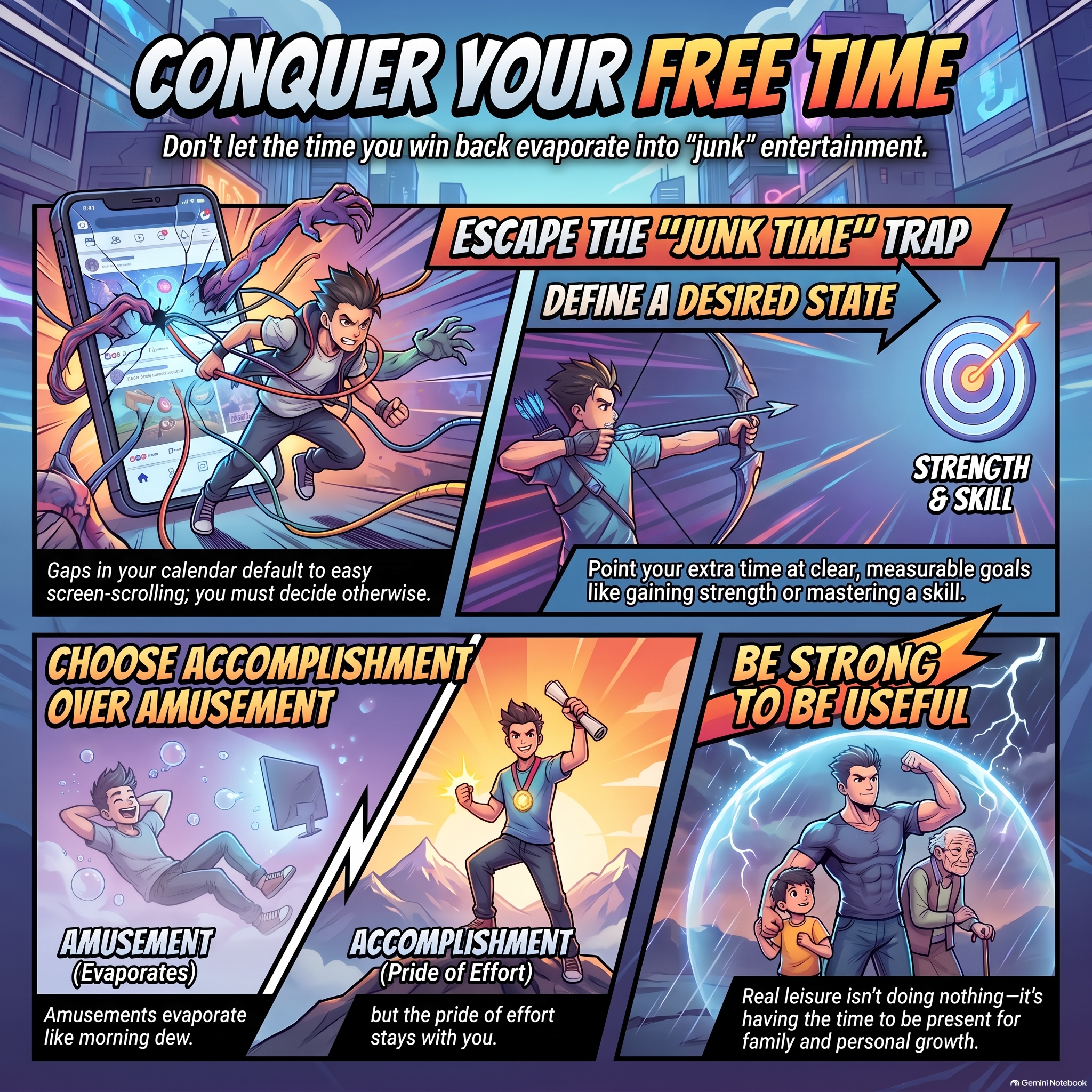
The point: It's in our nature to chase goals. People who finally get pure leisure (retirees, anyone with a free afternoon) tend to fill it with amusements that evaporate like morning dew — scrolling, watching, tapping. AI is handing Coach Mike hours back every week at Mighty Oak Athletic, and he's refusing to spend them on junk. Free time only counts if it's pointed at a goal. A screen is an amusement. A barbell is a goal.
Don't Fill the Time You Win Back With Junk
I was listening to a writer recently who said something that has stuck with me all week. He said it's in our DNA to work. Not to punch a clock, but to chase goals, to want to get from here to there. A goal, he said, is just a desired state of the world that you're trying to bring about. And then he pointed at the people we all know who retired, finally got everything they thought they wanted, no deadlines, no checklists, nothing but leisure, and became flat-out miserable.
The second half of his point hit harder. Most of us, when we get free time, don't use it for anything. We fill it with amusements. Something makes us smile or laugh for a few minutes, and then, like the morning dew, it evaporates. Scrolling, watching, tapping. Hours a day, maybe the majority of our waking hours, that don't add up to much of anything.
I'm thinking about this now because of what's happening at Mighty Oak Athletic behind the scenes. Over the last year I've built AI systems that handle a big chunk of the work that used to eat my evenings. The website, the emails, the scheduling, the parts of running a gym that nobody sees. It's working. It's giving me back hours every week. And the question I keep asking myself is the same one I want to put to you: now that you have the time, what are you going to do with it?
Here's the trap. The time you win back doesn't come labeled. It doesn't show up as a block on your calendar called "be a better father" or "get strong." It shows up as a gap, and gaps get filled by whatever is easiest. The easiest thing is a screen. That's how a guy ends up with more free time than he's ever had and less to show for it.
The answer isn't to work more. It's to point the time at a goal. That's the whole reason a gym like ours exists. Nobody needs a barbell to survive in 2026. What people need is a place where the desired state of the world is clear, measurable, and worth the effort. Add ten pounds to the bar. Earn the next shirt. Show up three times this week when nothing is on the line. Those are goals in the truest sense: from here to there, with your own effort in between.
Watch a kid at MOA do this. A six-year-old gets a kettlebell in his hands and he's not entertaining himself, he's working. He wants to get better at the thing. The look on his face when he finally cleans the bar isn't the morning-dew kind. It stays. Weeks later he's still telling you about it. That's the difference between an amusement and an accomplishment, and kids feel it long before they can name it.
Adults feel it too. We've just gotten better at numbing it. That vague dissatisfaction at the end of a Sunday where you "relaxed" the whole day? That's your nature telling you it wants a job. Not busywork. A goal.
So this is how I'm choosing to spend the hours the machines gave back. Coaching in person, on the floor, with more attention per athlete than I've had in years. Sitting down face to face with members to go through their nutrition journals. Training my own body, because I'm not going to ask your kid to chase a number I won't chase myself. Time with my family that isn't spent half-looking at a phone. None of that is leisure. All of it is better than leisure.
Technology is going to keep handing us time. That's not the problem. The problem is that junk time is the default, and defaults win unless you decide otherwise. So decide otherwise. Pick a goal with a barbell attached to it, or a kid attached to it, or a skill attached to it, and give your free time somewhere to go.
Be strong to be useful. That's what the extra time is for.
-
Human beings are wired to chase goals — a desired future state you work toward. Remove every goal and replace it with pure leisure, and many people lose the structure that made life feel meaningful.
-
An amusement gives a few minutes of pleasure and then evaporates (scrolling, watching). A goal has a clear endpoint and requires effort to reach — like adding weight to a bar or earning the next level in a progression. The satisfaction from a goal lasts.
-
Every session uses barbells, kettlebells, and bodyweight with measurable targets, plus a nine-level shirt progression system that gives athletes as young as six a clear path from here to there.
-
AI systems handle back-office work — website, email, scheduling — which frees Coach Mike to spend more time coaching in person on the gym floor and reviewing nutrition journals face to face with members.
Your Kid Is Going to Get Sick and Hurt. Here's What Decides How Fast They Recover.
Mighty Oak Athletic Podcast S3:E100 - Your Kid Is Going to Get Sick and Hurt - Here's What Decides How Fast They Recover
The Bottom Line
Muscle isn't just what makes kids fast. It's the organ they heal with. When a child gets the flu, rolls an ankle, or comes out of surgery, the body pulls amino acids straight out of muscle to run the immune response and rebuild tissue. Less muscle, longer recovery. Muscle is also the sponge that soaks up blood sugar and the signal tower that turns down inflammation, which matters because nearly 1 in 3 American teens already shows prediabetes-range blood sugar. Every MOA session, barbell, kettlebell, bodyweight, starting at age 6, builds the one organ that gets kids back on the field faster and keeps them off the metabolic path. Be strong to be useful.
The Organ Your Kid Heals With
Every parent has done the math on a sick week. Two days of fever, a missed tournament, a week of half-strength before the kid looks like himself again. And every sports parent has done the other math: the rolled ankle in October that somehow still isn't right in December. What almost nobody does is ask what the body was actually using to get better, and why some kids bounce back in three days while others drag for three weeks.
The answer, in large part, is muscle. The new issue of Experience Life features functional-medicine physician Frank Lipman making a case I've built a gym on since 2013: muscle is an organ. Not tissue that moves bones. An organ, with jobs to do that nothing else in the body can cover for. And the job most people never think about is recovery.
Here's how it works. When a child is sick, injured, or coming out of surgery, the body needs a flood of amino acids to build immune cells, close wounds, and rebuild damaged tissue. It doesn't get them from the pantry. It pulls them out of muscle. Muscle is the body's protein bank, and healing is a withdrawal. A kid with a deep account recovers and barely notices the balance dropped. A kid with a thin one runs low, and the illness lingers, the sprain nags, and the bounce-back takes twice as long. Lipman is blunt about it: sick kids need those amino acids, and they have to come from somewhere.
The injury side has its own research, and it's loud. A meta-analysis of youth athletes found that structured neuromuscular and strength training cut lower-body injury risk by roughly 42 percent, and the biggest effect showed up at two to three sessions a week. A separate systematic review found strength training was the single most effective form of injury prevention studied, and the more volume and intensity, the better the protection. Stronger tissue tears less. When it does tear, the kid with more muscle has more to heal with.
Now layer on what muscle does when nothing's wrong. Lipman describes it as a metabolic sponge, and the numbers support him. Roughly three-quarters of the sugar your body clears after a meal gets pulled into muscle and parked as fuel. Less muscle, less sponge. Sugar hangs around in the blood, insulin has to work harder, and the body drifts toward insulin resistance and type 2 diabetes. That used to be a story about grandparents. A 2026 analysis of federal health survey data found nearly one in three American adolescents between 10 and 19 already had blood sugar in the prediabetes or diabetes range. A JAMA study last year found extremely severe obesity in U.S. kids more than tripled between 2008 and 2023, dragging fatty liver, severe insulin resistance, and full metabolic syndrome along with it. Among teens with obesity, estimates run as high as four in ten meeting the definition for metabolic syndrome.
The thread tying recovery and metabolism together is the same one: when muscle contracts under load, it releases signaling molecules called myokines that travel to the liver, heart, immune system, and brain. Those signals lower chronic inflammation, improve fat metabolism, and support new neurons. Inflammation is what makes a cold linger and a joint stay swollen, and it's what quietly drives the metabolic cluster. More muscle, better signals, less of both.
This is why we don't wait at Mighty Oak Athletic. Kids start at six. Every session has a barbell, a kettlebell, and bodyweight work, because those three tools teach the body to produce force, and force is what tells muscle to grow, get stronger, and start signaling. The nine-level shirt system lets a nine-year-old watch the organ she's building get bigger and more capable, level by level, no lab test required. And the Death Resistant framework, Recovery, Movement, Nutrition, in that order, is built on the same principle Lipman lays out: protect muscle with sleep, build it with load, feed it with protein.
Kids get sick. Kids get hurt. That's not going to change. What changes is how much they have in the bank when it happens. The one who walks in with more muscle walks out sooner. Be strong to be useful.
Kids start at Mighty Oak Athletic at age 6. First session is free. Come see what building the organ they heal with looks like. → Book a free first session at Mighty Oak Athletic, Westmont, IL.
-
Yes. During illness, injury, and post-surgical healing, the body pulls amino acids from muscle to support immune function, wound healing, and tissue repair. More muscle mass means a larger reserve and typically a faster recovery.
-
Yes. A meta-analysis of youth athletes found structured neuromuscular and strength training reduced lower-extremity injury risk by about 42 percent, with the strongest effect at two to three sessions per week.
-
Yes. Metabolic syndrome (abdominal fat, high blood pressure, poor cholesterol, elevated glucose) is increasingly diagnosed in children and teens, particularly those with obesity, where prevalence estimates run from roughly 12 to 44 percent.
-
With qualified supervision and appropriate loads, children can begin around age 6. Mighty Oak Athletic starts athletes at 6 using barbell, kettlebell, and bodyweight movements.
Young Men Are in Crisis - The Solution Starts at Age Six
Mighty Oak Athletic Podcast S3:E99 - Young Men Are in Crisis - The Solution Starts at Age Six

The Bottom Line
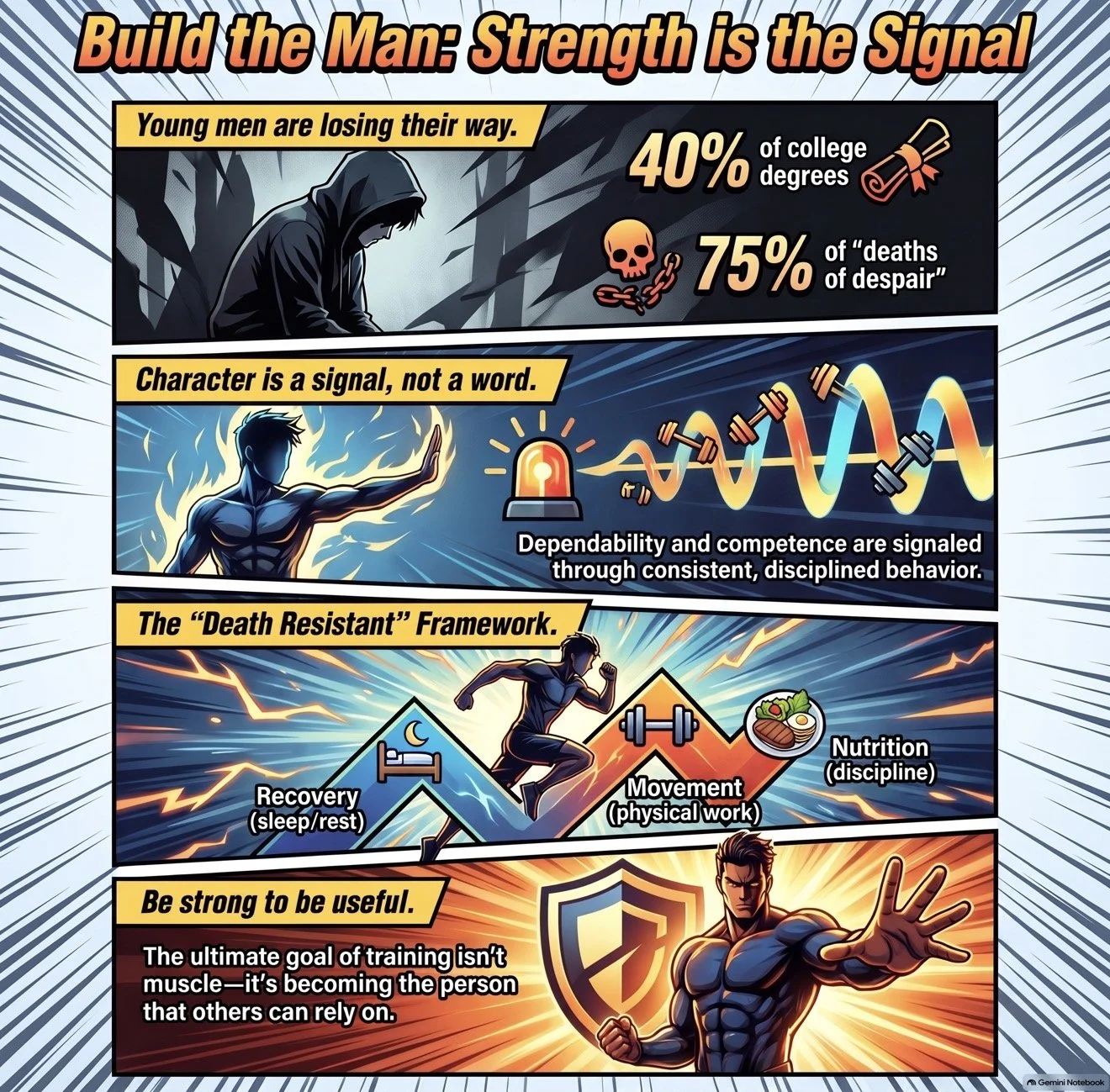
Young men in America are in trouble: falling behind in school, stepping out of the workforce, retreating into screens, and struggling to build friendships and relationships. That drift does not start at 22 — it starts in boyhood, in the years when a boy either learns that effort is required of him or learns that it is not. Research on what people value in a long-term partner keeps returning to traits like dependability, ambition, competence, and health — none of which can be seen directly. They have to be signaled through behavior. Strength training is the earliest, cleanest place a boy can start building and signaling all of them.
Look around at the young men in your life. Not the little boys — the nineteen-year-olds, the twenty-four-year-olds, the twenty-eight-year-olds. How many of them are actually thriving?
Here is what the numbers say, and they should alarm you. Women now earn about 60 percent of college degrees. In a nationally representative study of American high schoolers, boys made up two-thirds of the bottom tenth of the class by GPA. About one in nine prime-age men, ages 25 to 54, is neither working nor looking for work. Roughly one in three young men ages 18 to 34 still lives with his parents. The share of men who say they have zero close friends has jumped fivefold since 1990, from 3 percent to 15 percent. And men account for nearly three-quarters of the deaths in the categories often called deaths of despair. Our boys are drowning in screens and starving for purpose.
You have seen it up close, even if you have not named it. The nephew who games until 3 a.m. and cannot hold a job. The neighbor's son who graduated two years ago and never launched. The young man who cannot look an adult in the eye, ask a girl to dinner, or finish anything hard. He is not a bad kid. He is an unbuilt one. Nothing was ever required of him, so he never found out what he could do.
Here is the part every parent needs to hear: the drift does not start at 22. It starts at 8, 10, 12 — the years when a boy either learns that effort is required of him or learns that it is not. Which means those are also the years when the drift can be stopped. That is the work we do at Mighty Oak Athletic. Yes, it looks like getting faster for soccer. It is much bigger than that.
Here is something that makes people uncomfortable, so let's say it plainly. Decades of research on what people value in a long-term partner keeps returning to the same cluster of traits: dependability, ambition and the ability to provide, competence, and health. Now look at that list again. Not one of those traits can be seen directly. Every one of them has to be signaled through behavior. A fit body matters not because anyone is impressed by big arms, but because of what it signals: the discipline to train and the commitment to keep showing up. Competence signals that resources will follow. Reliability today signals reliability tomorrow.
The key word is signal. Nobody can see character directly. They can only see the evidence of it. A 16-year-old has no resources yet. What he has is behavior, and behavior is the signal.
Think about what a young man is actually broadcasting when he trains three days a week for two years. He is telling the world he shows up week after week, in season and out, whether anyone is watching or not. He can do hard things nobody is making him do. He can delay the reward. He can be told he is doing it wrong and fix it instead of quitting. He can take care of the one body he has been given. None of that is about muscle. All of it is about who he is becoming.
Now flip it around. The 22-year-old who orders another round at midnight when he has something important in the morning is signaling too. He is telling everyone in the room that the next day's obligations lose to tonight's fun. People notice. They may not say it out loud, but they file it away. The young man who says "I've got an early morning" and goes home is signaling something scarce. He is showing that he is the kind of person who will have something to offer later because he is protecting what matters now.
That decision does not appear out of nowhere at 22. It gets built somewhere. In our experience, it gets built at 8, and 12, and 15, in a room where a kid learns that the squat does not care how he feels today, and that the only way through is to do the work anyway.
This is why our whole program is built on the Death Resistant framework: Recovery, then Movement, then Nutrition. Recovery comes first because a young man who learns to sleep, to rest, and to make the right call when nobody is checking is learning the same skill that will make him someone others can rely on. Movement means barbells, kettlebells, and bodyweight, every session, starting at age six. Nutrition is the daily proof that he can take care of himself without being told. The MOA Nutrition journal is not a diet. It is a discipline log.
It is also why we use a nine-level shirt progression. A kid cannot buy the next shirt. He earns it by hitting real, measurable standards. When a young man walks into a gym, a school, or a tryout wearing a shirt he earned, he is wearing proof of every session it took to get it. That is the most honest signal there is.
So yes, your son will get faster on the soccer field. He will also, quietly and without anyone announcing it, become the kind of young man that good coaches want on their roster, good teachers want in their classroom, and good people want in their life. The crisis facing young men is real. It is also not inevitable. It gets stopped one required rep, one earned shirt, one disciplined boy at a time.
Be strong to be useful. That has always been the point. The strength is just how we get there.
Fact-check
~60% of college degrees: NCES/IPEDS 2023–24 (59.7% of associate's through doctoral; 58.3% of bachelor's alone)
Two-thirds of bottom GPA decile: NCES HSLS:09, Smith & Reeves analysis (2025) — scope is a nationally representative high-school cohort
1 in 9 prime-age men out of labor force: BLS CPS, July 2026 (10.8% of men 25–54); includes disability, caregiving, school — avoid "gave up looking"
1 in 3 young men living with parents: U.S. Census CPS 2022 (32.8% of men 18–34 living as child of householder)
No close friends 3% → 15%: Gallup 1990 vs. Survey Center on American Life 2021; different survey modes, not a perfect time series
~Three-quarters of deaths of despair: CDC/NVSS 2024 — men were 79.8% of suicide deaths, 69.4% of overdose deaths, ~70.4% of alcohol-induced deaths; "deaths of despair" is not an official CDC category
Mate-preference framing follows Buss (1989) and Shackelford, Schmitt & Buss (2005); the fitness-signals-discipline link is presented as our argument, not a research finding
Does Strength Training Make Kids Faster?
Key Takeaways
Yes — speed is a strength skill. Sprinting is force pushed into the ground, and stronger legs and hips produce more force.
Research on young athletes shows strength training improves sprint times, jump height, and change of direction.
Ladders and cone drills make feet busier, not faster. Squats, deadlifts, and sprinting itself build real speed.
Speed gains show up within one to two training blocks — and they transfer to every sport.
Does Strength Training Make Kids Faster?
Every parent of a young athlete eventually asks it: how do I make my kid faster? And an entire industry has an answer ready — speed camps, agility ladders, parachutes, cones arranged in clever patterns.
Here's the answer nobody's selling: yes, strength training makes kids faster. In fact, it's the most reliable speed program there is.
What speed actually is
Watch a sprinter in slow motion. Speed isn't fast feet — it's force. Every stride is a violent push into the ground, and the harder an athlete pushes, the farther and faster the ground sends them forward. Physics does the rest.
That means the question "how do I get faster?" is really the question "how do I push harder?" And the answer to that one has been settled for decades: get stronger. Squats, deadlifts, and power cleans train the exact muscles — glutes, hamstrings, quads, core — that drive every sprint stride.
What the research shows
Studies on youth athletes consistently find that strength and resistance training improves sprint speed, jump height, and change-of-direction ability. Stronger young athletes accelerate faster, cut harder, and reach top speed sooner than their weaker teammates. This holds across sports — soccer, football, basketball, baseball, volleyball. Speed is general. Strength feeds all of it.
The mechanism is simple: a stronger leg delivers more force per stride without working harder to do it. Same effort, more output. That's what "getting faster" is.
The agility ladder problem
So why do speed camps sell ladders and cones? Because they look like speed. Quick feet tapping through a ladder feels fast and films great for social media.
But tap-dancing through a ladder teaches you to take small, fast, weak steps — the opposite of sprinting, which rewards long, powerful strides. Ladders have their place as a warm-up and coordination tool. As a speed program, they're a treadmill: lots of motion, no destination.
The formula that actually works has two ingredients: get stronger in the weight room, and sprint — actually sprint, at full effort, with full recovery between runs. Strength builds the engine. Sprinting teaches the body to use it.
When the results show up
This isn't a someday payoff. Coaches see it inside one or two six-week training blocks: the kid who added 20 pounds to their squat suddenly beats everyone to the ball. Parents usually hear it secondhand — "Coach says she's gotten so much quicker" — before they connect it to the barbell.
And unlike a speed camp, the gains don't expire when the week ends. Strength compounds. A kid who trains through the school year doesn't just get faster this season — they raise the ceiling on every season after it.
The bottom line
If your athlete wants to be faster, skip the gimmicks. Two to three strength sessions a week built on squats, hinges, presses, and pulls, plus real sprinting, will beat any ladder drill ever invented. It's not flashy. It just works.
Want to see the engine get built? Come watch a session at Mighty Oak Athletic in Westmont — first one's free.
-
Yes. Sprinting speed comes from force pushed into the ground, and strength training builds the glutes, hamstrings, quads, and core that produce that force. Research on youth athletes shows strength training improves sprint times, jump height, and change of direction.
-
Ladders build coordination and make a fine warm-up, but they train small, quick, weak steps — the opposite of the long, powerful strides that create real speed. Strength work plus actual sprinting outperforms ladder drills.
-
Most young athletes show measurable improvement within one to two six-week training blocks — often noticed first by their sport coaches.
-
Squats, deadlifts, and power cleans build the force behind every stride, paired with full-effort sprinting. Mighty Oak Athletic in Westmont, IL coaches all of them for athletes ages 6–18 — $199/month unlimited, free trial session. Call 630-464-9498.
Coach Mike Ockrim is a Certified Strength and Conditioning Specialist (CSCS), USA Weightlifting Level 1 coach, USA Triathlon coach, and second-degree black belt. He founded Mighty Oak Athletic in Westmont, IL in 2013, runs the Sunday Funday Sports youth leagues, has taught group fitness at Life Time for more than eight years, and is the author of Death Resistant, 13 Pounds in 30 Days, and MOA Nutrition. He lives in the western suburbs with his wife Carey and their four kids.
What Are the Benefits of Strength and Conditioning Programs for Children?

Key Takeaways
Properly coached strength training is safe for kids — the NSCA and American Academy of Pediatrics both support it, starting as young as 6.
Benefits go beyond sports: stronger bones, fewer injuries, better posture, healthier body composition, and real confidence.
Strength built in childhood pays off for decades — bone density, movement habits, and self-belief all compound.
The gains that matter most aren't physical: discipline, focus, and the experience of earning progress week by week.
What Are the Benefits of Strength and Conditioning Programs for Children?
Somewhere along the way, a myth took hold: that weights are dangerous for kids. That lifting stunts growth. That children should stick to games and leave the barbell for later.
The research says the opposite. The National Strength and Conditioning Association and the American Academy of Pediatrics both endorse properly coached strength training for children — and the list of benefits is long enough that the real question isn't whether kids should train. It's why so few do.
Stronger bones, built on a deadline
Here's something most parents have never been told: childhood and adolescence are when bones are most responsive to loading. The squats and presses a 10-year-old does don't just build muscle — they signal growing bones to lay down density that becomes the skeleton they carry for life. That window doesn't stay open forever. Strength training during it is one of the best long-term health investments a kid can make.
Fewer injuries, on and off the field
Youth sports injuries are exploding — overuse injuries especially, driven by kids playing one sport year-round with no strength base underneath. Structured strength and conditioning is the counterweight. Stronger muscles and connective tissue protect knees, ankles, and shoulders. Better movement patterns mean better landing, cutting, and falling mechanics. Research consistently shows that young athletes who strength train get hurt less than those who only play their sport.
Better athletes — in every sport
Speed, jumping, throwing, change of direction: all of it runs on strength. A conditioning program doesn't compete with your child's sport; it feeds it. The kid who squats, hinges, presses, and pulls twice a week shows up to every practice with a bigger engine than the kid who doesn't. And because strength is general, it transfers — the same base powers soccer in the fall, basketball in the winter, and baseball in the spring.
Healthier bodies and better habits
Strength training improves body composition, insulin sensitivity, and cardiovascular health in kids — benefits that used to be credited only to endless cardio. But unlike laps run as punishment, lifting is something kids genuinely enjoy getting better at. That matters, because the habit is the prize. A child who learns at 8 that training is normal, measurable, and fun is an adult who still trains at 40.
The confidence you can't fake
Ask any coach what changes first in a new athlete. It's not the legs. It's the posture.
There's a particular kind of confidence that comes from doing something measurably hard — adding five pounds to a lift you couldn't do six weeks ago, or hitting your first real chin-up. It can't be given, purchased, or faked. It's earned in reps. Kids carry that earned confidence out of the gym and into classrooms, tryouts, and friendships. For many of them, it's the first place they learn that effort reliably turns into results.
Discipline that transfers
A structured program teaches things a scoreboard can't: show up consistently, do the work with focus, track your progress, be patient with the process. Those are life skills wearing gym clothes. Parents notice it in homework habits and attitude long before they notice it in muscles.
The long game
The point of youth strength and conditioning was never just this season. It's decades out: dense bones at 50, an intact back at 60, the strength to carry your own groceries at 80. Be strong to be useful — now, and for the rest of their life. The kids who start early get a head start that compounds forever.
The window is open. The barbell is lighter than the myth says. And the first session at Mighty Oak Athletic in Westmont is free — come see what your kid can build.
-
Stronger bones during the key growth window, fewer sports injuries, better athletic performance in every sport, healthier body composition, and earned confidence and discipline that carry into school and life. Both the NSCA and American Academy of Pediatrics endorse properly coached youth strength training.
-
Yes — with qualified coaching that teaches technique before adding weight. Research shows supervised strength training has lower injury rates than most youth sports themselves.
-
No. That myth has been thoroughly debunked. Properly coached loading actually strengthens growing bones — childhood is when bones respond best to training.
-
With proper coaching, kids can start around age 6. Mighty Oak Athletic in Westmont, IL trains athletes ages 6–18 using barbells, kettlebells, and bodyweight — $199/month unlimited, free trial session, no contracts. Call 630-464-9498.
Coach Mike Ockrim is a Certified Strength and Conditioning Specialist (CSCS), USA Weightlifting Level 1 coach, USA Triathlon coach, and second-degree black belt. He founded Mighty Oak Athletic in Westmont, IL in 2013, runs the Sunday Funday Sports youth leagues, has taught group fitness at Life Time for more than eight years, and is the author of Death Resistant, 13 Pounds in 30 Days, and MOA Nutrition. He lives in the western suburbs with his wife Carey and their four kids.
How to Help Your Child Improve Athletic Performance Through Structured Training

Key Takeaways
More games and more practices don't build athleticism — structured strength training does.
Structured means a plan: measured progressions through the four foundational movements (squat, hinge, press, pull), not random workouts.
Two to three training sessions a week is the sweet spot for most student athletes.
Recovery and nutrition are part of the program. A tired, underfed athlete can't get stronger.
How to Help Your Child Improve Athletic Performance Through Structured Training
Your kid wants to make the team. Or start. Or finally beat the kid who's been faster than them since second grade. So what do most parents do? Sign them up for more — more games, more practices, more private lessons in the same sport, year-round.
Here's the uncomfortable truth: more of the sport is rarely the answer. The kids pulling ahead aren't playing more games. They're getting stronger.
Sports reveal athleticism - Training builds it
Speed, power, quickness, balance — every quality coaches drool over in tryouts comes from the same source: strength. A faster sprint is a harder push into the ground. A higher jump is more force produced in less time. A kid who can't be knocked off the ball has a stronger core and stronger hips than the kid trying to knock them.
Practice teaches the skills of the game. But the engine underneath — the strength that powers every cut, sprint, and shot — gets built in the gym. That's the piece most young athletes are missing, and it's why the answer to "how do I help my kid improve" usually isn't another travel season.
What "structured" actually means
Walk into most gyms and you'll see random workouts: different exercises every day, sweat as the goal, nothing measured. That's working out. It feels productive. It goes nowhere.
Structured training is different. It's a plan:
The foundation is four movement patterns — squat, hinge, press, and pull. Master those and you've covered nearly everything a young body needs to do in any sport.
Progress happens in measured steps. At Mighty Oak Athletic, athletes move through nine cumulative six-week programs. Every session builds on the last. Every athlete knows what they lifted last week and what the target is this week. When the number on the bar goes up over months, the kid on the field is faster, more powerful, and harder to push around. And they can see the proof in their own logbook — which is where athletic confidence actually comes from.
Frequency stays sane. Two to three sessions a week, about an hour each, is plenty for a student athlete who also has practices, games, homework, and a life. Consistency over months beats intensity over weeks — every single time.
Start with the movements, not the weight
Structured doesn't mean heavy on day one. Young athletes earn the barbell by mastering the movement first — bodyweight squats before back squats, hip hinges before deadlifts. A good program (and a good coach) progresses load only as fast as technique allows. That's how kids as young as 6 train safely, and it's why the research from the NSCA and the American Academy of Pediatrics supports properly coached strength training for children.
The two multipliers: recovery and nutrition
Training is the stimulus. Growth happens afterward — in sleep and at the dinner table. A young athlete who trains hard but sleeps six hours and skips breakfast is spinning their wheels. The most underrated performance upgrades in youth sports are a consistent bedtime and real food. Strength is built in the gym, but it's cemented in recovery.
What you can do this week
Ask your child's current program one question: "What's the plan?" If the answer is a real progression — written down, measured, building toward something — you've found structure. If the answer is a shrug and another scrimmage, your athlete is leaving their potential on the table.
Structured training is the long game: stronger at 10, faster at 14, durable at 17, and still training at 40. Be strong to be useful — for the season, and for life.
Want to see what structure looks like? Watch a session at Mighty Oak Athletic in Westmont. The first one's free.
-
Add two to three strength sessions a week built on the four foundational movements — squat, hinge, press, and pull — with measured progressions, plus consistent sleep and real food. Structured strength training builds the speed and power that sport practice alone can't.
-
Two to three sessions of about an hour each fits alongside practices and games. Consistency over months matters more than intensity in any single week.
-
Yes. Speed is force into the ground — stronger legs and hips produce more force. That's why structured strength work improves sprinting, jumping, and change of direction across every sport.
-
With proper coaching that puts technique before load, kids can start as young as 6. Mighty Oak Athletic in Westmont, IL trains athletes ages 6–18, $199/month unlimited with a free trial session. Call 630-464-9498.
Coach Mike Ockrim is a Certified Strength and Conditioning Specialist (CSCS), USA Weightlifting Level 1 coach, USA Triathlon coach, and second-degree black belt. He founded Mighty Oak Athletic in Westmont, IL in 2013, runs the Sunday Funday Sports youth leagues, has taught group fitness at Life Time for more than eight years, and is the author of Death Resistant, 13 Pounds in 30 Days, and MOA Nutrition. He lives in the western suburbs with his wife Carey and their four kids.
What Qualifications Should a Youth Strength Coach Actually Have?
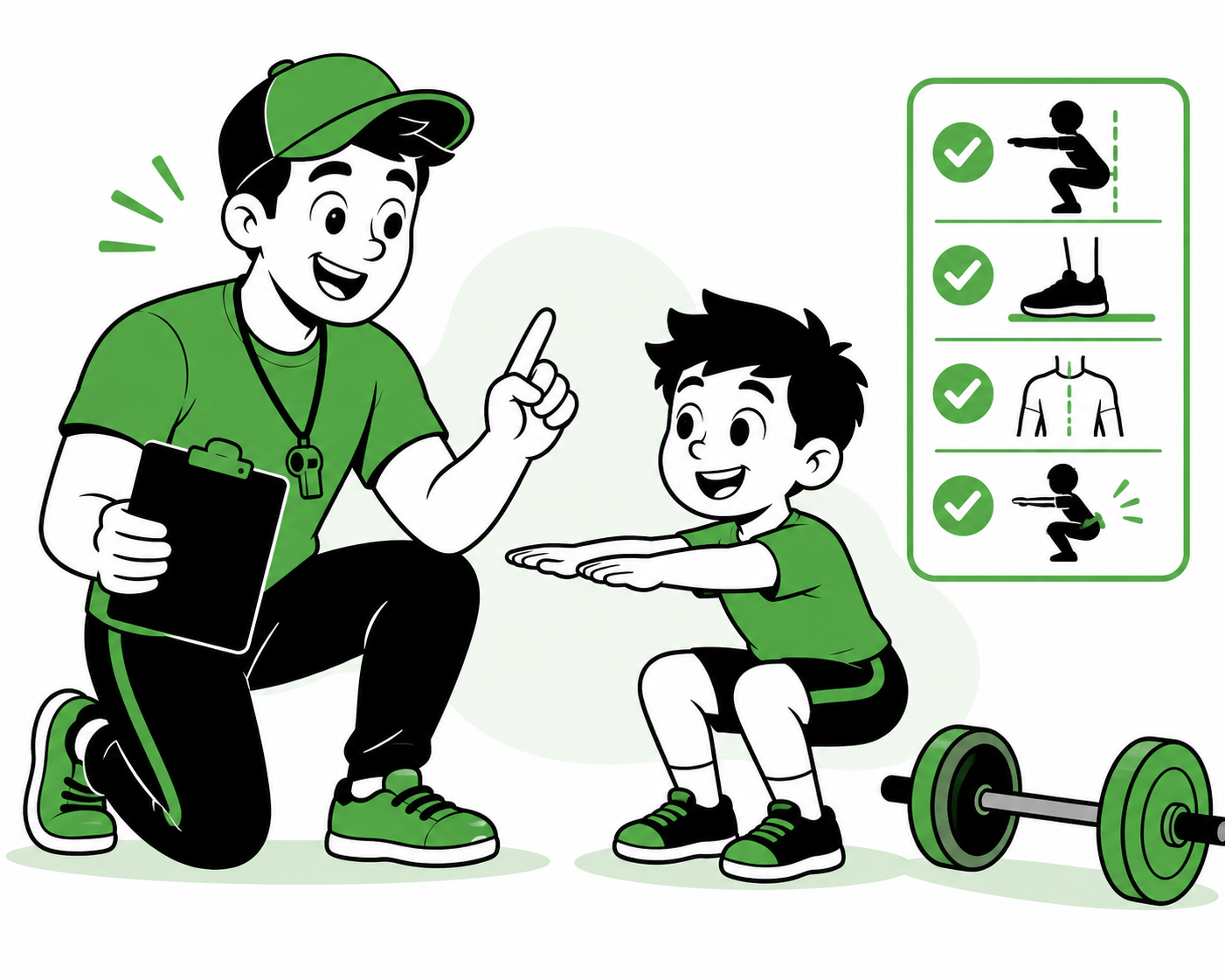
Key Takeaways
Look for a CSCS (Certified Strength and Conditioning Specialist) — the gold-standard credential from the NSCA, requiring a bachelor's degree and a rigorous exam.
Ask how long they've coached KIDS, not just adults. Coaching a 7-year-old is a different skill than coaching a 27-year-old.
Watch a session before you sign up. Good coaches teach technique first and add weight second.
A free trial session is a green flag — confident coaches let their coaching sell itself.
What Qualifications Should You Look For in a Youth Strength and Conditioning Coach?
You wouldn't hand your car keys to someone who watched a few driving videos. So why do so many parents hand their kids to trainers whose only credential is a weekend certificate and a nice Instagram page?
Here's the problem: "trainer" is not a protected title. Anyone can print business cards tomorrow. That's why knowing what to look for matters — especially when the athlete is 8 years old and still learning how their body moves.
Start with the letters: CSCS
The credential that matters most is the CSCS — Certified Strength and Conditioning Specialist — issued by the National Strength and Conditioning Association. It's not a weekend course. It requires a bachelor's degree, a demanding exam covering exercise science and program design, and ongoing continuing education to keep it.
Plenty of certifications exist. Most take a weekend. The CSCS takes years of preparation. When a coach holds one, it tells you they treat this as a profession, not a side hustle.
Other credentials worth respecting: USA Weightlifting certifications (for teaching the barbell lifts properly) and sport-specific coaching credentials. Stack them together and you're looking at someone who has invested seriously in their craft.
Experience with kids — not just experience
Here's what the certificate can't tell you: whether the coach can actually coach children.
A great adult trainer can be a terrible kids' coach. Kids need shorter instructions, more patience, more play, and a coach who can tell the difference between "I'm tired" and "I'm bored." They need someone who knows that a 6-year-old learning to squat is doing something completely different than a 16-year-old preparing for high school sports — even if the movement looks the same.
Ask the question directly: How many years have you coached athletes under 18? How young do you start? What does a session for a 7-year-old look like versus a 14-year-old? A qualified youth coach answers those questions immediately and specifically. An unqualified one changes the subject.
Watch how they teach
Before you commit, watch a session. You're looking for three things.
First, technique before load. Kids should master the movement — squat, hinge, press, pull — with light weight or bodyweight before anything heavy touches their hands. If you see kids straining under weights with sloppy form while a coach scrolls their phone, walk out.
Second, progression with a plan. Ask the coach how athletes advance. There should be a real answer — structured programs that build in measured steps, not random daily workouts. Training is a calculated path. Working out is just sweating.
Third, the room itself. Are kids engaged? Are they being corrected kindly and specifically? Does the coach know every kid's name? Culture is a qualification too.
The free trial test
One more green flag: a free trial session. Coaches who are confident in their program let you see it before you pay for it. A hard sell, pressure tactics, or long-term contracts before your child has ever set foot in the gym — those are the marks of a business protecting itself, not a coach protecting your kid.
The long game
The right coach isn't building your child for next season. They're building them for the next forty years — strong bones, confident movement, and a relationship with training that lasts long after the last youth game ends. Be strong to be useful. That's the standard. Find a coach who holds it.
If you're in the western Chicago suburbs, come watch a session at Mighty Oak Athletic in Westmont. First one's free — because it should be.
Coach Mike Ockrim is a Certified Strength and Conditioning Specialist (CSCS), USA Weightlifting Level 1 coach, USA Triathlon coach, and second-degree black belt. He founded Mighty Oak Athletic in Westmont, IL in 2013, runs the Sunday Funday Sports youth leagues, has taught group fitness at Life Time for more than eight years, and is the author of Death Resistant, 13 Pounds in 30 Days, and MOA Nutrition. He lives in the western suburbs with his wife Carey and their four kids.
-
Look for the CSCS (Certified Strength and Conditioning Specialist) from the NSCA — it requires a bachelor's degree and a rigorous exam. Add years of experience coaching kids specifically, credentials like USA Weightlifting Level 1, and a teaching style that puts technique before weight.
-
Yes. The CSCS is the most respected credential in strength and conditioning. It signals formal education in exercise science and program design — the foundation for training growing athletes safely.
-
Heavy weights with sloppy form, no structured progression plan, pressure to sign long-term contracts, and coaches who can't explain how they train different ages differently. If you can't watch a session first, keep looking.
-
Yes. Every new athlete at Mighty Oak Athletic in Westmont, IL gets one free trial session. Membership is $199/month, unlimited training, no contracts. Call 630-464-9498 or visit MightyOakAthletic.com.
Before the Scholarship, Before Varsity, There Was a Kid Learning to Deadlift
Key Takeaways (TL;DR)
A viral-worthy transformation — a 6-year-old deadlifting 12 pounds becoming an 18-year-old college football player pulling 355 — isn't about the weights. It's about the 12 years of consistency in between.
The best question parents can ask isn't "How fast can my child get stronger?" It's "What habits can my child build today that will still serve them ten years from now?"
The right age to start strength training is before your child needs to be stronger — long before varsity tryouts, scholarships, or college athletics enter the picture.
At Mighty Oak Athletic in Westmont, kids as young as 6 learn to squat, hinge, push, pull, and carry safely — building patience, focus, and confidence along with strength.
The strongest athletes aren't the ones who started lifting the heaviest. They're the ones who started building the earliest.
Every Mighty Oak Starts as a Tiny Acorn
One of my favorite videos we've ever filmed starts with a six-year-old.
He's standing over a 12-pound weight. A yoga block sits beneath it so he can practice the correct starting position. The lift isn't heavy. It isn't impressive by social media standards. No one is going to mistake him for a college athlete.
And that's exactly the point.
The video ends with an eighteen-year-old college football player confidently deadlifting 355 pounds.
Most people see the beginning and the end.
We see everything in between.
Thousands of reps. Hundreds of training sessions. Small improvements nobody noticed because they happened one day at a time.
The world celebrates the 355-pound deadlift. We celebrate the 12-pound one just as much.
Because the first lift is where the second one begins.
The Question Parents Ask — and the Better One
Too often, parents want to know how quickly their child can become stronger, faster, or more athletic. They ask which program produces the biggest results in the shortest amount of time.
They're asking the wrong question.
The better question is: What habits can my child build today that will still serve them ten years from now?
Strength isn't built in a weekend. Confidence isn't built in a weekend. Discipline isn't built in a weekend.
Those things grow quietly, almost invisibly, until one day everyone notices what years of consistency have created.
That's how an acorn becomes an oak.
The Weight Is Just a Tool
At Mighty Oak Athletic, our youngest athletes don't train because they need to lift heavy weights. They train because they need to learn how to move well, listen, focus, overcome challenges, and believe they can do hard things.
The weight is simply a tool.
The real goal is building capable young people.
When we teach a six-year-old how to hinge correctly, brace their core, or finish a deadlift with good posture, we're not just coaching a movement. We're teaching patience. We're teaching attention to detail. We're teaching that doing something well matters more than doing it fast.
Those lessons compound.
Year after year, they become stronger bodies, more resilient minds, and confident young adults. Strong to be useful — in sports, in school, and in life.
When Should a Child Start Strength Training?
People often ask us, "What's the right age to start strength training?"
Our answer is simple: The best time to start isn't when your child needs to get stronger. It's before they need to.
Long before scholarships, varsity teams, or college athletics enter the picture, there is a child learning how to squat, push, pull, carry, and pick something up safely from the floor.
That's where athletic development really begins.
The strongest athletes aren't usually the ones who started lifting the heaviest. They're the ones who started building the earliest.
Plant the Seed
The six-year-old in the video isn't trying to become an eighteen-year-old overnight.
He's simply becoming a little better than he was yesterday.
That's enough.
Because every mighty oak starts as a tiny acorn.
Plant the seed. Protect it. Be patient. Trust the process.
One day, you'll look back and realize the 355-pound deadlift started with a child, a 12-pound weight, and a yoga block.
Ready to plant the seed? Mighty Oak Athletic coaches young athletes ages 6–18 in Westmont, serving families across DuPage County — including Downers Grove, Clarendon Hills, Hinsdale, Darien, and Oak Brook. Every athlete's journey starts the same way ours does: with a single session.
-
Kids can safely begin structured strength training around age 6, once they can follow directions and focus for a coaching session. The goal at that age isn't lifting heavy — it's learning to squat, hinge, push, pull, and carry with good technique under qualified supervision.
-
Yes, when it's coached properly and scaled appropriately. A 6-year-old practicing a hinge pattern with a 12-pound weight from an elevated block is learning safe movement mechanics — the same skill that protects their back every time they pick something up off the floor for the rest of their life.
-
Kids improve coordination, confidence, and movement quality within weeks — but the real payoff compounds over years. Athletes who start young build a foundation that later becomes visible strength, speed, and resilience in high school and beyond.
-
Mighty Oak Athletic is located at 6424 S. Cass Ave. in Westmont, IL, and trains athletes ages 6–18 from across DuPage County, including Downers Grove, Clarendon Hills, Hinsdale, Darien, and Oak Brook. Every new family starts with a free training session.
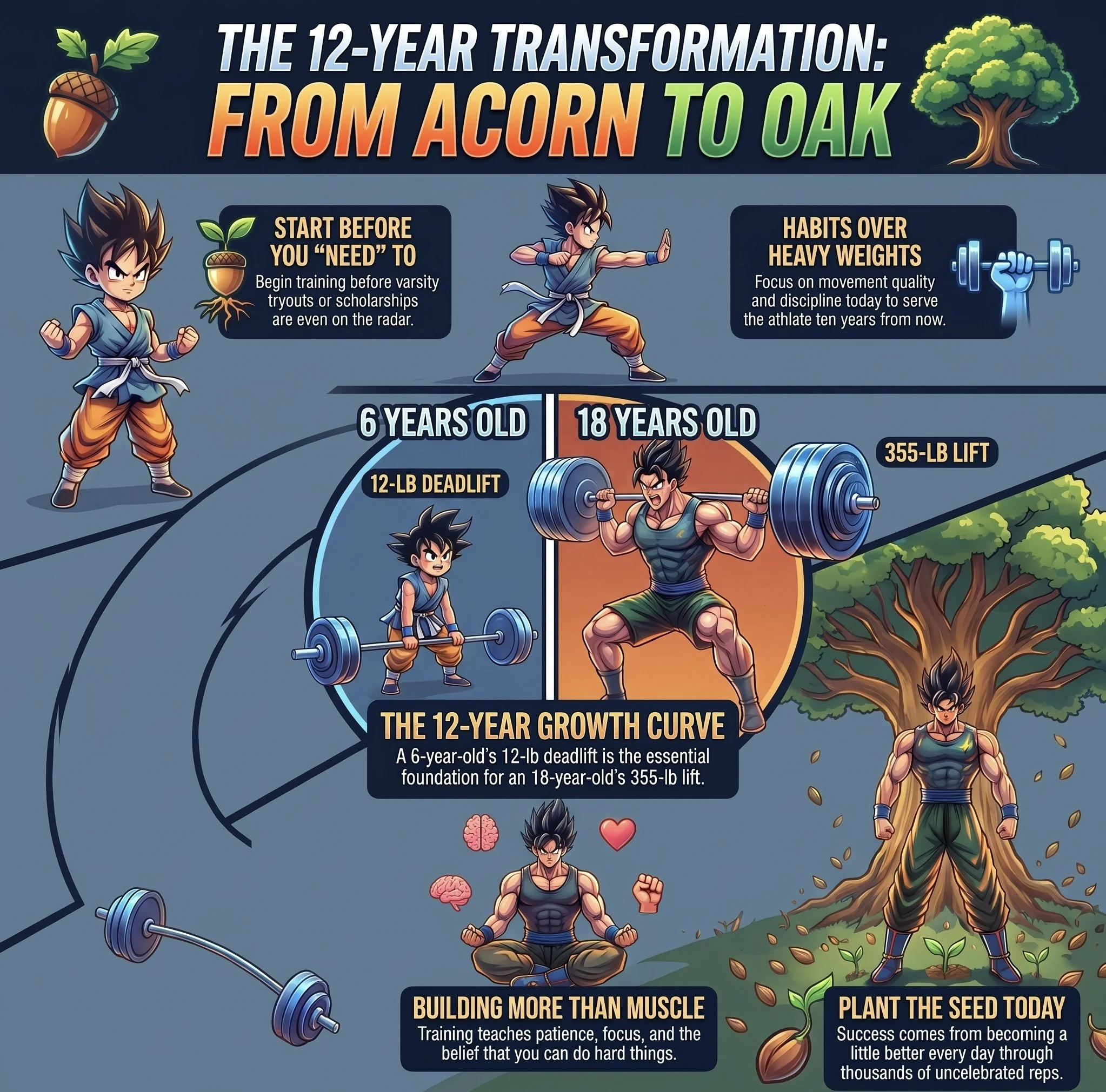
What Is the Army Fitness Test in 2026? The New AFT, Explained

Key Takeaways
The Army Fitness Test (AFT) replaced the ACFT on June 1, 2025. Five events, 500-point maximum, minimum 60 points per event: 3-Rep Max Deadlift, Hand-Release Push-Ups, Sprint-Drag-Carry, Plank, and 2-Mile Run.
The Standing Power Throw is gone — cut because it produced more training injuries than useful readiness data.
There are now two passing standards: soldiers in 21 designated combat MOSs must score 350+ under sex-neutral scoring; everyone else needs 300+ under sex- and age-normed scoring. Both require 60 in every event — fail one event and the whole test fails, regardless of total.
The combat standard has had teeth since January 1, 2026 for active duty (June 1, 2026 for Guard and Reserve): failing brings an administrative flag, and combat-MOS soldiers who can't meet 350 face possible reclassification.
If you're preparing to enlist or commission: train the deadlift and the 2-mile run hardest. One rewards absolute strength, the other exposes anyone who skipped their aerobic base — and they're at opposite ends of the fitness spectrum on purpose.
Get the free MOA Military Prep Guide. The AFT, Marine PFT, service academy CFA, and ROTC standards in one place — event breakdowns, where candidates lose points, and a twelve-week progression laid out week by week.
Training in the Chicago suburbs? We coach future soldiers, academy applicants, and ROTC candidates in person at our Westmont facility. See the military prep program.
What Is the Army Fitness Test in 2026? The New AFT, Explained
The Army has changed its fitness test three times in recent memory, which is why half the internet still says "APFT," the other half says "ACFT," and the test your recruit will actually take is called neither.
Here's the current test, why it changed, what the scores mean, and how to train for it — written for the people I coach: high schoolers heading to basic, ROTC candidates, and the parents trying to keep up with the acronyms.
The short version
Since June 1, 2025, the Army's official test is the Army Fitness Test (AFT). Five events, in order:
3-Repetition Maximum Deadlift (MDL) — heaviest weight you can pull off the ground three times on a hex bar.
Hand-Release Push-Ups (HRP) — max reps in two minutes, hands lifted off the ground at the bottom of every rep.
Sprint-Drag-Carry (SDC) — five 50-meter shuttles: sprint, sled drag, lateral shuffle, kettlebell carry, sprint. For time.
Plank (PLK) — max hold.
2-Mile Run (2MR) — for time.
Each event is worth up to 100 points, for a 500-point maximum. Every event has a floor of 60 points — drop below it on any single event and you fail the entire test, no matter what your total says.
Why the Army changed the test — again
Two reasons, and they're both instructive if you're the kind of person who trains for a living.
First, injuries. The old ACFT included a Standing Power Throw — hurling a 10-pound ball backward over your head. It turned out to be the test's biggest source of training injuries while telling the Army very little about combat readiness that the other events didn't already capture. So it's gone. Six events became five, and the old 600-point maximum became 500.
Second, the data said the standards needed restructuring. The Army analyzed over a million ACFT administrations and rebuilt the scoring around a dual-standard system:
Combat MOS standard: soldiers in 21 designated combat jobs — infantry, armor, combat engineers, and so on — are scored sex-neutral and must total 350 or better. Same tables for men and women. The job doesn't care who's carrying the litter.
General standard: everyone else is scored on sex- and age-normed tables and must total 300 or better.
That combat standard stopped being theoretical on January 1, 2026 for active duty (June 1, 2026 for Guard and Reserve). Failing now brings an administrative flag that blocks promotion and reenlistment — and a combat-MOS soldier who can't reach 350 can be reclassified out of the job entirely.
What the scores actually mean
The score questions people search — "is 432 good," "is 465 good," "what's the minimum" — sort out like this:
300 — minimum pass, general standard.
350 — minimum pass, combat MOS, and a respectable general score.
400–450 — above average, and where promotion competitiveness starts to live.
450+ — top tier. A 465 has had specific policy significance tied to body-composition rules, but that policy has been revised more than once — treat any claim about score-based exemptions as perishable and check the current regulation rather than a blog post, including this one.
500 — max. Rare, and requires being genuinely strong and genuinely conditioned, which is the whole design.
That last point deserves a sentence. The AFT deliberately puts a maximal deadlift and a 2-mile run in the same hour. Powerlifters lose points on the run; runners lose them on the bar. Maxing this test requires being good at both ends of the spectrum — which is exactly what a strength-and-conditioning program builds and a single-focus program doesn't.
How to train for it
The same base we build for every military-bound athlete covers the AFT, with two emphases:
The deadlift is free points for the trained and a wall for the untrained. The MDL is performed on a hex bar — the same tool we start teens on. If you've spent a year progressively deadlifting twice a week, this event is a warm-up. If you've never pulled from the floor, no amount of push-ups will save your total. Start here.
The Sprint-Drag-Carry punishes the unprepared more than any other event. It's 90 seconds of everything at once — sprinting, dragging a sled backward, carrying kettlebells. Loaded carries, sled work, and short shuttle intervals are the preparation. It's also the event where technique (low sled position, tight turns) buys real seconds.
The plank and push-ups reward the same trunk. Hollow-body holds, weighted planks, and honest push-up volume in clean sets. The hand-release standard removes the half-rep bounce, so train the full range from day one.
The 2-mile run follows the same rule as every military run: mostly easy aerobic mileage, a weekly dose of intervals at faster than goal pace, and strength work underneath so your stride holds up in mile two. If you read the Marine PFT piece, the run prescription is the same and so is the reason.
And rehearse the whole test. Five events in sequence is its own stressor. The deadlift you pull fresh and the run you start forty minutes into a test are different animals. At least two full rehearsals before test day.
If you're a parent reading this
The acronym soup — APFT, ACFT, AFT — isn't your kid's problem to solve. Their problem is simpler and older: get strong, build an aerobic base, and do both for months before they ship, not weeks.
A teenager who deadlifts, carries, does strict push-ups, and runs easy miles twice a week walks into any version of any branch's test prepared. The test names keep changing. What the tests measure hasn't changed since the Spartans.
Be strong to be useful.
-
The Army Fitness Test (AFT) is the Army's official physical assessment, replacing the ACFT on June 1, 2025. It has five events — 3-Rep Max Deadlift, Hand-Release Push-Ups, Sprint-Drag-Carry, Plank, and 2-Mile Run — with a 500-point maximum and a required minimum of 60 points per event.
-
Two reasons: the Standing Power Throw caused a disproportionate share of training injuries while adding little readiness information, and analysis of over a million ACFT results led the Army to restructure scoring into a dual-standard system separating combat and non-combat roles.
-
The AFT has five events instead of six (the Standing Power Throw was removed), a 500-point maximum instead of 600, and a new dual standard: combat MOS soldiers are scored sex-neutral with a 350-point minimum, while all other soldiers are scored on sex- and age-normed tables with a 300-point minimum.
-
300 total under the general standard, 350 under the sex-neutral combat MOS standard — and in both cases at least 60 points on every individual event. Scoring below 60 on any single event fails the whole test regardless of total.
-
Failure triggers an administrative flag that blocks promotion, reenlistment, and favorable actions until a passing retest. Combat-MOS soldiers who cannot meet the 350 combat standard can additionally face mandatory reclassification into a non-combat specialty.
-
For untrained candidates, the 3-Rep Max Deadlift and the Sprint-Drag-Carry — the deadlift exposes anyone who has never trained with a barbell, and the Sprint-Drag-Carry combines sprinting, sled dragging, and loaded carries into roughly 90 seconds of continuous output.