Soccer Parents: Ask Your Coach This One Question
A New York Times Magazine story followed a teen soccer player who tore her ACL at 12, rehabbed for a year, came back… and then tore the ACL in her other knee. It also followed a second girl who tore her ACL, returned, and tore it again. The most shocking part wasn’t the injuries.
It was how normal the adults around them said it has become.
If you’re a sports parent or coach, you’ve probably felt that same dread: one wrong cut, one awkward landing, one “I just stepped funny”… and suddenly a season becomes a year of surgery and rehab
Here’s the good news: a lot of ACL tears—especially the non-contact ones—are modifiable. We can’t control everything. But we can control the biggest “low-hanging fruit”: how athletes warm up, decelerate, land, cut, and build strength.
What an ACL tear really costs
An ACL injury isn’t like a broken wrist.
It’s usually surgery, months of rehab, and a long return-to-play timeline. It can also come with a higher chance of future knee issues like osteoarthritis. And for teenagers, it can hit identity hard: “Who am I if I can’t play?”
That’s why this matters: teen girls have a higher ACL injury rate than boys in several cutting and jumping sports, including soccer and basketball. Some sources describe the gap as multiple times higher depending on the sport and study.
Why this is happening more now
The article points to a pattern I see in youth sports every week:
1) Kids aren’t learning movement basics early enough
Less free play means fewer reps of climbing, landing, scrambling, decelerating, and regaining balance. That matters because ACL tears often happen during a millisecond of “the knee didn’t know where to go.”
Research is increasingly linking poor foundational movement skills with riskier landing mechanics—especially in girls.
2) Early specialization (one sport, all year) adds wear and tear
Soccer 12 months a year is common now. That means a lot of cutting on tired legs, with the same patterns repeated over and over.
3) Strength training has lagged for girls
Many boys get introduced to weight rooms earlier. Many girls don’t—sometimes because the environment feels unwelcoming, sometimes because coaches just don’t prioritize it.
But stronger hips, hamstrings, and trunk control are exactly what help keep the knee from collapsing inward when an athlete cuts or lands.
4) Return-to-play risk is real
Young athletes who return to sport after ACL reconstruction have a meaningful risk of a second ACL injury (either the same knee or the other one).
That doesn’t mean “don’t come back.” It means “come back smarter.”
The biggest win: prevention warm-ups actually work
This is the part that should make every coach pause.
Neuromuscular warm-up programs (think: FIFA 11+ style) have repeatedly shown substantial reductions in ACL injuries and overall injuries when teams do them consistently and correctly.
So why don’t more teams do them?
Because youth sports is busy. Coaches feel pressure to “get to the ball.” Parents assume practice is enough. And nobody hands people a simple plan.
Let’s fix that.
The Mighty Oak ACL Plan (simple, realistic, and repeatable)
Part 1: The 12-minute warm-up you do before every practice and game
You can use FIFA 11+ directly, or use a shortened version that keeps the key ideas: balance, deceleration, landing, hip control.
Do 1 round each:
Jog + skip (2 minutes total)
Easy pace. Wake up the body.
Leg prep (2 minutes)
Walking lunges x 10 steps
High knees x 20 yards
Butt kicks x 20 yards
Single-leg balance + reach (2 minutes)
Stand on one leg, reach the other foot forward/side/back x 3 each direction
Switch legs.
Landing mechanics (2 minutes)
“Snap down” to athletic position x 5
Small pogo jumps x 15
Stick a two-foot landing x 5
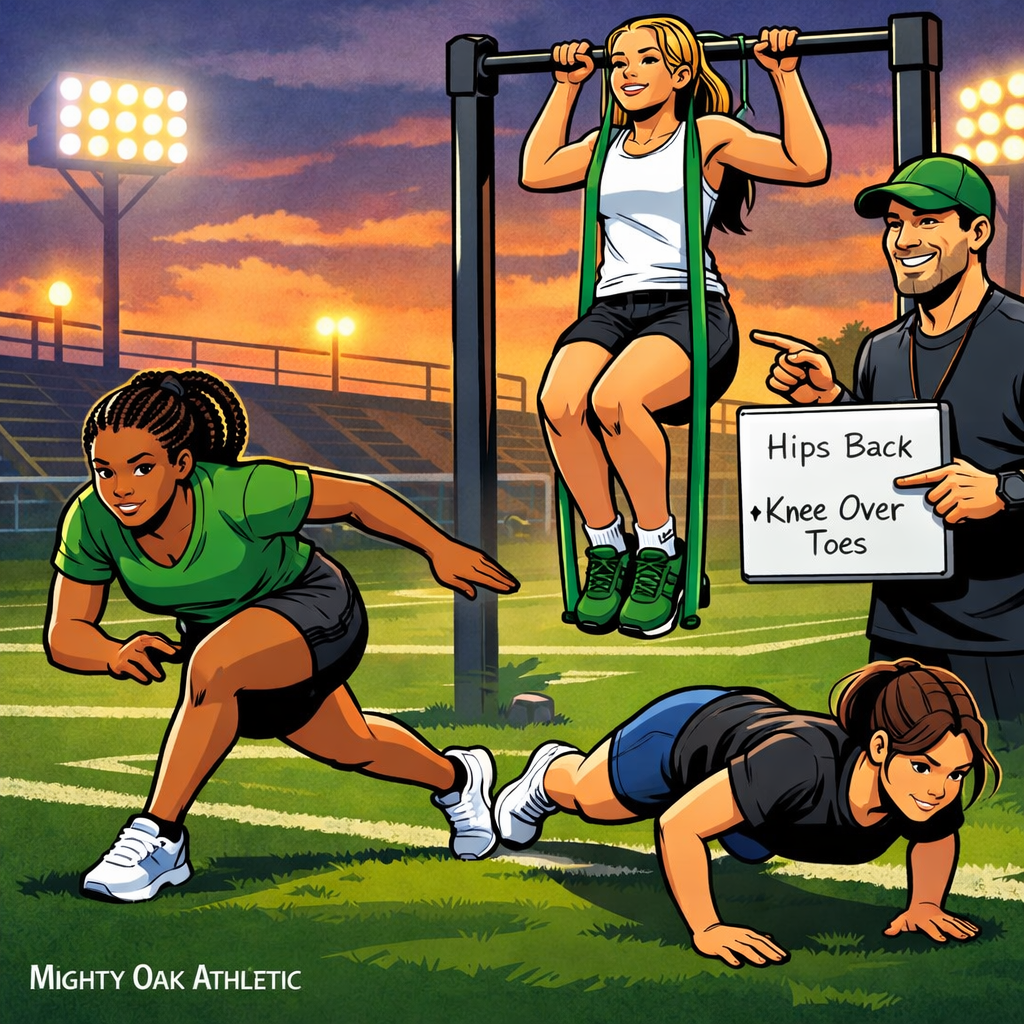
Coaching cue: “Land quiet. Knees over toes. Hips back.”
Deceleration + cut (4 minutes)
Sprint 10 yards → hard stop in athletic position x 4
Shuffle 5 yards → plant → shuffle back x 4
Coaching cue: “Drop your hips. Don’t stay tall.”
If you only do one thing from this whole essay, do this warm-up.
Part 2: Two strength sessions per week (the knee armor)
This is the “bulletproof the kids” part.
Two days a week. 35–45 minutes. Simple lifts. Perfect technique.
Day A
Goblet squat or front squat: 3 x 5–8
Romanian deadlift (RDL): 3 x 6–10
Split squat: 2 x 8/leg
Side plank: 2 x 20–40 seconds/side
Day B
Trap bar deadlift or hinge variation: 3 x 5
Step-ups: 2 x 8/leg
Hamstring curls (ball or sliders): 3 x 8–12
Calf raises: 2 x 12–20
Carry (farmer carry): 4 x 20–30 yards
Why these? Because the ACL usually loses when:
hips are weak,
hamstrings aren’t doing their job,
the athlete can’t control deceleration,
or the trunk collapses and the knee caves inward.
Part 3: The coaching cues that save knees
If you’re a coach, say these a lot:
“Hips back when you stop.”
“Don’t be tall—get low.”
“Knee tracks over the middle toes.”
“Land quiet.”
“Control first, speed second.”
And here’s the sneaky one:
“Show me the same perfect stop even when you’re tired.”
Because most injuries don’t happen in the first 5 minutes. They happen when fatigue and focus drop.
What parents can do (without becoming the bad guy)
If you’re a parent, you don’t need to be the strength coach.
You just need to be the person who asks one question:
“Coach, what’s your knee warm-up plan?”
If they don’t have one, offer this:
“We’ll support you. Can we do a 10–12 minute warm-up like FIFA 11+ before every session?”
This isn’t overstepping. This is seatbelts.
The International Olympic Committee has encouraged neuromuscular warm-ups like FIFA 11+ for youth athletes to build safer movement habits.
The Mighty Oak message
Girls’ sports are booming. That’s a great thing.
But we can’t celebrate opportunity while accepting a system where torn ACLs feel “normal.”
The next wave of great female athletes won’t just be skilled.
They’ll be strong, coordinated, and trained to decelerate like pros.
That’s how we keep them on the field—and keep sports fun.