Mighty Oak Athletic Podcast S3:E87 - What Age Can Kids Safely Start Lifting Weights?
By Coach Mike Ockrim, CSCS Founder, Mighty Oak Athletic • Founder, Sunday Funday Sports • Author of Death Resistant, 13 Pounds in 30 Days, and Mighty Oak Athletic Nutrition
Key Takeaways for Parents in Westmont, DuPage County, and the Chicago Suburbs
There is no universal "right age." Readiness matters more than a birthday.
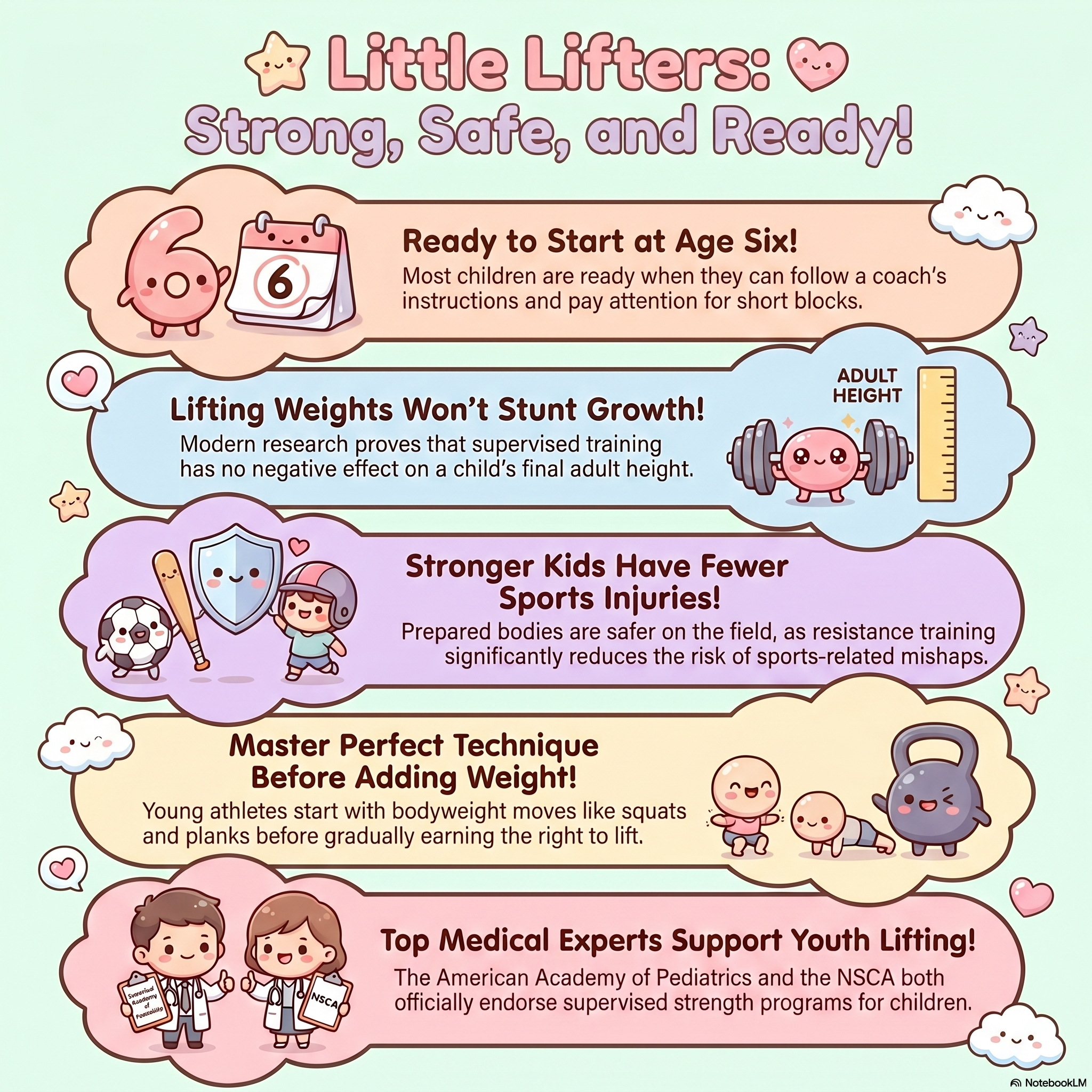
Most kids are ready around age 6 or 7 — which is why Mighty Oak Athletic starts youth strength training at age 7.
Strength training, when properly supervised, does not stunt growth. That myth has been dead for decades.
The American Academy of Pediatrics, in its 2020 statement reaffirmed in November 2024, supports resistance training for children and adolescents.
Properly supervised strength training reduces injury risk in youth sports — it does not increase it.
Parents in Westmont, Hinsdale, Clarendon Hills, and Downers Grove ask me this question more than any other:
"At what age can my kid safely start lifting weights?"
Most parents expect the answer to be "high school" or "after puberty." That answer is wrong. It has been wrong for over twenty years. And the gap between what the research says and what most parents believe is one of the biggest reasons kids in our area get hurt playing sports.
Here is what the science actually says — and what we do about it at Mighty Oak Athletic in Westmont.
The Short Answer
There is no magic age. The right question is not "how old is my kid?" — the right question is "is my kid ready?"
Most healthy children are ready by age 6 or 7. That is the entry age we use at MOA, and it matches the consensus from the leading sports medicine and strength science organizations in the country.
A child is ready to start strength training when they can:
Follow directions from a coach
Pay attention for short blocks of time
Understand and demonstrate safe technique on simple movements
If your child can sit through a math lesson, take turns in a soccer drill, and listen to a coach for ten minutes — they are ready. The barrier is not strength. The barrier is attention and instruction.
What the Research Says
The three biggest names in this field all reached the same conclusion years ago.
The American Academy of Pediatrics (AAP) published its current statement on resistance training for children and adolescents in 2020. That statement was reaffirmed in November 2024. The AAP supports properly designed and supervised resistance training programs for healthy youth — and explicitly notes the benefits for both athletes and non-athletes. Source: Stricker PR, Faigenbaum AD, McCambridge TM, et al. Resistance Training for Children and Adolescents. Pediatrics 2020;145(6):e20201011.
The National Strength and Conditioning Association (NSCA) published its updated position statement on youth resistance training in 2009 — the foundational paper that pediatricians, strength coaches, and athletic trainers still reference. The NSCA confirms that resistance training is safe and beneficial for children when prescribed and supervised by a qualified professional, and that the benefits include improved strength, motor skill performance, and injury risk reduction. Source: Faigenbaum AD, Kraemer WJ, Blimkie CJ, et al. Youth resistance training: updated position statement paper from the National Strength and Conditioning Association. J Strength Cond Res 2009;23(5 Suppl):S60-S79.
The British Journal of Sports Medicine published the landmark 2016 paper "Citius, Altius, Fortius" — Latin for "Faster, Higher, Stronger," the Olympic motto. That paper laid out the case that resistance training in young athletes improves performance and reduces the risk of sports-related injury when grounded in motor skill development and proper coaching. Source: Faigenbaum AD, Lloyd RS, MacDonald J, Myer GD. Citius, Altius, Fortius: beneficial effects of resistance training for young athletes: narrative review. Br J Sports Med 2016;50(1):3-7.
Three independent organizations. Same answer.
The Three Myths Parents Still Believe
Myth #1: "Lifting weights stunts growth."
This one has been thoroughly debunked. The fear came from old, low-quality case reports — almost all involving unsupervised teenagers, ego-lifting, or improper technique. When kids train under proper supervision with appropriate loads, the research shows no negative effect on growth plates or final adult height. The AAP, the NSCA, and the British Journal of Sports Medicine all agree on this point.
Myth #2: "Wait until they hit puberty."
Pre-pubertal kids can absolutely build strength. Most of the early gains come from neural adaptation — the brain learning how to recruit muscle fibers more efficiently — rather than from muscle size. Waiting until puberty also means missing the window when kids most easily learn motor skills. The earlier a child learns to squat, hinge, press, and pull with good technique, the better off they are for the rest of their athletic life.
Myth #3: "Strength training isn't safe for kids."
This is the most damaging myth of all, because the truth is the opposite. Children supervised in properly designed resistance training programs have lower injury rates than children playing most organized youth sports. The injury risk is not in the squat rack. The injury risk is in unprepared bodies playing high-velocity sports.
What "Lifting Weights" Actually Looks Like for an 8-Year-Old
Most parents picture a teenager grinding under a loaded barbell. That picture is not what youth strength training looks like — at MOA or anywhere else doing it right.
For our youngest athletes, "lifting weights" means:
Bodyweight movements — squats, push-ups, planks, hangs, jumps, carries
Light kettlebells and dumbbells introduced gradually as technique earns the load
Empty or lightly-loaded barbells for kids who have mastered the bodyweight version
Four foundational movement patterns — squat, hinge, press, pull
Time spent learning — technique always comes before load
We do not chase one-rep maxes. We do not load kids before they have earned the movement. We teach the pattern, then add the load. That sequence is the entire game.
If you want a deeper look at exactly how we keep kids safe and progress them through these patterns, read our cornerstone guide: Youth Strength Training Safety: How Mighty Oak Athletic Keeps Kids Safe Under the Bar.
Why We Start at Age 6 at Mighty Oak Athletic
Six is not a magic number — it is the age where the majority of kids in our community hit the readiness threshold. They can follow a coach. They can pay attention for a 45-minute session. They can learn a movement pattern and reproduce it. Some 5-year-olds are ready. Some 9-year-olds are not. We meet kids where they are, but age 6 is the line where we open the door.
By starting at 6, we get years to build the movement foundation before the kid hits the middle school and high school stage where sports get fast, contact gets real, and unprepared bodies start getting hurt. That is the Death Resistant approach in action — Recovery, Movement, Nutrition — built into a kid's life before they need it.
Be Strong to Be Useful
The phrase that anchors everything we do at MOA is "be strong to be useful." Strength is not for showing off. It is not for chasing numbers. It is the foundation that lets a kid run faster, jump higher, fall safer, recover quicker, and stay in the game longer.
The right age to start building that foundation is the age when your child is ready to learn it — and for most kids in the Chicago suburbs, that age is 6 or 7.
If you are wondering whether your child is ready, the best way to find out is to bring them in for a free trial session at our Westmont gym. We will spend 45 minutes with your kid, assess where they are, and tell you honestly whether they are ready to start now or whether we should wait a few months.
Book your free trial at Mighty Oak Athletic →
-
The American Academy of Pediatrics, in its 2020 clinical report (reaffirmed November 2024), states that for children ages 5 to 7, it is reasonable to begin strength-building activities using bodyweight movements like frog jumps, bear crawls, and one-leg hops. Mighty Oak Athletic starts kids at age 6, right in the middle of that AAP-supported window. The real readiness markers are the ability to follow a coach's directions, pay attention for short blocks of time, and learn and reproduce a simple movement pattern. There is no universal "right age" — readiness matters more than birthday.
-
No. The American Academy of Pediatrics (2020 statement, reaffirmed November 2024) states directly that "Appropriately designed resistance training programs have no apparent negative effect on linear growth, physeal health, or the cardiovascular system." The growth-stunting myth was based on old, low-quality case reports involving unsupervised teenagers and improper technique. The National Strength and Conditioning Association and the British Journal of Sports Medicine reached the same conclusion.
-
At Mighty Oak Athletic, strength training for young kids centers on bodyweight movements (squats, push-ups, planks, hangs, jumps, carries), light kettlebells and dumbbells introduced gradually, and four foundational movement patterns — squat, hinge, press, and pull. Technique is taught before any load is added. The session is structured, supervised, and matched to the child's developmental stage.
-
Yes — for healthy children in properly designed and supervised programs. The American Academy of Pediatrics' 2020 clinical report states directly: "Injury rates in youth resistance training settings that adhere to qualified supervision and proper technique are lower than those occurring in other sports or general recess play at school." The British Journal of Sports Medicine's 2016 narrative review confirmed that an integrative training program grounded in resistance training and motor skill development reduces sports-related injury risk in young athletes.
Coach Mike Ockrim is the founder of Mighty Oak Athletic in Westmont, IL. He is a Certified Strength and Conditioning Specialist (CSCS) through the National Strength and Conditioning Association, a USA Weightlifting Level 1 Coach, and a USA Taekwondo Coach holding a 2nd-degree black belt. He has over 30 years of personal training experience and has taught group fitness at Life Time Fitness for more than 8 years. He is the author of three wellness books: Death Resistant, 13 Pounds in 30 Days, and Mighty Oak Athletic Nutrition. MOA serves families in Westmont, Hinsdale, Clarendon Hills, Downers Grove, Darien, Burr Ridge, Oak Brook, Willowbrook, Lisle, Woodridge, La Grange, Western Springs, and the surrounding western Chicago suburbs.