
Military Prep Training at Mighty Oak Athletic
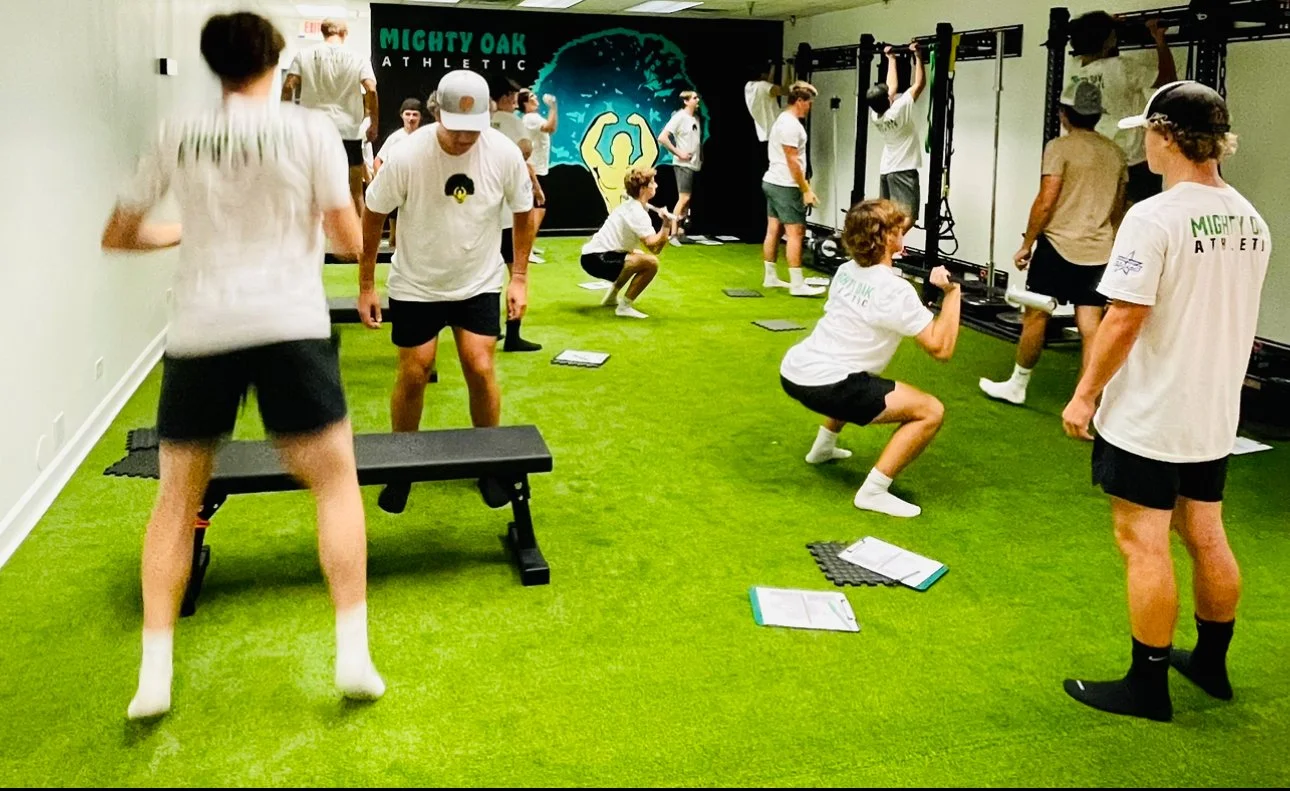
Built for Future Marines, Soldiers, Airmen, Sailors, and Cadets
CSCS-coached strength and conditioning for high school athletes, ROTC cadets, and service academy applicants preparing for the USMC IST and PFT, the Army Fitness Test (AFT), ROTC physical assessments, and the Service Academy Candidate Fitness Assessment (CFA).
Real barbells. Real kettlebells. Real coaching. Not an app, not a circuit class, not a chain gym pretending to be a strength program.

United States Marine Corps — IST, PFT, and CFT Prep
The Marine Corps doesn’t have a fitness test. It has three.
The Initial Strength Test (IST) is the gate at the Marine Corps Recruit Depot — pull-ups (or push-ups), plank, and a 1.5-mile run. Recruits take it on arrival at Parris Island or San Diego. Fail it and you head to the Physical Conditioning Platoon for remedial PT before recruit training can start.
The Physical Fitness Test (PFT) is the annual test every Marine takes — pull-ups or push-ups, plank, and a three-mile run. Testing window is January through June. PFT scores feed directly into composite score and factor into promotion.
The Combat Fitness Test (CFT) is the war-fighting test, on its own annual cycle from July through December — an 880-yard movement-to-contact in boots and utility uniform, an ammo-can lift (30-lb can, overhead, max reps in 2 minutes), and a 300-yard maneuver-under-fire course. Combat-coded MOSs (infantry, recon, combat engineer) carry higher load-bearing standards.
How we train future Marines at MOA
Our USMC Candidate Prep is a six-week cycle, run as two three-week phases. Each phase progresses 3x5 → 4x5 → 5x5 on five barbell lifts, with a different rotation in each phase.
Phase 1: Barbell lunge, barbell snatch, barbell bench, Australian row, rack carry.
Phase 2: Barbell squat, barbell clean, barbell press, barbell row, farmer carry.
Every session opens with a Tabata animal-crawl warm-up — leopard, crab, spider, spiderman — rotating :20 on / :10 off. Core block runs the same Tabata format on plank variations: walk low plank, side plank, rotational plank, bird-dog plank.
The point: a Marine candidate’s body learns to keep producing force under cardiovascular load. That’s what the PFT and CFT punish you for not having.
MOA target standards for USMC candidates:
20 pull-ups in a row
85 push-ups in 2 minutes
4-minute plank hold
120 reps of 35-lb ammo can overhead in 2 minutes
Those aren’t the minimums to pass. The CFT ammo can is 30 lb — we train heavier. The point is to make the test comfortably below what the candidate can do.
United States Army — AFT and Basic Training Prep
The Army’s fitness test changed on June 1, 2025. The Army Combat Fitness Test (ACFT) was retired. The new test is the Army Fitness Test (AFT) — five scored events, 0–100 points each, 500 points maximum.
The five AFT events:
1. Three-rep max deadlift — 60-lb hex bar with plates loaded for max effort. Scored on weight moved.
2. Hand-release push-ups — chest to the floor, hands lift briefly to break contact, then push. Two minutes, max reps.
3. Sprint-drag-carry — 250 yards mixing a sprint, a sled drag, lateral shuffles, kettlebell carries, and a final sprint. Scored on time.
4. Plank — single sustained hold, replacing the old leg tuck. Scored on time.
5. Two-mile run — measured, flat course. Scored on time.
(The Standing Power Throw — the old ACFT event — is gone. RAND analysis flagged it as too injury-prone for the value it added.)
General standard: 60 points minimum per event, 300 total to pass.
Combat MOS standard: 60 minimum per event, 350 total, scored on a sex-neutral, age-normed scale. New scoring kicked in January 1, 2026 for active duty and takes effect June 1, 2026 for Reserve and National Guard. Applies to 21 combat military occupational specialties — infantry (11-series), combat engineer (12B), field artillery (13F), special forces (18-series), armor (19-series), and a handful of others.
How we train future Soldiers at MOA
Future Soldiers train alongside every other MOA athlete — same barbell foundation, same conditioning blocks — with extra emphasis on the AFT’s five events:
• Deadlift progression from the floor with grip work, programmed to peak on AFT day.
• Hand-release push-up volume. Real reps from chest, with the hand release on every rep.
• Sprint-drag-carry simulation. Sled drags, kettlebell carries, lateral shuffles, sprint intervals — the actual movement patterns the AFT scores.
• Two-mile pace work. Track repeats. Tempo runs at 2-mile target pace. Not just long slow miles.
• Plank past three minutes. Trained the way the test asks for it — single sustained hold, not 20-second sets.
For combat-MOS goals, the bar is 350, not 300. MOA programs to that higher standard so the test itself is well below what the candidate can hit.
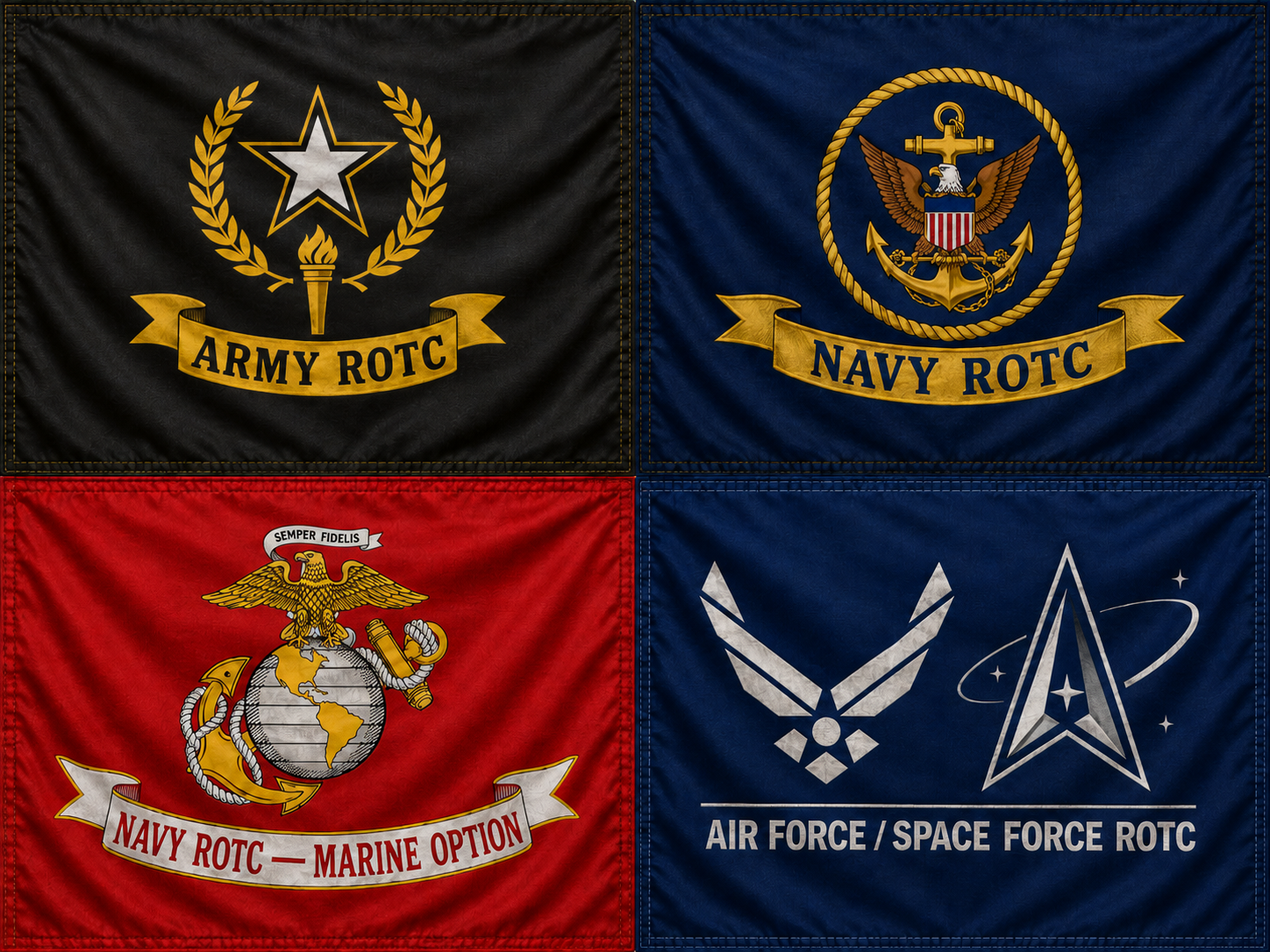
ROTC — Branch-Specific Physical Assessment Prep
ROTC cadets train for different tests depending on their branch.
• Army ROTC → Army Fitness Test (AFT). Same five events as the active-duty AFT (see Army section above). The test of record for cadets as of academic year 2025–2026.
• Navy ROTC (Navy option) → Navy Physical Readiness Test (PRT). Push-ups, forearm plank, and a 1.5-mile run (or approved cardio alternate: 500m swim, 2km row, or 12-minute bike). Moving to twice yearly in 2026.
• Navy ROTC (Marine option) → Marine Corps PFT. Pull-ups or push-ups, plank, three-mile run (see USMC section above). Marine-option midshipmen commission as Marine officers.
• Air Force / Space Force ROTC → Physical Fitness Readiness Assessment (PFRA, replacing the old PFA). Push-ups, sit-ups, and a two-mile run. The waist-measurement event was removed in the most recent overhaul.
The test changes by branch. The training doesn’t change as much as people think.
How we train ROTC cadets at MOA
Whether a cadet is preparing for an Army contract, a Navy option, a Marine option, or an Air Force/Space Force commission, the underlying work is the same: build an athlete who can deadlift, pull, push, plank, and run.
What changes is the emphasis cycle:
• Army contract cadets lean into hex-bar deadlift, sprint-drag-carry, hand-release push-ups, and the two-mile run.
• Navy option midshipmen lean into push-up volume, plank time, and 1.5-mile pace work.
• Marine option midshipmen lean into pull-up volume and three-mile pace work.
• Air Force / Space Force cadets lean into push-up form, sit-up endurance, and two-mile pace.
Cadets training at MOA include college-age cadets home for summer or breaks, plus cadets at Benedictine, North Central, and other local colleges who can commute to Westmont. Same membership. Same coaching.
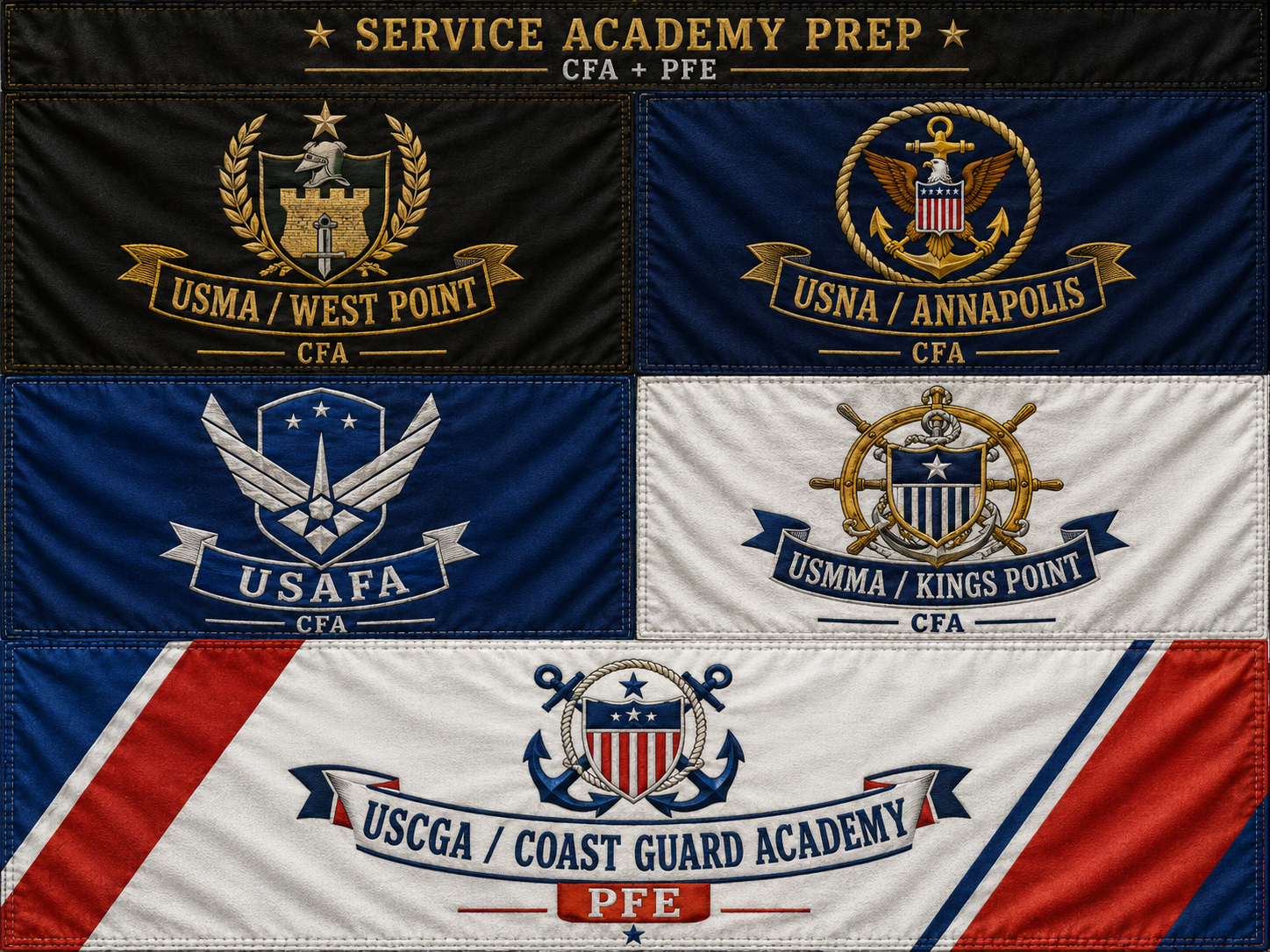
Service Academies — CFA and PFE Prep
Two different physical assessments, depending on which academy a kid applies to.
CFA — Four academies use this one
If a kid is applying to West Point (USMA), Annapolis (USNA), the Air Force Academy (USAFA), or Kings Point (USMMA), they’re taking the Candidate Fitness Assessment (CFA) as part of the application package.
The CFA is six events, in this order, with timed rest in between:
1. Basketball throw (kneeling) — power and accuracy with a med ball.
2. Cadence pull-ups for males, flexed-arm hang for females — upper body strength on a metronome cadence.
3. 40-yard shuttle run — agility and speed change.
4. Modified sit-ups — two-minute test.
5. Push-ups — two-minute test.
6. One-mile run — flat, timed.
A candidate takes one CFA and submits it to multiple academies — same score, multiple applications. The CFA is graded on a sliding scale, and competitive applicants don’t aim for the minimum. At West Point, the CFA is approximately 10% of the application — alongside SAT/ACT, GPA, congressional nomination, leadership record, and the rest of the file.
PFE — Coast Guard Academy is different
The U.S. Coast Guard Academy (USCGA) does not use the CFA. Coast Guard Academy applicants take the Physical Fitness Exam (PFE) — three events:
1. Cadence push-ups (2 minutes, one push-up every two seconds)
2. Sit-ups (2 minutes)
3. 1.5-mile run
USCGA cadets retake the PFE at the start of every semester. Dual applicants to USCGA and any CFA academy take both tests.
How we train Service Academy candidates at MOA
CFA prep at MOA layers event-specific work on top of the same barbell foundation every MOA athlete trains on.
For each CFA event, candidates train through specific progressions:
• Basketball throw. 4-lb and 6-lb med ball throws, right hand and left hand, multiple sets. Hip drive, follow-through, repetition.
• Cadence pull-ups / flex arm hang. Underhand, close overhand, wide overhand grip work. Weighted dead hangs, Australian rows in matching grip positions, weighted flex-arm holds. The flex hang is trained in :05 and :10 holds across multiple grip positions before going for time.
• Shuttle run. 10’-20’-30’-20’-10’ interval pattern. Plant-and-cut drills, deceleration work.
• Sit-ups. Dead bug, jack knife, flutter kicks, bird dog, and med ball twists at 20 reps each, then 5 sets of modified sit-ups at 15 reps. Endurance form, not max-effort sprint.
• Push-ups. J-Cup pyramid sets — 10x10, 8x8, 6x6 one cycle; 9x9, 7x7, 5x5 the next. Weighted T-push-ups, incline planks, down dog.
• One-mile run. Walk a quarter, jog a quarter, sprint a quarter, walk a quarter. Interval pace work that translates straight to a sub-6 mile.
MOA target standards for CFA candidates (male / female):
• Pull-ups / flex arm hang: 12 reps / :31 hold
• Shuttle run: 8.1 sec / 9.4 sec
• Sit-ups: 81 reps / 78 reps in 2 minutes
• Push-ups: 62 reps / 41 reps in 2 minutes
• One-mile run: 5:20 / 6:00
For Coast Guard Academy candidates, the work shifts — longer-duration push-up volume, sit-up endurance to match the 2-minute window, and 1.5-mile pace work instead of the 1-mile sprint pace the CFA asks for.
📩 Want the FREE CFA Prep Guide? Enter your email in the form above and we'll send it straight to your inbox — event-by-event training, target standards, and a sample training week.
We’ll send you a Candidate Fitness Assessment Prep Guide, event-by-event, plus a free 10-minute coaching call to talk through your kid’s timeline and admissions track.
Senior Military Colleges and Junior Colleges — Other Pathways
For families considering a military-style college experience outside the federal academies, two more paths exist.
Senior Military Colleges (6 schools):
• The Citadel — Charleston, SC
• Virginia Military Institute (VMI) — Lexington, VA
• Texas A&M University Corps of Cadets — College Station, TX
• Norwich University — Northfield, VT (the birthplace of ROTC)
• University of North Georgia — Dahlonega, GA
• Virginia Tech Corps of Cadets — Blacksburg, VA
SMC cadets contract through a standard ROTC branch — Army, Navy, Marine option, or Air Force/Space Force — so the fitness test depends on the contracted branch. See the ROTC section above for the prep details. Some SMCs add an internal physical assessment on top (the Citadel’s CPET, VMI’s VFT), administered at the school.
Military Junior Colleges (4 schools):
• Marion Military Institute (AL)
• New Mexico Military Institute (NM)
• Valley Forge Military Academy and College (PA)
• Georgia Military College (GA)
MJCs are two-year programs offering the Army’s Early Commissioning Program (ECP) — commission as a 2LT after the associate’s, then finish a bachelor’s while serving. ECP cadets take the Army Fitness Test (AFT).
How We Train at Mighty Oak Athletic

Every MOA session — youth strength, team, military prep — hits three things: a barbell, a kettlebell, and the athlete’s own bodyweight.
Barbell. Back squat, deadlift, overhead press, power clean from the floor, and floor rows. These five lifts build the foundation every future Marine, Soldier, Airman, Sailor, and Cadet needs.
Kettlebell. Goblet squats, swings, carries, presses. The athletic conditioning that shows up on a sprint-drag-carry, an ammo-can event, or a ruck.
Bodyweight. Chin-ups (banded if needed), push-ups, plank holds, glute bridges, flutter kicks. The stuff that builds an athlete who can move their own body — and someone else’s — under load.
No machines pretending to be training. No “boot camp” circuits choreographed for a workout video. Just the three modalities that build real strength and the conditioning to hold up at Parris Island, Fort Jackson, Lackland, or the gates of an academy.
Coach Mike — CSCS, Published Author, MOA Founder
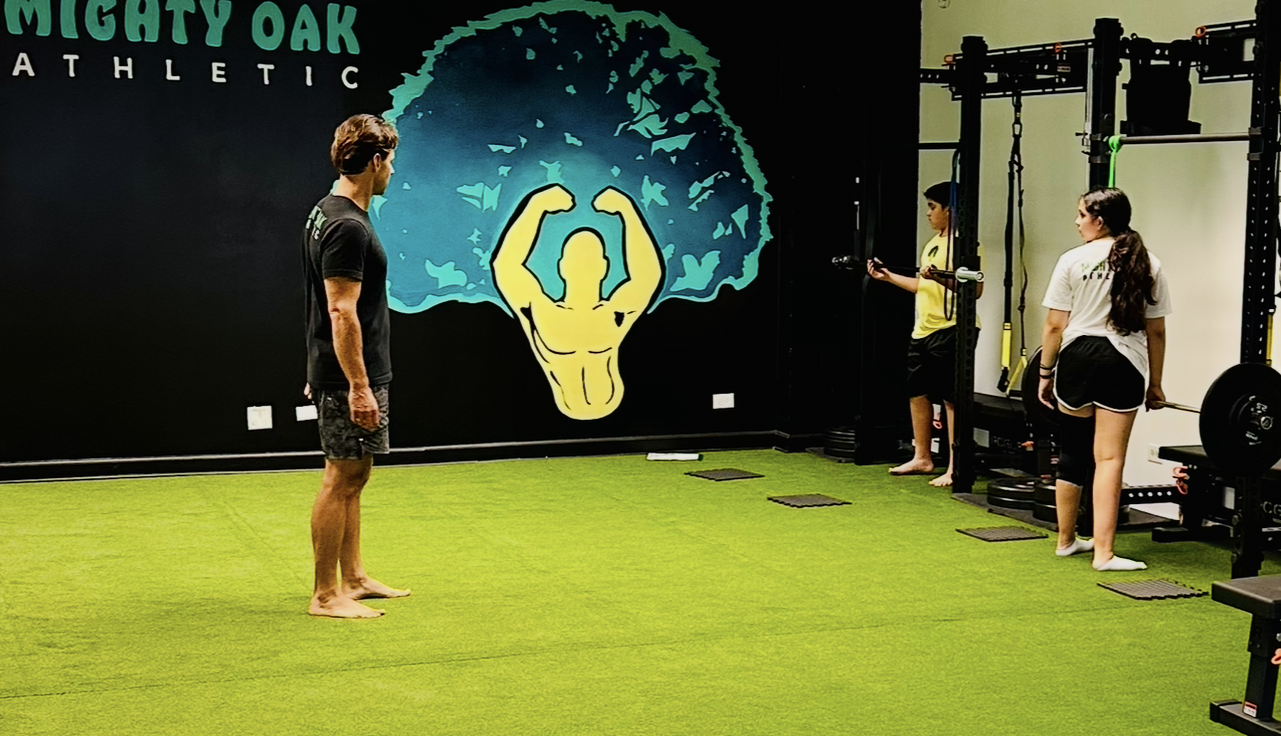
Mighty Oak Athletic is led by Michael Ockrim, a Certified Strength and Conditioning Specialist (CSCS) through the National Strength and Conditioning Association, with 13+ years of coaching kids and student athletes in DuPage County and the Chicago suburbs. He’s the author of Death Resistant, 13 Pounds in 30 Days, and Mighty Oak Athletic Nutrition, and a regular voice on the Mighty Oak Substack.
Every military prep session is CSCS-coached. Not by an app. Not by a college kid running a circuit class. By a coach who’s been programming for kids — and watching kids ship out — for over a decade.
Frequently Asked Questions
-
We work with high schoolers, ROTC cadets, and service academy applicants. Kids as young as middle school can start building the strength foundation that pays off years later — but most military prep work picks up real intensity in high school, when the test and ship dates are on the horizon.
-
It’s regular strength training with branch-specific programming emphasis. The Youth Strength and Agility membership ($199/month, unlimited sessions) covers it. We adjust the emphasis blocks — more pull-up volume for Marine candidates, more sprint-drag-carry for Soldiers, more shuttle work for academy candidates — without running a separate military track.
-
A lot, if the kid shows up. Eight weeks is enough to add 5–10 pull-ups, drop a minute off a 1.5-mile, and build the push-up and plank endurance the test asks for. It’s three or four sessions a week, every week, until ship date.
-
Yes. We work with cadets home for summer or breaks, and with cadets at Benedictine, North Central, or any of the local colleges who can commute to Westmont. Same membership. Same coaching.
-
The CFA isn’t a separate program — it’s the regular MOA training with focused work on the six CFA events as application season approaches. Most academy applicants train at MOA for years before they apply.
-
Yes — through our Army H2F unit training program. That’s a separate B2B offering for active-duty, National Guard, and Reserve units. Reach out at coach@mightyoakathletic.com for a unit quote.
-
6424 S. Cass Ave, Westmont, IL 60559. We’re a 5–15 minute drive from Hinsdale, Clarendon Hills, Downers Grove, Darien, Burr Ridge, Willowbrook, Oak Brook, Lemont, La Grange, Western Springs, Lisle, and Woodridge.
Come See the Place
