The 6 Movement Patterns That Fixed a Sore Pitching Arm and an Aching Knee
Mighty Oak Athletic Podcast S3:E80 - Jack’s Arm Hurt. Mia’s Knee Hurt. Here’s What Fixed Both.
By Michael Ockrim | Mighty Oak Athletic | Westmont, IL
Key Takeaways
Youth overuse injuries aren't bad luck — they're the predictable result of year-round specialization without foundational strength.
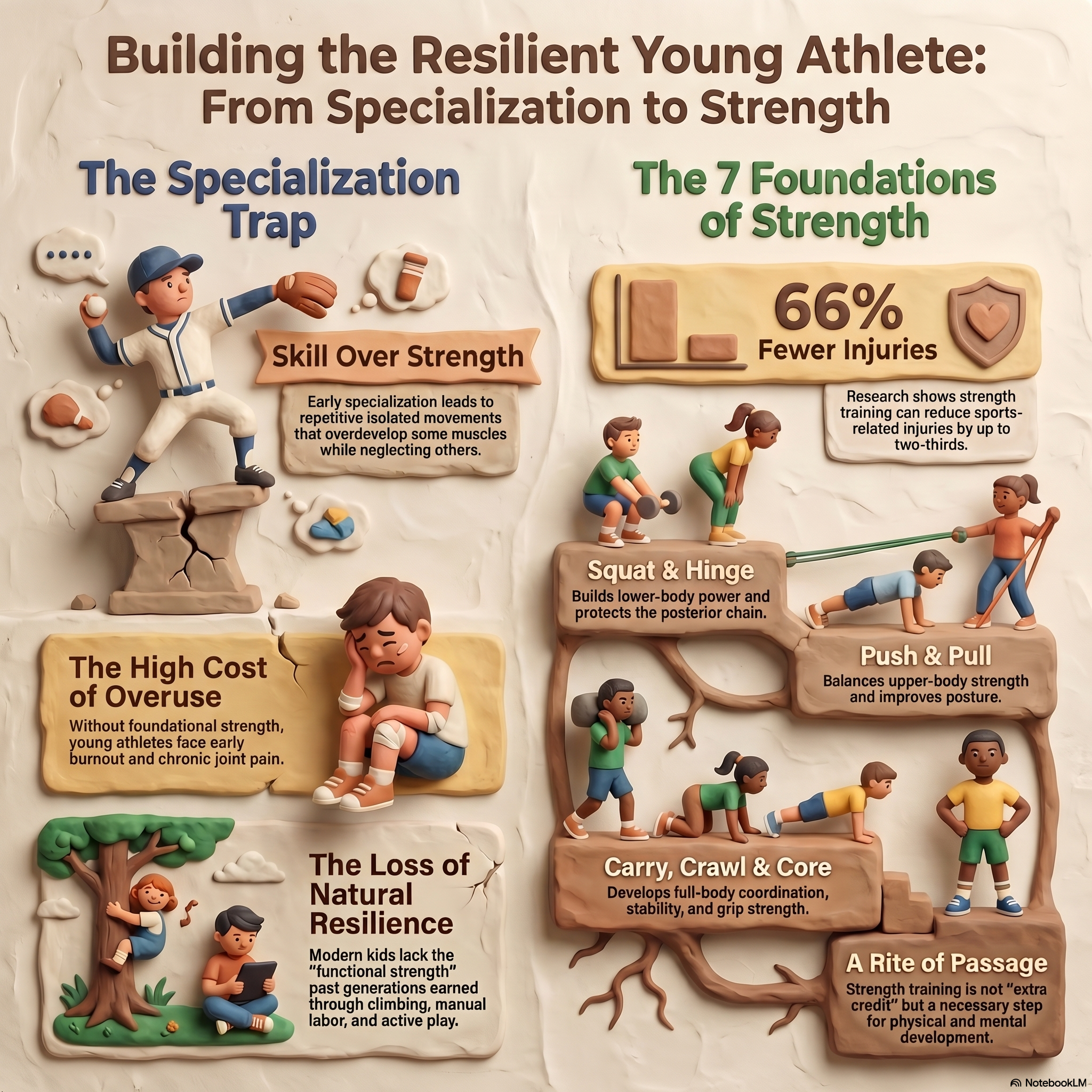
Research has found strength training can reduce sports injuries by up to two-thirds, and the American Academy of Pediatrics confirms it does not stunt growth.
Six movement patterns build a resilient young athlete: squat, hinge, push, pull, core stability, and carry.
Jack's sore pitching arm and Mia's aching soccer knee were both fixed the same way — by strengthening what their sports never train.
Mighty Oak Athletic coaches these patterns for athletes ages 6–18 in Westmont, IL. First session free.
There was a time when kids didn't have to be told to get strong.
Strength was part of life — climbing trees, hauling buckets, playing rough-and-tumble games that built real-world resilience. Before year-round organized sports, kids developed natural strength through play, manual labor, and daily movement.
Fast forward to today, and the landscape has shifted. Young athletes are more specialized than ever — yet physically weaker than past generations. Instead of well-rounded movement, they grind year-round in a single sport, repeating the same motions over and over. A 10-year-old pitcher throws thousands of reps but never strengthens his legs or back. A young soccer player sprints and cuts for hours but never builds the foundational strength to absorb impact.
The result? Injuries, burnout, and kids walking away from sports long before they reach their potential.
What if we reframed strength training — not as an optional extra — but as a rite of passage?
Where We Went Wrong
Jack is 10. He's a pitcher. A talented one. Spring, summer, and fall baseball. Winter in the cages. His dad tells me, "His velocity is down and his arm is always sore."
Jack has been playing more than ever. But he's getting weaker.
Mia is 11. She plays soccer year-round — outdoor leagues, indoor leagues, extra skills sessions. She's had knee pain for months, but no one wants her to take time off. "She's afraid she'll fall behind," her mom tells me.
Jack and Mia aren't unique. Across the country, kids are playing sports harder than ever while training their bodies less than ever. Their overuse injuries aren't random bad luck. They're the predictable result of a culture that prioritizes skill work over fundamental strength.
We wouldn't build a house on a cracked foundation. Yet we expect young athletes to perform at high levels without first fortifying their bodies.
The Strength That Used to Be Built Naturally
Our grandparents didn't need structured strength training because life made them strong. They walked everywhere, carried heavy loads, climbed, ran, and played hard. Their strength was functional — earned through necessity.
Today's kids train differently. Single-sport specialization has robbed them of natural movement variety. Instead of playing different games, running, climbing, and lifting, they spend their time in repetitive, isolated movements that overdevelop some muscles while neglecting others.
The science backs this up. Research has found that strength training can reduce sports injuries by up to two-thirds. The NSCA confirms that strength training improves movement mechanics and helps young athletes tolerate the demands of sport. The American Academy of Pediatrics is clear: there is no evidence that strength training stunts growth or harms development.
Strength training doesn't damage young athletes. It protects them.
The Movements Every Young Athlete Needs
Building a resilient young athlete doesn't require a complicated program. It requires mastering a handful of fundamental movement patterns — the same ones humans have used to build strong bodies for centuries.
Squat. The foundation of lower-body power. Before a young athlete ever touches a barbell, they need to own their squat. Hips back, chest up, knees tracking over toes. This single pattern builds the leg strength that makes
Hinge. The hip hinge — deadlifts, Romanian deadlifts — is the most neglected movement in youth training and the most important. The posterior chain (hamstrings, glutes, low back) is the engine of every sprint, jump, and change of direction. A weak posterior chain is an injury waiting to happen.
Push. Push-ups first, then overhead pressing once the body is ready. Upper body pressing builds the shoulder stability that protects young throwers, swimmers, and volleyball players from the chronic overuse injuries that end careers early.
Pull. Every push needs a pull. Rows — floor rows, barbell rows — build the back strength that balances all the forward motion in sports. This is the movement most young athletes are missing entirely.
Core Stability. Not crunches. True midsection control. Planks, hollow holds, and anti-rotation work teach a young athlete to transfer force efficiently and protect their spine under load.
Carry. Walking with weight builds grip strength, posture, and full-body resilience in a way that nothing else replicates. It's simple, low-tech, and brutally effective.
What Happened to Jack and Mia
Jack's program focused on posterior chain work and pulling movements — the exact opposites of what his throwing arm demanded all year. Within weeks, his arm felt stronger. His velocity came back.
Mia built single-leg strength and hip stability. Her knee pain disappeared.
Neither stopped playing their sport. They just got strong enough to handle it.
Mia's story is part of a bigger pattern: girls' ACL injuries are climbing faster than boys' — and most non-contact tears are preventable. If your daughter plays a cutting sport, read our complete plan: Soccer Parents: Ask Your Coach This One Question.
Strength Is a Rite of Passage
For centuries, strength wasn't about aesthetics. It was about functionality, resilience, and self-sufficiency. It proved you could handle what life threw at you.
We don't live in a world where physical capability is required for daily survival anymore. But that doesn't mean we should discard it. Strength still matters. And for young athletes, learning to build and use their strength is a lesson that reaches far beyond the playing field.
Strength teaches discipline. Progress isn't instant — it's earned through consistency.
Strength builds resilience. Fewer injuries, and a better ability to bounce back when setbacks come.
Strength develops mental toughness. Pushing through discomfort to accomplish something hard changes how a kid sees themselves.
This is why strength training isn't optional at Mighty Oak Athletic. It's the foundation — the thing everything else is built on.
Start Now
If your child is playing sports year-round, they need to be strength training. Not for bulk. Not for aesthetics. For longevity, performance, and durability.
The window to build this foundation doesn't stay open forever. Every year of specialization without strength work is another year of compounding risk.
Jack still plays baseball. Mia still plays soccer. But now they have the strength to handle their sport — instead of being broken by it.
Every young athlete faces a choice: build strength now, or pay for its absence later.
Better to build it.
-
A sore pitching arm in a young athlete is usually an overuse pattern: thousands of throwing reps that overdevelop the front of the body while the posterior chain, upper back, and pulling muscles that decelerate the arm stay untrained. Strengthening those neglected areas — rows, hinges, and core work — typically resolves the soreness without giving up baseball. Persistent pain should always be evaluated by a physician.
-
Yes. Research has found strength training can reduce sports injuries by up to two-thirds, and the National Strength and Conditioning Association confirms it improves movement mechanics and helps young athletes tolerate the demands of their sport. It works by building the strength to produce and absorb force that repetitive sport practice never develops.
-
No. The American Academy of Pediatrics states there is no evidence that properly supervised strength training stunts growth or harms development in children and adolescents. The greater risk to a young athlete is year-round sport specialization without the strength foundation to handle it.
-
Six fundamental patterns: squat (lower-body power), hinge (the posterior chain behind every sprint and jump), push (push-ups progressing to overhead pressing), pull (rows to balance sport's forward motions), core stability (planks and anti-rotation work, not crunches), and carry (loaded walking for grip, posture, and resilience).
Start today. If you're near Westmont, Hinsdale, Clarendon Hills, Darien, or anywhere in DuPage County, book a free training session and we'll assess exactly which patterns your athlete is missing. Training at home? The free off-season baseball strength program builds every pattern in this essay with zero equipment, and our exercise video library demonstrates the movements.