Mighty Oak Athletic Podcast S3:E93 - Stop Raising Harmless Kids — Strength Is What Makes Kindness Real
Key Takeaways
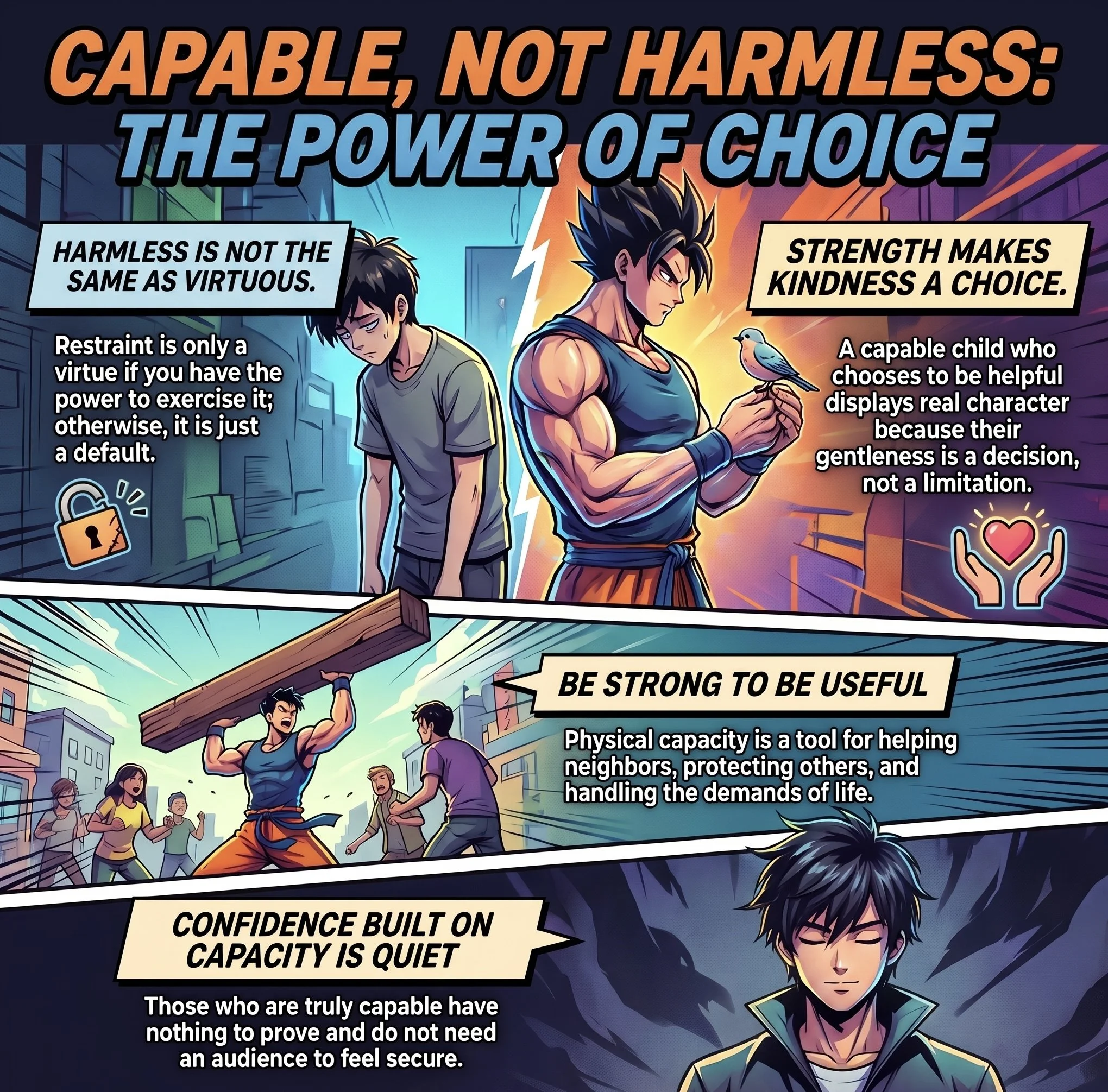
Harmless is not the same as good — restraint only counts as virtue when a kid actually has strength to restrain
Kindness means more when it's a choice, not a limitation
Capable kids get quieter, not louder — real confidence doesn't need an audience
MOA trains kids to be capable, not aggressive: strong to be useful
Raising Kids Who Are Strong AND Good
There’s an old proverb: those who have swords and know how to use them — but keep them sheathed — will inherit the world.
Strip away the sword imagery and there’s a lesson in there that every parent should hear, because it’s the exact opposite of how our culture often talks to kids about strength.
Harmless is not the same as good
Somewhere along the way, we started confusing harmless with virtuous. A kid who never pushes back, never takes up space, never tests their limits gets labeled “good.” But think about what that label is actually rewarding. If a child is incapable of standing up for themselves — physically, socially, emotionally — then their quietness isn’t a choice. It’s a default. There’s no character in a restraint you never had to exercise.
Now flip it. A kid who is strong, fast, and confident — and who chooses to be kind, to include the smaller kid, to help carry the groceries, to walk away from the dumb confrontation — that kid is displaying real virtue. Their gentleness means something because it’s a decision, not a limitation.
That’s the heart of it: self-control is only a virtue if there’s something to control.
What this looks like in the gym
At Mighty Oak Athletic, we don’t train kids to be tough for toughness’ sake, and we certainly don’t train them to be aggressive. We train them to be capable. There’s a difference, and kids feel it immediately.
A 10-year-old who can deadlift with clean form, carry a heavy kettlebell across the gym, and climb without fear carries himself differently at school. Not louder — usually quieter, actually. Capable kids have nothing to prove. The kids who posture and push are almost always the ones who feel weak underneath. Confidence built on real capacity doesn’t need an audience.
We say it all the time because it’s the foundation of everything we do: be strong to be useful. Strength isn’t for dominating anyone. It’s so you can shovel the neighbor’s driveway, carry your own backpack, protect a younger sibling, and someday lift your own kids overhead without your back giving out. Usefulness is the point. Strength is the tool.
What to discuss with your kiddo
If they ever ask why they train, keep it simple: “So you never have to be afraid — and so being kind is always your choice.” The rest they’ll figure out under the bar.
The world doesn’t need more harmless kids. It needs more capable ones who choose to be good. That’s what we build at Mighty Oak Athletic — one rep, one sheathed sword, at a time.
Mighty Oak Athletic trains athletes ages 6–18 in Westmont, Illinois, using barbells, kettlebells, and bodyweight movement in every session, coached by a Certified Strength and Conditioning Specialist. Schedule a free trial session at mightyoakathletic.com.
-
No. Research and coaching experience show the opposite: structured strength training teaches self-control, patience, and discipline. At Mighty Oak Athletic, kids learn to never load a bar past what they can control — thousands of small reps of governing their own power.
-
It's the Mighty Oak Athletic training philosophy, rooted in physical educator Georges Hébert's motto. Strength exists to serve others — carrying, helping, protecting — not to dominate. We train capability, not aggression.
-
MOA trains athletes ages 6–18 in Westmont, Illinois, using barbells, kettlebells, and bodyweight movement scaled to each child's development, coached by a Certified Strength and Conditioning Specialist (CSCS).
-
Confidence built on real capability doesn't need an audience. Kids who can lift, carry, and climb with competence carry themselves with quiet assurance at school — they have nothing to prove.