By Coach Mike Ockrim, CSCS, USA Weightlifting Level 1 Coach
Founder, Mighty Oak Athletic • Founder, Sunday Funday Sports • Author of Death Resistant, 13 Pounds in 30 Days, and Mighty Oak Athletic Nutrition
🏐 Key Takeaways
Volleyball is a jumping and landing sport — and research shows most serious lower-body injuries happen on the landing, not the takeoff.
The fix isn't more volleyball. It's strength and landing skill built off the court, where you can slow things down and coach them right.
MOA builds young players around four movement patterns — squat, hinge, press, and pull — using barbell, kettlebell, and bodyweight work every session. The "press" is overhead, which is exactly how a player serves and spikes.
The American Academy of Pediatrics says kids as young as 5 can build strength with moves like one-legged hops and jumps. MOA starts kids at age 6.
You can start at home today with the 20-minute "Jump & Land" workout below: jump squats, lateral bounds, broad jumps, and single-leg balance.
The 20-Minute "Jump & Land" Workout (At Home)
No equipment needed. This bodyweight session trains the takeoff and the landing, which is the part most kids never practice. Move with control. A quiet, soft landing beats a high jump every time.
Bodyweight Squats — 2 rounds of 12 (warm up the jump)
Broad Jumps — 3 rounds of 5, sticking each landing for 2 seconds (power out, land soft)
Lateral Bounds — 3 rounds of 6 per side, pausing on each landing (side-to-side control for the net)
Jump Squats — 3 rounds of 6, landing quiet and bending the knees and hips (the volleyball motion)
Single-Leg Balance — 3 rounds of 20 seconds per leg (the foundation of a safe one-leg landing)
Glute Bridges — 3 rounds of 12 (wake up the hips that absorb the load)
The rule for every jump: land like a ninja. Soft, balanced, hips back. Do this twice a week and your player will jump higher and land safer.
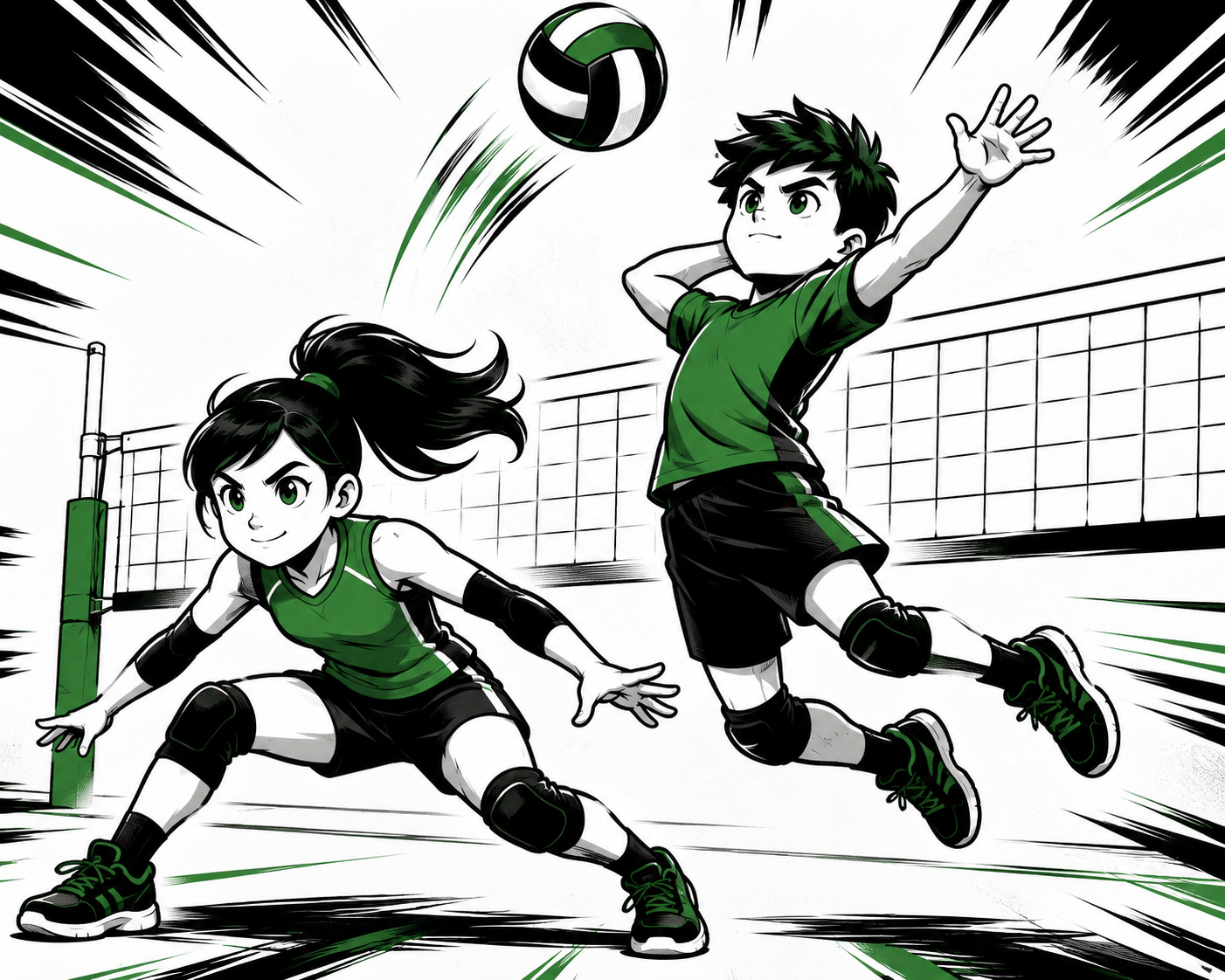
A good volleyball player jumps a lot. Serve, block, spike, repeat — a single match can mean dozens and dozens of explosive jumps, each one ending in a hard landing. Now multiply that across a club season. That's a huge amount of force traveling through a young athlete's knees and ankles, over and over.
Here's what most parents don't realize: the strength that protects your young volleyball player isn't built on the court. It's built off it. More reps at practice won't fix a shaky landing. Slowing down and teaching the body how to absorb force will. That's what we do at Mighty Oak Athletic in Westmont.
What the Research Says
Volleyball is "non-contact," but the loads are anything but gentle. The constant jumping and landing — especially on spikes — puts heavy, repeated stress on the lower body, and that's where most volleyball injuries show up. The two big ones are ankle sprains and knee injuries, and the serious knee injuries tend to happen during landings, often when a player comes down off-balance or on one leg.
The good news is that landing well is a skill — and skills can be taught. Studies comparing experienced and beginner players found that the experienced ones simply land in safer positions. Even better, research on young athletes shows that strength and neuromuscular training programs measurably reduce lower-body injury risk, including the scary knee injuries. In plain terms: a stronger, better-coordinated athlete who has practiced landing is a safer athlete.
And before anyone worries that strength training is too much for a young body — it isn't. The American Academy of Pediatrics, in its 2020 clinical report (reaffirmed in November 2024), says well-designed resistance training has no shown negative effect on kids' growth plates, height, or heart health. It even points out that children as young as 5 can build strength with simple moves like one-legged hops and jumps. That's not a coincidence — those are landing drills.
The Four Patterns for Volleyball
At MOA, every athlete trains the four movement patterns that build real athletic performance: squat, hinge, press, and pull. For a volleyball player, each one has a clear job.
Squat builds the legs that drive every jump. A higher, more powerful vertical starts here.
Hinge teaches the hips to load and absorb force — the exact motion of a soft, safe landing. This is the most under-trained pattern in most young players, and the most important for protecting knees.
Press at MOA is an overhead press. It builds the shoulder strength and stability a player uses on every serve and spike, and research shows shoulder strength work lowers injury risk from all that repetitive overhead action.
Pull balances out all that pressing and keeps the shoulders healthy for the long haul.
We coach these with barbell, kettlebell, and bodyweight, all three, every session — light and clean first, heavier only when a kid earns it.
Recovery, Movement, Nutrition
Strength is just one piece. Our Death Resistant framework runs on three circles: Recovery, Movement, and Nutrition. A young player who jumps all weekend but sleeps badly and eats junk is running on empty. Training is the Movement circle — but it only pays off when sleep and food back it up. That's the long game, and it's how you keep a player healthy across a whole season.
Why We Start at Age 6
Plenty of gyms make families wait until middle school. We don't. The AAP supports strength work for kids in the 5-to-7 window using bodyweight and light resistance — and the hops and jumps they recommend are the same landing skills a volleyball player needs anyway. We open the door at 6 because the science opens it at 5, and because every year a young athlete spends learning to move well is a year of advantage they keep for life.
Be Strong to Be Useful
A strong volleyball player isn't just a bigger threat at the net. They're a more durable athlete, a more confident kid, and someone whose body can handle whatever comes next — in sport and out of it. That's our whole philosophy at MOA: be strong to be useful.
Want to see what off-court training looks like for your young player? Book a free trial at Mighty Oak Athletic in Westmont and let's build a stronger, safer athlete — one clean landing at a time.
Coach Mike Ockrim is the founder of Mighty Oak Athletic in Westmont, IL. He is a Certified Strength and Conditioning Specialist (CSCS) through the National Strength and Conditioning Association, a USA Weightlifting Level 1 Coach, and a USA Taekwondo Coach holding a 2nd-degree black belt. He has over 30 years of personal training experience and has taught group fitness at Life Time Fitness for more than 8 years. He is the author of three books: Death Resistant, 13 Pounds in 30 Days, and Mighty Oak Athletic Nutrition. MOA serves families in Westmont, Hinsdale, Clarendon Hills, Downers Grove, Darien, Burr Ridge, Oak Brook, Willowbrook, Lisle, Woodridge, La Grange, Western Springs, and the surrounding western Chicago suburbs.