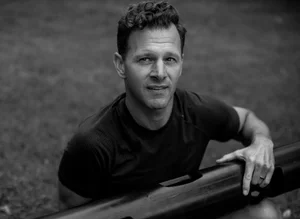
By Coach Mike Ockrim, CSCS, USA Weightlifting Level 1 Coach
Founder, Mighty Oak Athletic • Founder, Sunday Funday Sports • Author of Death Resistant, 13 Pounds in 30 Days, and Mighty Oak Athletic Nutrition
🏛️ Key Takeaways
People have been getting strong by lifting heavy things for thousands of years — ancient Greeks and Egyptians lifted stones to build and prove their strength.
The core idea — lift a little more over time — is captured in the famous legend of the wrestler Milo of Croton. It's a legend, but it points at a real principle: progressive overload.
That idea only became real science in the 1940s, when an American doctor used resistance training to rehabilitate wounded soldiers faster.
Today the American Academy of Pediatrics confirms strength training is safe and good for kids, with children as young as 5 able to build strength.
MOA uses this time-tested principle the modern, safe way — four movement patterns, starting at age 6.
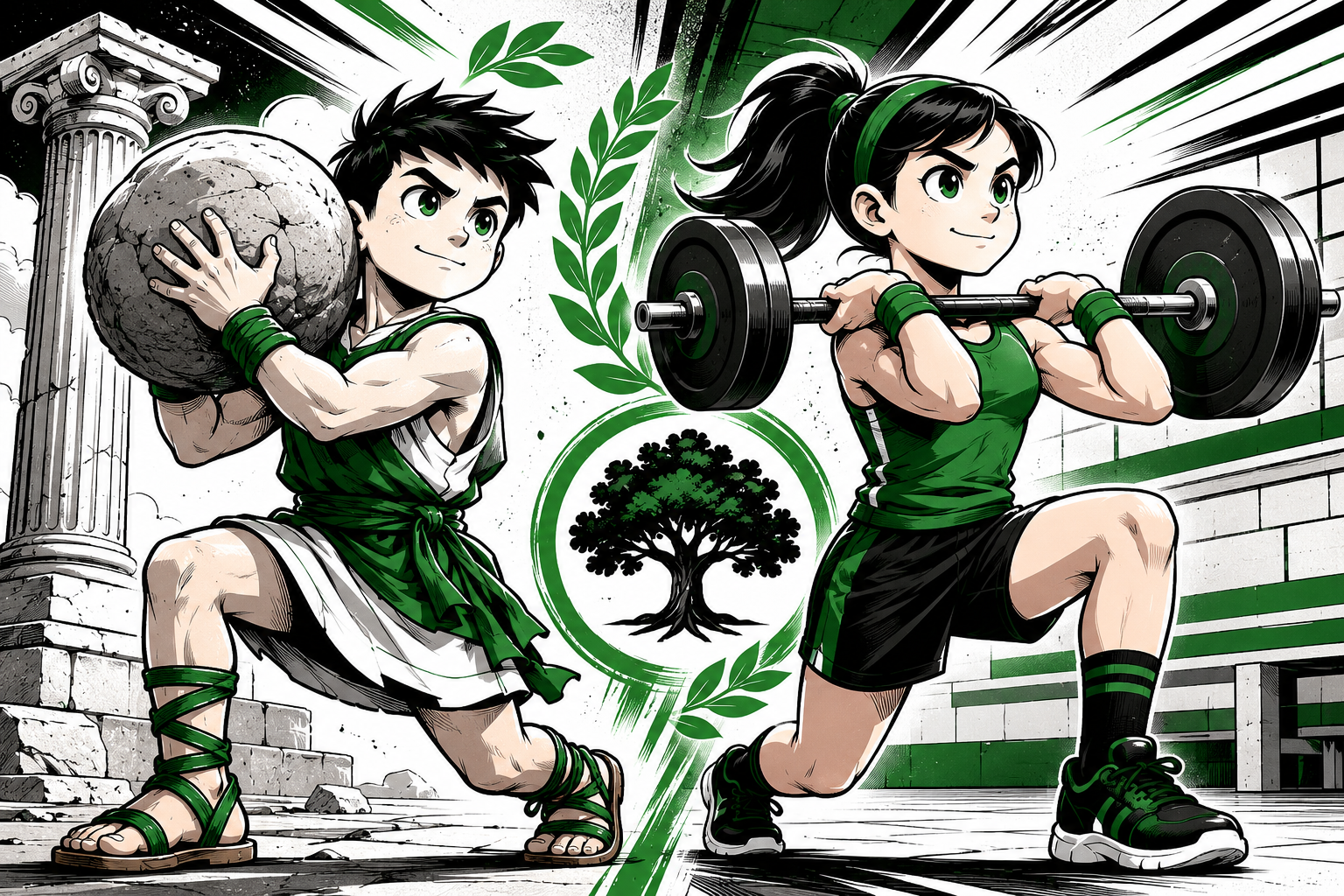
Long before there were gyms, dumbbells, or fitness apps, people figured out a simple truth: if you want to get strong, you pick up heavy things and you keep doing it. That idea is thousands of years old. The science behind it is surprisingly new. And at Mighty Oak Athletic in Westmont, we use both.
So how did we get from ancient strongmen to a safe, smart way to train a 6-year-old? It's a better story than you'd think.
The Ancient Roots
Strength training is about as old as civilization. Ancient Greeks and Egyptians lifted heavy stones to build their bodies and prove their power. Lifting wasn't a hobby — it was how you got useful, on the farm and on the battlefield.
The most famous strength story of all comes from ancient Greece: the wrestler Milo of Croton. Milo was real — a champion wrestler from the late 500s BC who won at the Olympic Games many times over. As the legend goes, young Milo lifted a newborn calf onto his shoulders and carried it. He did it again the next day, and every day after. As the calf grew heavier, Milo grew stronger, until one day he was carrying a full-grown bull.
Now, historians treat the bull story as legend, not a documented workout plan — the old writers told it to show off Milo's freakish strength, not to teach a method. But it captures something true and timeless: get a little stronger by lifting a little more, a little at a time. Coaches today call that progressive overload. It's the single most important principle in all of strength training.
When the Idea Became Science
For most of history, that principle was just folk wisdom. The sport of weightlifting got organized in the late 1800s — it was one of the very first sports in the first modern Olympic Games in Athens in 1896, and it became a permanent Olympic sport by 1920. But organized lifting and proven training science aren't the same thing.
The real turning point came in the 1940s. During World War II, hospitals were overwhelmed with wounded soldiers and short on beds. A doctor named Thomas DeLorme used heavy resistance exercise to rehabilitate those soldiers faster than anyone expected. In 1951, he and Dr. Arthur Watkins published their method — what we now call progressive resistance exercise. For the first time, the ancient idea behind the Milo legend had real numbers, real sets, and real proof behind it.
That's the leap: from a story about a man and a bull, to a measurable method a coach can use with anyone — including a kid.
What the Research Says Today
Here's where it gets relevant to your family. For years, parents worried that lifting might stunt a child's growth. The science says otherwise. The American Academy of Pediatrics, in its 2020 clinical report (reaffirmed in November 2024), found that well-designed resistance training has no shown negative effect on kids' growth plates, height, or heart health. It even notes that children as young as 5 can build strength with simple moves like hops and jumps.
In other words, the oldest idea in fitness is now one of the best-studied — and it's been given the green light for young athletes.
How We Use It at MOA
This is exactly how we train at Mighty Oak Athletic, and why we start kids at age 6. We take that 2,500-year-old principle and apply it the modern, safe way.
Every young athlete trains the four movement patterns that build real athletic performance: squat, hinge, press, and pull. We coach them with barbell, kettlebell, and bodyweight — all three, every session. And we apply progressive overload the smart way: master the movement first, add load only when a kid earns it, in small steps.
Progressive overload at home is simple, too. A child who can do 5 clean push-ups this month aims for 6 or 7 next month. A kid holding a plank for 20 seconds works toward 30. Same principle Milo's legend points at — just safe, gradual, and coached. (For the full ancient-to-modern angle, see our companion piece on how to train like a Roman warrior.)
It all lives inside our Death Resistant framework — Recovery, Movement, and Nutrition — because strength only sticks when sleep and food back it up.
Be Strong to Be Useful
The ancient Greeks didn't lift to look good in a mirror. They lifted to be capable — to carry the load and do the job. That's our whole philosophy at MOA: be strong to be useful. The tools have changed in 2,500 years. The goal hasn't.
Want to see the oldest idea in strength applied to your young athlete the modern way? Book a free trial at Mighty Oak Athletic in Westmont and let's build a strong, useful kid — one small step at a time.
Coach Mike Ockrim is the founder of Mighty Oak Athletic in Westmont, IL. He is a Certified Strength and Conditioning Specialist (CSCS) through the National Strength and Conditioning Association, a USA Weightlifting Level 1 Coach, and a USA Taekwondo Coach holding a 2nd-degree black belt. He has over 30 years of personal training experience and has taught group fitness at Life Time Fitness for more than 8 years. He is the author of three books: Death Resistant, 13 Pounds in 30 Days, and Mighty Oak Athletic Nutrition. MOA serves families in Westmont, Hinsdale, Clarendon Hills, Downers Grove, Darien, Burr Ridge, Oak Brook, Willowbrook, Lisle, Woodridge, La Grange, Western Springs, and the surrounding western Chicago suburbs.