Why We Make Six-Year-Olds Do Hard Things on Purpose
Mighty Oak Athletic Podcast S3:E89 - Why We Make Six-Year-Olds Do Hard Things on Purpose: Kids Need Struggle to Grow Strong
There’s a worry running through every honest conversation about the next generation, and it goes something like this: when a machine can hand a kid the answer before they’ve even finished asking the question, the kid never has to do the reaching. And the reaching was the whole point. The part of the mind that wrestles, that sits in the discomfort of not-knowing, that pushes through a hard problem and comes out the other side proud — that part only stays sharp if it gets used. Take the effort away and it quietly fades.
That’s not a metaphor for atrophy. That is atrophy.
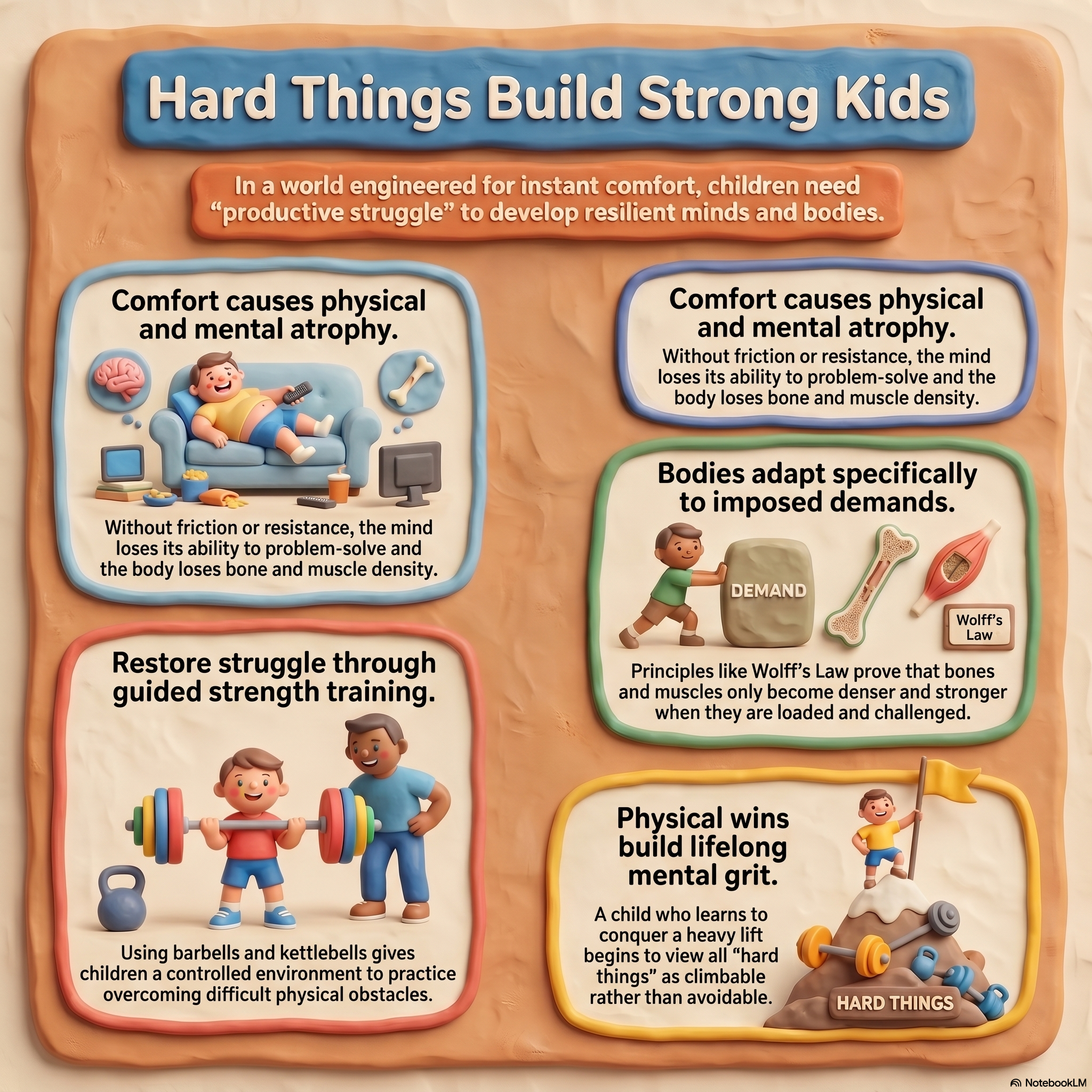
And here’s the part most people miss: the exact same thing is happening to kids’ bodies, for the exact same reason.
Learning and lifting run on the same engine
Real growth — the kind that sticks — requires friction. The mind only develops by struggling against problems it can’t immediately solve. The reward shows up after the effort, not before it, and a kid who never feels the effort never learns to go looking for what’s waiting on the other side. They never get the specific, honest pride of having made something hard with their own two hands.
Your child’s body works on an identical principle. Muscle, bone, tendon, and the nervous system that coordinates all three only grow stronger when something demands more of them than they’re comfortable giving. Physiologists call it the SAID principle — Specific Adaptation to Imposed Demands. In plain English: the body changes in response to what you make it do. Lift something challenging, and it builds the tissue to handle it next time. Wolff’s Law says the same about bone: load it, and it lays down density to meet the load.
Take the demand away and the process reverses. We have brutal proof of this. Put a healthy adult on a few weeks of bed rest and they lose measurable muscle and bone. Send an astronaut into the weightlessness of orbit — the ultimate friction-free environment — and their skeleton starts thinning so fast that exercise becomes non-negotiable just to come home walking. No resistance, no reason to adapt. Comfort isn’t neutral. Comfort is a slow leak.
A generation engineered for ease
Now look at the world we’ve built for our kids. Screens that entertain without asking for anything back. A device in their pocket that answers any question before the thought is fully formed. Recess shortened, PE cut, free play swapped for structured screen time. We have, with the best of intentions, sanded the friction out of childhood.
The worry for the mind — that a kid raised on instant answers never learns the pride of producing something original — has a physical twin. A kid raised on instant comfort never finds out what their own body is capable of. They never feel the satisfaction of doing something genuinely hard with their back and their legs and discovering they were stronger than they thought.
That feeling isn’t a luxury. It’s how a human being learns they can do hard things at all.
Strength training is the friction we put back
This is the entire reason Mighty Oak Athletic exists, and it’s why we start kids as young as six. We are not in the business of making them tired. We are in the business of giving back the productive struggle a frictionless world quietly stole.
Every session a kid trains with us touches a barbell, a kettlebell, and their own bodyweight. That’s deliberate. Each one teaches the body a different kind of climb — loading a bar, controlling a swinging weight, owning the space their own body moves through. None of it is easy. All of it asks for something. And when a seven-year-old finishes a set they didn’t think they had in them, you can watch the lesson land on their face: the hard part was the point.
The physical payoff is real and well-documented. Properly coached, supervised resistance training builds the bone density, joint stability, coordination, and tissue resilience that reduce a young athlete’s injury risk for years to come. But the payoff that keeps parents coming back isn’t the deadlift numbers. It’s the kid who starts treating hard things as climbable instead of avoidable — at the gym, then at the desk, then everywhere.
This is the core of our Death Resistant philosophy. It starts with Recovery, runs through Movement, and is fed by Nutrition — but underneath all of it is one stubborn truth the modern world keeps trying to talk us out of: things that don’t get challenged don’t get stronger. Not minds. Not muscles. Not kids.
You can’t outsource the climb. But you can make sure your kid still gets to make it.
-
Yes. When it's properly coached and supervised, resistance training is safe for children and is associated with stronger bones, better coordination and joint stability, and reduced injury risk in young athletes. The risk comes from poor supervision and bad technique, not from the training itself.
-
Mighty Oak Athletic starts kids at age six. The early focus is on movement quality and learning to handle load through a barbell, kettlebell, and bodyweight — not on lifting maximal weight.
-
The body only adapts in response to demand — a principle called Specific Adaptation to Imposed Demands (SAID). Muscle, bone, and the nervous system grow stronger when challenged and weaken when they aren't. Comfort and inactivity lead to loss of strength and bone density, which is why deliberate, productive challenge matters for a growing child.
-
Productive struggle is meaningful effort against a challenge a child can eventually overcome. It's how kids learn — both academically and physically — that they're capable of doing hard things. Strength training is one of the clearest, most measurable ways to give a child that experience.