Key Takeaways
The best bodyweight exercises for teenagers are squats, push-ups, toe touches, bird dogs, shoulder taps, squat jumps, jump lunges and skater jumps.
Federal guidelines say ages 6 to 17 should do muscle-strengthening activity at least three days a week. Push-ups count.
Organize the week into a strength day, a power day and a conditioning day, with a rest day between sessions.
Land quietly on every jump. A quiet landing means the legs absorbed the force the right way.
To make bodyweight exercises harder, slow down, add a pause or add a set. Move on when every rep looks the same.
Free download: The Mighty Oak At-Home Athlete Program, a no-equipment training plan with a video for every exercise.
A teenager doesn't need a gym membership to get strong. A floor, about 25 minutes, and a plan that gets followed three days a week will do it. Some of the best training habits I know of started in a bedroom or a basement with no equipment at all.
Short answer: the best bodyweight exercises for teenagers are squats, push-ups, toe touches, bird dogs, shoulder taps, squat jumps, jump lunges, and side-to-side skater jumps. Together they cover strength, core control, and power. Put them on a schedule and they work.
The research backs this up. Federal physical activity guidelines say kids and teens ages 6 to 17 should do muscle-strengthening activity at least three days a week, and the CDC lists push-ups as an example. The American Academy of Pediatrics, in its 2020 clinical report on resistance training, reaffirmed in 2024, says children of all ages can benefit with proper supervision and technique. Its lead author put it plainly: resistance training is much more than lifting weights. Bodyweight counts. When the report came out, the AAP noted that children as young as 5 can build strength with moves like one-legged hops and frog jumps. A teenager can do a great deal more than that.
Here is how I'd organize it. Think in three kinds of days.
A strength day is slow and controlled. Squats for three sets of 10 to 15. Push-ups for three sets of 6 to 15, from the knees if needed. Toe touches, which teach the hip hinge, for three slow sets of 10 with a flat back. Then bird dogs and shoulder taps for the core, where the whole job is keeping the hips still while the arms and legs move.
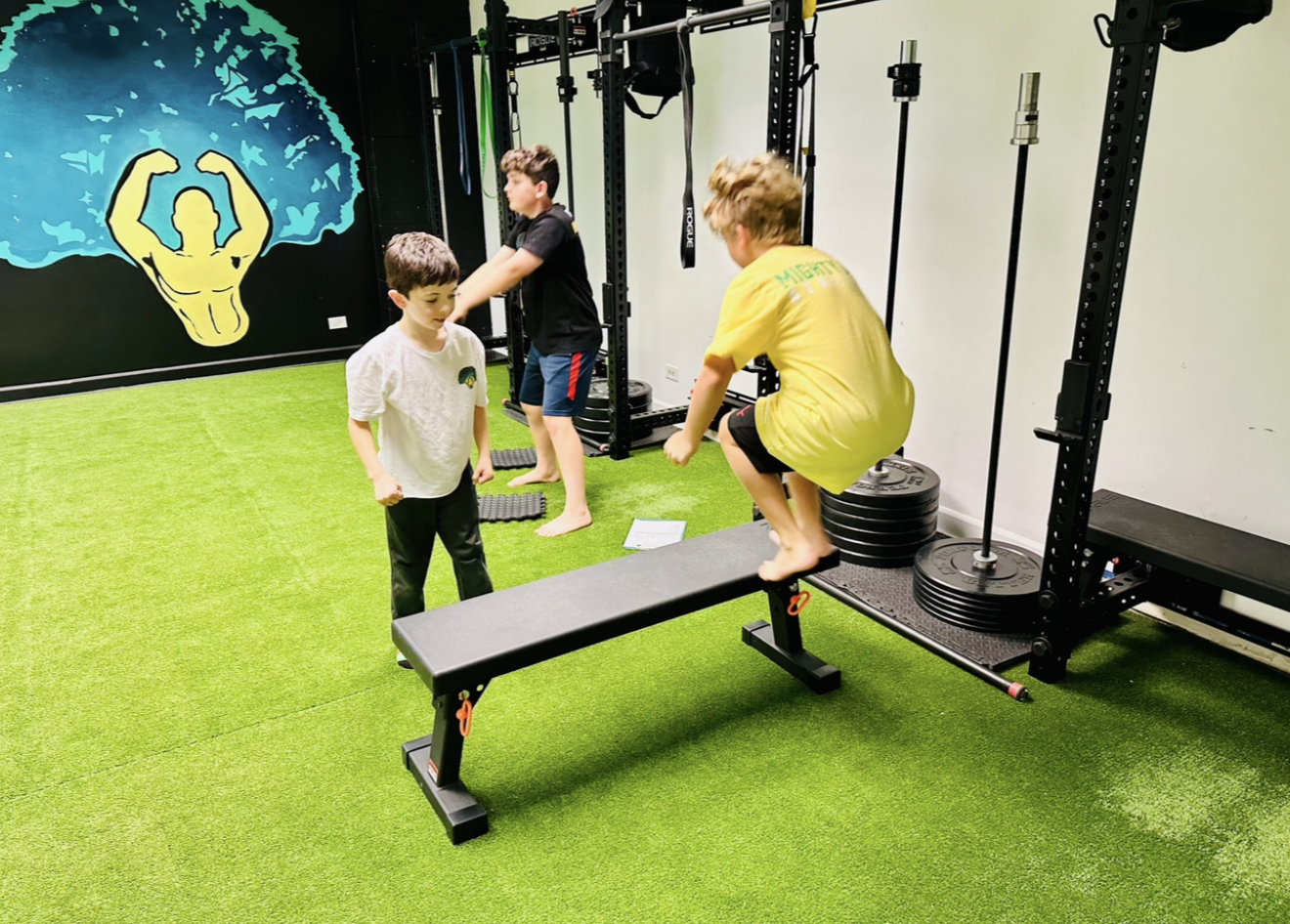
A power day is fast and crisp. Squat jumps for three sets of 5. Jump lunges for two sets of 4 per leg. Skater jumps for three sets of 5 per side. The rule on every jump is to land quietly. A quiet landing means the legs absorbed the force the way they should, and that habit carries straight into cutting, rebounding, and coming down from a block. Keep the reps low. Power training is about quality, so end each set while the jumps are still sharp.
A conditioning day ties it together. Pick five movements, work for 30 seconds, rest for 30 seconds, and go through the circuit three times. That's 15 minutes, and it will get a teenager's attention.
Put a rest day between sessions. Three days a week is plenty. Muscles get stronger during recovery, and a teenager who also plays a sport is already carrying a full load. During the season, two days is enough.
How do you make bodyweight exercises harder without adding weight? Slow down. Take three seconds to lower into a squat or a push-up and the same exercise becomes a different animal. Add a pause at the bottom. Add a set. Move from knee push-ups to full push-ups, then put the feet up on a step. I use one rule for progress: when every rep in a set looks identical from first to last, the athlete has earned the next step.
You can watch every one of these movements on our free exercise video page. There are 16 of them, grouped by mobility, conditioning, core, strength, and power, and each video is short enough to watch right before a set.
Where does this lead? In our gym, bodyweight is where everyone starts, including the six-year-olds. We start kids at 6 because movement is a skill, and skills take years of practice. A teenager who can squat, hinge, push, and land with control has built the foundation for the barbell and kettlebell work that comes next. Bodyweight training is the first chapter of lifting.
I put all of this into a free plan called the Mighty Oak At-Home Athlete Program. It lays out the warm-up, all three days, and a six-week tracking sheet, with a video demonstration for every one of the 16 movements. Enter your email and download it. No equipment, no cost.
And if you live in the western suburbs, come see what the next chapter looks like. Your teen's first coached session at our gym in Westmont is free.
Be strong to be useful.
— Coach Mike
Book a free first session: https://calendly.com/mightyoakathletic/youth-strength
Frequently Asked Questions
What are some good bodyweight exercises for teenagers?
Squats, push-ups, toe touches, bird dogs, shoulder taps, squat jumps, jump lunges and skater jumps. Together they train strength, core control and power with no equipment. Mighty Oak Athletic has a free video of each one at mightyoakathletic.com/exercises.
How many days a week should a teenager do bodyweight workouts?
Three days a week with a rest day between sessions. Federal physical activity guidelines recommend muscle-strengthening activity at least three days a week for ages 6 to 17. Teens in a sports season can drop to two days.
Can a teenager build muscle with bodyweight exercises?
Yes. Bodyweight exercises build strength when they are done with control and made harder over time. Slow the lowering phase to three seconds, add a pause at the bottom, add a set, or move to a harder version such as feet-elevated push-ups.
What is a good at-home workout for a 13 or 14 year old?
A simple three-day plan: a strength day (squats, push-ups, toe touches, bird dogs, shoulder taps), a power day (squat jumps, jump lunges, skater jumps) and a 15-minute conditioning circuit. The free Mighty Oak At-Home Athlete Program lays out all three days with videos.