Your Kid Has Access to Good Food. So Why Isn't He Eating It?
Mighty Oak Athletic Podcast S3:E102 - Your Kid Has Access to Good Food - So Why Isn’t He Eating It?
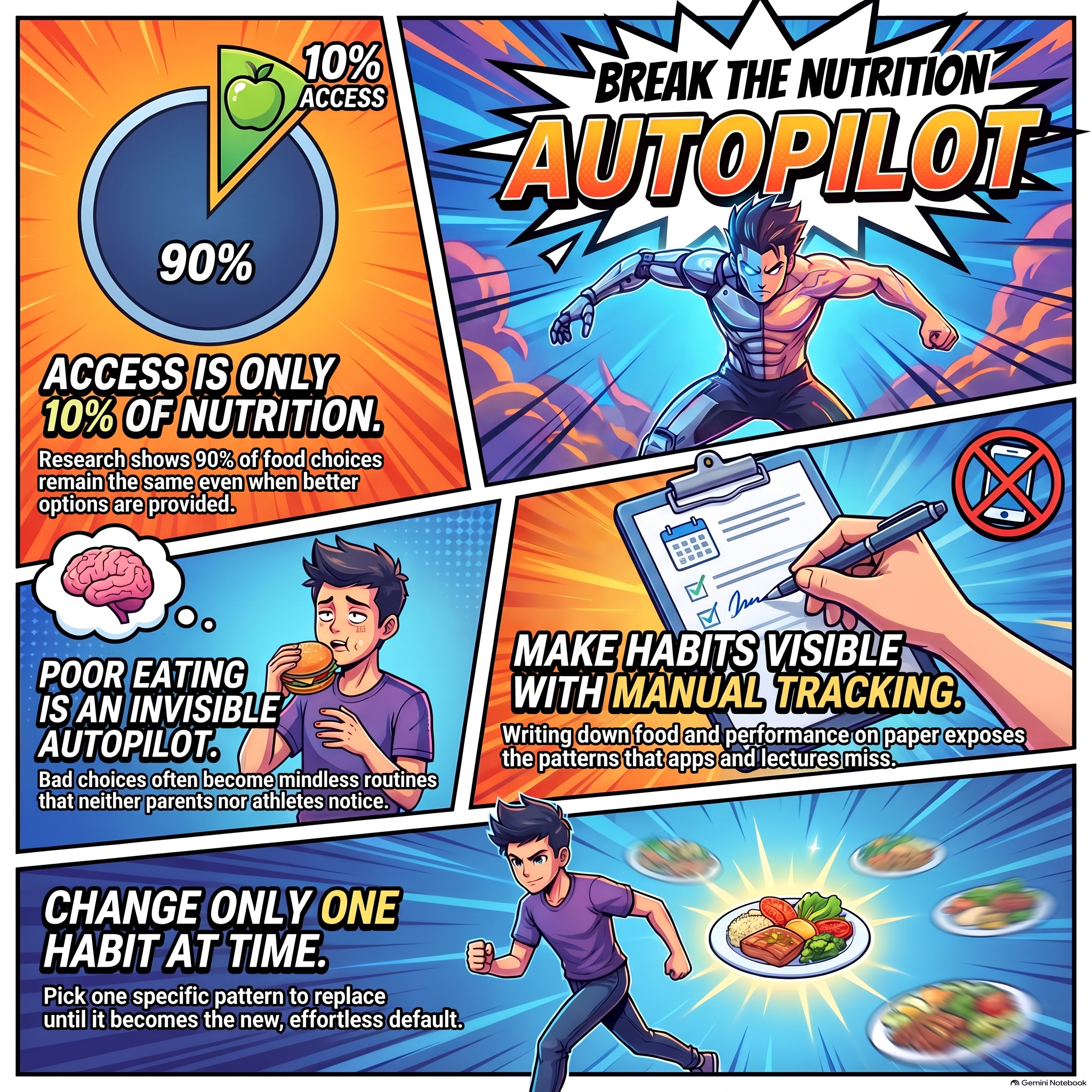
TL;DR: A landmark 2019 Quarterly Journal of Economics study found that giving families better access to healthy food closes only about 10% of the nutrition gap. The other 90% comes from what people choose to buy. Your kid's kitchen isn't the problem. The problem is the routine running on autopilot, and nobody can change a routine they can't see. That's the whole point of the MOA Nutrition book and journal: your athlete writes down what they ate, how they slept and how they performed every day, in their own handwriting. Within a week the pattern is on the page. Then Coach Mike reviews it with them in person and they pick one thing to change. Awareness first, then one better default at a time. Free for every MOA member.
The Fridge Isn't the Problem
Every parent I talk to at Mighty Oak Athletic wants their kid to eat better. And almost every one of them has a theory about why it isn't happening. The schedule. The drive-thru between practice and the game. The school lunch. The friend's house with the pantry full of junk. Notice what all of those theories have in common: they blame the environment. If the good food were just closer, easier, more available, the kid would eat it.
A group of economists put that theory to the test, and the answer should change how you think about your own kitchen. In 2019 the Quarterly Journal of Economics published a study by Hunt Allcott, Rebecca Diamond, Jean-Pierre Dubé and colleagues on food deserts. They tracked what tens of thousands of American households actually bought at the grocery store, then ran a simulation: what happens if you give lower-income families the exact same stores, products and prices that wealthy families enjoy?
Almost nothing. Closing the access gap shrank the nutrition gap by about ten percent. The other ninety percent came from what people chose to put in the cart. When new supermarkets opened in neighborhoods that had none, residents mostly changed where they shopped, not what they bought. The study is about adults, not kids and not athletes, and I don't want to stretch it further than it goes. But the principle underneath it is one I see in the gym every week. Not one athlete at MOA lives in a food desert. Every one of them has a kitchen with real food in it. And plenty of them are still running on chips, sports drinks and whatever's fastest after school.
Kids don't eat poorly because the better option doesn't exist. They eat poorly because the worse option is the one on repeat. The after-school snack that's been the same since second grade. The bottle of blue liquid at every game. The stop on the way home that started as a treat and became a routine. Nobody decided any of it. It just became the default, and here's the part that makes it hard to fix: nobody in the house can actually see it. Ask a twelve-year-old what he ate yesterday and you'll get a shrug. Ask his parents and you'll get a guess. A habit that runs on autopilot is invisible to the person running it.
That's why the MOA Nutrition program starts with a pen, not a meal plan. Every athlete gets the printed MOA Nutrition book, and the back half of it is a daily journal. Each day he writes down three things in his own handwriting: what he ate, how he slept and how he performed. No app to ignore, no notification to swipe away. It takes about two minutes. And within a week, something happens that no lecture from me could ever accomplish. The pattern shows up on the page. He sees the same snack five days in a row. He sees that the day he felt flat at practice was the day lunch was a bag of chips. He sees the sports drink he didn't think of as sugar. The autopilot becomes visible, and once a kid can see a habit, he owns it in a way he never did before.
The journal also becomes the agenda for our weekly review. Every member athlete sits down with me in person before a session and we go through the week together. I'm not grading it. I'm looking for the one pattern worth changing, and we pick one. Not five. Water instead of the blue stuff at games. A real breakfast on school days. Something in the bag for the drive home so the drive-thru never gets a vote. Then he writes that down too, and the next week we look at whether it held. That's how a new default gets built: one change, tracked on paper, repeated until it no longer requires a decision.
This works at a strength gym for a reason a health class can't replicate. A kid who has spent three months watching his squat go up already believes that small things done consistently add up. We just point that belief at the plate. And the parents are in on it, because the athlete doesn't buy the groceries. When the journal shows the pattern, the whole kitchen adjusts around it.
The study says ninety percent of how families eat comes down to choices. Choices you can't see are the hardest ones to change. So we make them visible, one page a day, and then we change them one at a time. The MOA Nutrition book and journal is free for every member, and I review it with your athlete every week. Bring him in for a free first session and let's put the first week on paper.
Be strong to be useful,
Coach Mike