Your Kid Doesn't Need You at Every Game - They Need to Watch You Try Something Hard
Mighty Oak Athletic Podcast S3:E103 - It’s okay to miss the game - What your kid actually learns from watching you
TL;DR
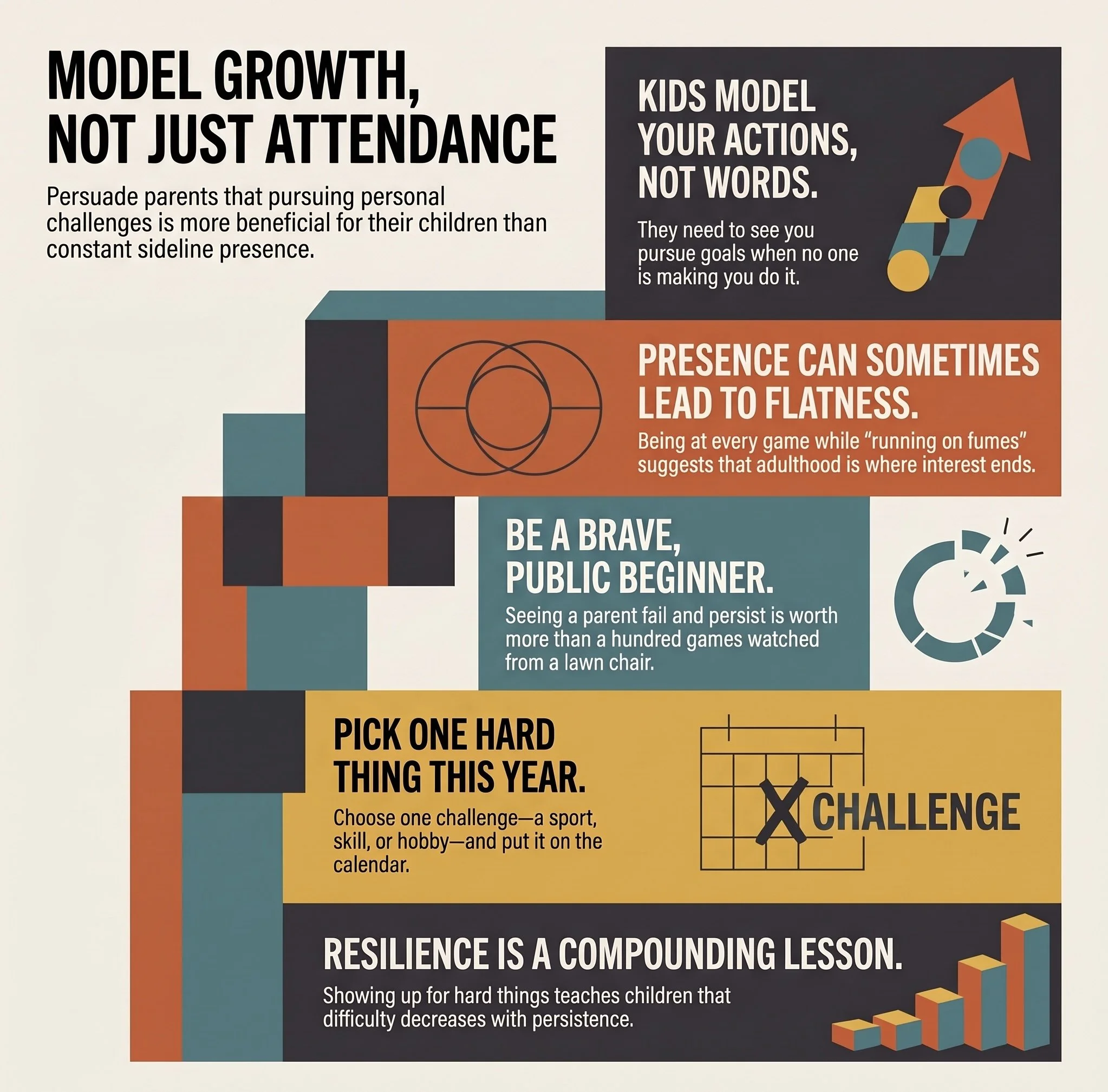
Your kids don't need you at every game. They need to watch you try something hard. A parent who is still learning, still a beginner at something, still a little bit ambitious, teaches a kid more about hard things than a parent who attends everything on fumes. Pick one hard thing for the next year, put it on the calendar next to their practices, and let them see you go.
Your Kid Doesn't Need You at Every Game - They Need to Watch You Try Something Hard
Every fall I hear a version of the same sentence from a parent in the MOA lobby. It goes something like this: I'd love to get back in shape, or take that class, or finally learn the thing I've been talking about for ten years, but right now I have to be about the kids. It always sounds responsible. It usually gets nods from the other parents. And I think it's one of the most quietly damaging ideas in modern parenting.
Here's the problem. Kids don't learn who to become from what you tell them. They learn from watching what you do with your own life when nobody is making you do anything. If what they see is a parent who set down every ambition the day they were born, the lesson isn't "my parents love me." The lesson is "adulthood is where interesting stops." And then we act surprised when a fourteen-year-old boy doesn't want to try anything he isn't already good at.
I've watched this from the other side too. Some of the most present parents I know, the ones who never miss a practice, are running on fumes. They show up, they sit in the car or in the folding chair, they scroll, they drive home. Their kid feels the presence, but they also feel the flatness. A kid can absolutely tell the difference between a parent who is there because they want to be and a parent who is there because there's nowhere else they're allowed to be.
Now flip it. Picture a kid who knows Dad missed the second half of the game because he was at a class he'd been nervous about for months. Or Mom skipped the tournament because she had her first race. That kid doesn't feel abandoned. That kid gets a story. They get proof that a grown adult can still be a beginner, can still fail at something in public, can still care about getting better. That is worth more than a hundred games watched from a lawn chair.
This is the same argument I make for putting a six-year-old under a barbell. Not because the weight matters at six. Because the reps teach a kid that hard things get easier when you keep showing up, and that lesson compounds for the rest of their life. The catch is that it doesn't land if the person driving them to the gym has quietly stopped believing it. Kids have very good radar for hypocrisy. You cannot ask them to be brave about hard things while you've retired from all of them.
There's a marriage piece too, and nobody talks about it. Your spouse didn't marry a settled person. They married somebody who was going somewhere, who had plans, who was a little bit dangerous in the good way. Routine is fine. Routine is how strong households run. But a routine with nothing new inside it is just a rut with better scheduling. The partner who comes home from a hard workout, or a language lesson, or a kitchen disaster they're determined to fix next week, has a certain glow to them. Ask any long-married couple. That glow is a big part of what keeps things alive at 45 and 55.
So the question isn't whether you have time. Almost nobody has time. The question is what you pick and how you fit it inside the life you already run. Pick one hard thing for the next twelve months. One. Make it something that spills over onto the family: learning to cook real food for them, getting strong enough to hike with them, picking up the instrument that's been in the basement since college. Put it on the calendar the same way you put in their practices. Tell your kids what it is and why it scares you. Then let them see you go.
You will miss some things. That's the cost. But the parent your kids need isn't the one at every single game. It's the one who is still becoming somebody. Be strong to be useful, and remember that useful includes being someone worth watching.