Does Strength Training Make Kids Faster?
Key Takeaways
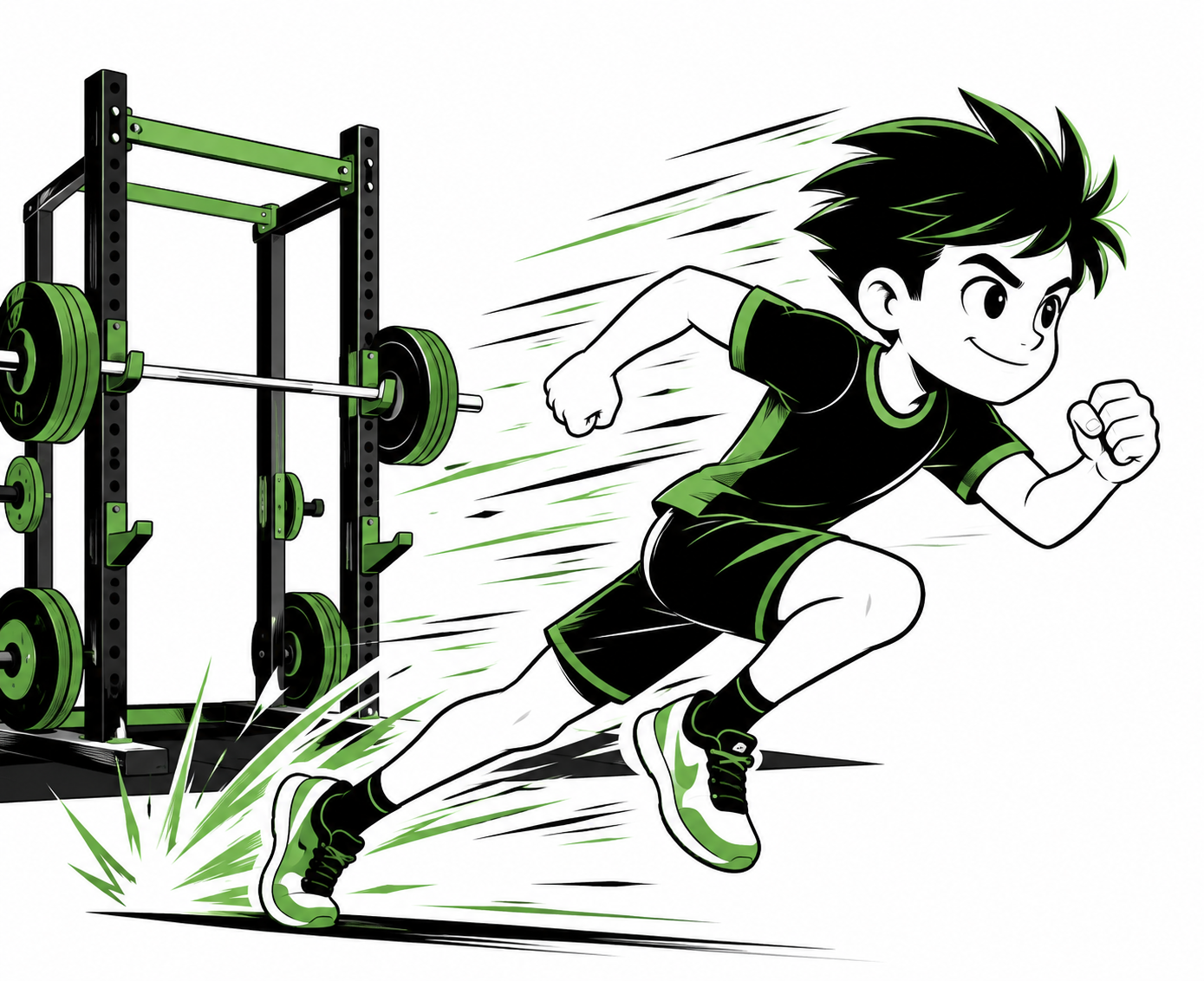
Yes — speed is a strength skill. Sprinting is force pushed into the ground, and stronger legs and hips produce more force.
Research on young athletes shows strength training improves sprint times, jump height, and change of direction.
Ladders and cone drills make feet busier, not faster. Squats, deadlifts, and sprinting itself build real speed.
Speed gains show up within one to two training blocks — and they transfer to every sport.
Does Strength Training Make Kids Faster?
Every parent of a young athlete eventually asks it: how do I make my kid faster? And an entire industry has an answer ready — speed camps, agility ladders, parachutes, cones arranged in clever patterns.
Here's the answer nobody's selling: yes, strength training makes kids faster. In fact, it's the most reliable speed program there is.
What speed actually is
Watch a sprinter in slow motion. Speed isn't fast feet — it's force. Every stride is a violent push into the ground, and the harder an athlete pushes, the farther and faster the ground sends them forward. Physics does the rest.
That means the question "how do I get faster?" is really the question "how do I push harder?" And the answer to that one has been settled for decades: get stronger. Squats, deadlifts, and power cleans train the exact muscles — glutes, hamstrings, quads, core — that drive every sprint stride.
What the research shows
Studies on youth athletes consistently find that strength and resistance training improves sprint speed, jump height, and change-of-direction ability. Stronger young athletes accelerate faster, cut harder, and reach top speed sooner than their weaker teammates. This holds across sports — soccer, football, basketball, baseball, volleyball. Speed is general. Strength feeds all of it.
The mechanism is simple: a stronger leg delivers more force per stride without working harder to do it. Same effort, more output. That's what "getting faster" is.
The agility ladder problem
So why do speed camps sell ladders and cones? Because they look like speed. Quick feet tapping through a ladder feels fast and films great for social media.
But tap-dancing through a ladder teaches you to take small, fast, weak steps — the opposite of sprinting, which rewards long, powerful strides. Ladders have their place as a warm-up and coordination tool. As a speed program, they're a treadmill: lots of motion, no destination.
The formula that actually works has two ingredients: get stronger in the weight room, and sprint — actually sprint, at full effort, with full recovery between runs. Strength builds the engine. Sprinting teaches the body to use it.
When the results show up
This isn't a someday payoff. Coaches see it inside one or two six-week training blocks: the kid who added 20 pounds to their squat suddenly beats everyone to the ball. Parents usually hear it secondhand — "Coach says she's gotten so much quicker" — before they connect it to the barbell.
And unlike a speed camp, the gains don't expire when the week ends. Strength compounds. A kid who trains through the school year doesn't just get faster this season — they raise the ceiling on every season after it.
The bottom line
If your athlete wants to be faster, skip the gimmicks. Two to three strength sessions a week built on squats, hinges, presses, and pulls, plus real sprinting, will beat any ladder drill ever invented. It's not flashy. It just works.
Want to see the engine get built? Come watch a session at Mighty Oak Athletic in Westmont — first one's free.
-
Yes. Sprinting speed comes from force pushed into the ground, and strength training builds the glutes, hamstrings, quads, and core that produce that force. Research on youth athletes shows strength training improves sprint times, jump height, and change of direction.
-
Ladders build coordination and make a fine warm-up, but they train small, quick, weak steps — the opposite of the long, powerful strides that create real speed. Strength work plus actual sprinting outperforms ladder drills.
-
Most young athletes show measurable improvement within one to two six-week training blocks — often noticed first by their sport coaches.
-
Squats, deadlifts, and power cleans build the force behind every stride, paired with full-effort sprinting. Mighty Oak Athletic in Westmont, IL coaches all of them for athletes ages 6–18 — $199/month unlimited, free trial session. Call 630-464-9498.
Coach Mike Ockrim is a Certified Strength and Conditioning Specialist (CSCS), USA Weightlifting Level 1 coach, USA Triathlon coach, and second-degree black belt. He founded Mighty Oak Athletic in Westmont, IL in 2013, runs the Sunday Funday Sports youth leagues, has taught group fitness at Life Time for more than eight years, and is the author of Death Resistant, 13 Pounds in 30 Days, and MOA Nutrition. He lives in the western suburbs with his wife Carey and their four kids.