Mighty Oak Athletic Podcast S3:E99 - Young Men Are in Crisis - The Solution Starts at Age Six

The Bottom Line
Young men in America are in trouble: falling behind in school, stepping out of the workforce, retreating into screens, and struggling to build friendships and relationships. That drift does not start at 22 — it starts in boyhood, in the years when a boy either learns that effort is required of him or learns that it is not. Research on what people value in a long-term partner keeps returning to traits like dependability, ambition, competence, and health — none of which can be seen directly. They have to be signaled through behavior. Strength training is the earliest, cleanest place a boy can start building and signaling all of them.
Look around at the young men in your life. Not the little boys — the nineteen-year-olds, the twenty-four-year-olds, the twenty-eight-year-olds. How many of them are actually thriving?
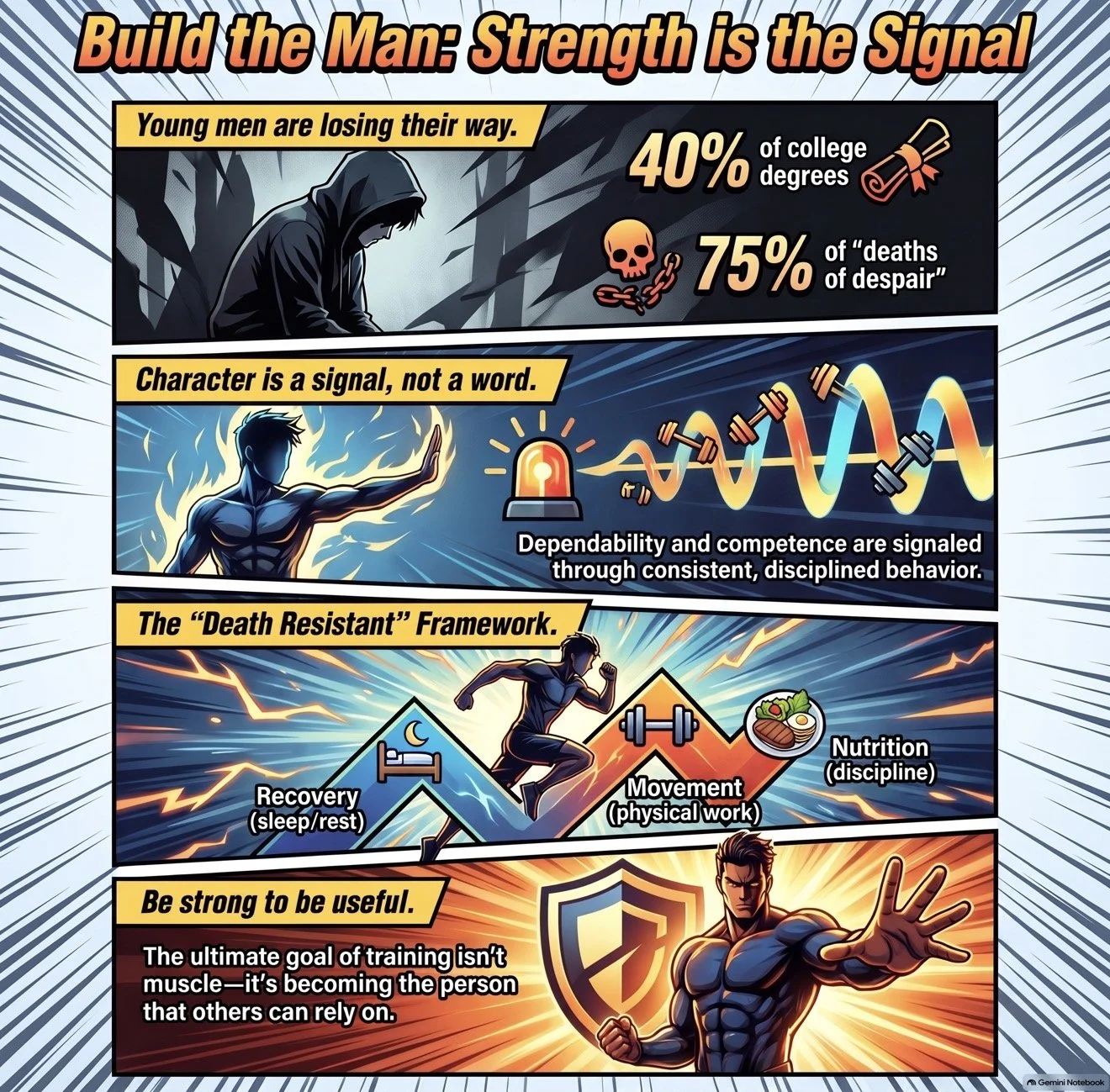
Here is what the numbers say, and they should alarm you. Women now earn about 60 percent of college degrees. In a nationally representative study of American high schoolers, boys made up two-thirds of the bottom tenth of the class by GPA. About one in nine prime-age men, ages 25 to 54, is neither working nor looking for work. Roughly one in three young men ages 18 to 34 still lives with his parents. The share of men who say they have zero close friends has jumped fivefold since 1990, from 3 percent to 15 percent. And men account for nearly three-quarters of the deaths in the categories often called deaths of despair. Our boys are drowning in screens and starving for purpose.
You have seen it up close, even if you have not named it. The nephew who games until 3 a.m. and cannot hold a job. The neighbor's son who graduated two years ago and never launched. The young man who cannot look an adult in the eye, ask a girl to dinner, or finish anything hard. He is not a bad kid. He is an unbuilt one. Nothing was ever required of him, so he never found out what he could do.
Here is the part every parent needs to hear: the drift does not start at 22. It starts at 8, 10, 12 — the years when a boy either learns that effort is required of him or learns that it is not. Which means those are also the years when the drift can be stopped. That is the work we do at Mighty Oak Athletic. Yes, it looks like getting faster for soccer. It is much bigger than that.
Here is something that makes people uncomfortable, so let's say it plainly. Decades of research on what people value in a long-term partner keeps returning to the same cluster of traits: dependability, ambition and the ability to provide, competence, and health. Now look at that list again. Not one of those traits can be seen directly. Every one of them has to be signaled through behavior. A fit body matters not because anyone is impressed by big arms, but because of what it signals: the discipline to train and the commitment to keep showing up. Competence signals that resources will follow. Reliability today signals reliability tomorrow.
The key word is signal. Nobody can see character directly. They can only see the evidence of it. A 16-year-old has no resources yet. What he has is behavior, and behavior is the signal.
Think about what a young man is actually broadcasting when he trains three days a week for two years. He is telling the world he shows up week after week, in season and out, whether anyone is watching or not. He can do hard things nobody is making him do. He can delay the reward. He can be told he is doing it wrong and fix it instead of quitting. He can take care of the one body he has been given. None of that is about muscle. All of it is about who he is becoming.
Now flip it around. The 22-year-old who orders another round at midnight when he has something important in the morning is signaling too. He is telling everyone in the room that the next day's obligations lose to tonight's fun. People notice. They may not say it out loud, but they file it away. The young man who says "I've got an early morning" and goes home is signaling something scarce. He is showing that he is the kind of person who will have something to offer later because he is protecting what matters now.
That decision does not appear out of nowhere at 22. It gets built somewhere. In our experience, it gets built at 8, and 12, and 15, in a room where a kid learns that the squat does not care how he feels today, and that the only way through is to do the work anyway.
This is why our whole program is built on the Death Resistant framework: Recovery, then Movement, then Nutrition. Recovery comes first because a young man who learns to sleep, to rest, and to make the right call when nobody is checking is learning the same skill that will make him someone others can rely on. Movement means barbells, kettlebells, and bodyweight, every session, starting at age six. Nutrition is the daily proof that he can take care of himself without being told. The MOA Nutrition journal is not a diet. It is a discipline log.
It is also why we use a nine-level shirt progression. A kid cannot buy the next shirt. He earns it by hitting real, measurable standards. When a young man walks into a gym, a school, or a tryout wearing a shirt he earned, he is wearing proof of every session it took to get it. That is the most honest signal there is.
So yes, your son will get faster on the soccer field. He will also, quietly and without anyone announcing it, become the kind of young man that good coaches want on their roster, good teachers want in their classroom, and good people want in their life. The crisis facing young men is real. It is also not inevitable. It gets stopped one required rep, one earned shirt, one disciplined boy at a time.
Be strong to be useful. That has always been the point. The strength is just how we get there.
Fact-check
~60% of college degrees: NCES/IPEDS 2023–24 (59.7% of associate's through doctoral; 58.3% of bachelor's alone)
Two-thirds of bottom GPA decile: NCES HSLS:09, Smith & Reeves analysis (2025) — scope is a nationally representative high-school cohort
1 in 9 prime-age men out of labor force: BLS CPS, July 2026 (10.8% of men 25–54); includes disability, caregiving, school — avoid "gave up looking"
1 in 3 young men living with parents: U.S. Census CPS 2022 (32.8% of men 18–34 living as child of householder)
No close friends 3% → 15%: Gallup 1990 vs. Survey Center on American Life 2021; different survey modes, not a perfect time series
~Three-quarters of deaths of despair: CDC/NVSS 2024 — men were 79.8% of suicide deaths, 69.4% of overdose deaths, ~70.4% of alcohol-induced deaths; "deaths of despair" is not an official CDC category
Mate-preference framing follows Buss (1989) and Shackelford, Schmitt & Buss (2005); the fitness-signals-discipline link is presented as our argument, not a research finding