
Can My Kid Pass the Service Academy CFA?
Key Takeaways
The Candidate Fitness Assessment (CFA) is a six-event battery run consecutively in under 40 minutes: kneeling basketball throw, cadence pull-ups (or flexed-arm hang), shuttle run, modified sit-ups, push-ups, and a one-mile run. It's required for West Point, the Naval Academy, and the Air Force Academy.
The events are sequenced deliberately to produce a cumulative loading effect. Candidates who train each event in isolation and never rehearse the full battery get ambushed by the one-mile run.
The two events where candidates lose the most points are pull-ups and the basketball throw — one is a strength problem, the other is a technique problem almost nobody practices.
Twelve weeks is a realistic runway from "unprepared athlete" to "competitive score." Six weeks is a rescue mission. Two weeks is a scoring exercise, not a training plan.
The CFA is one component of the Whole Candidate Score. A strong score won't carry a weak file, but a weak score will absolutely sink a strong one.
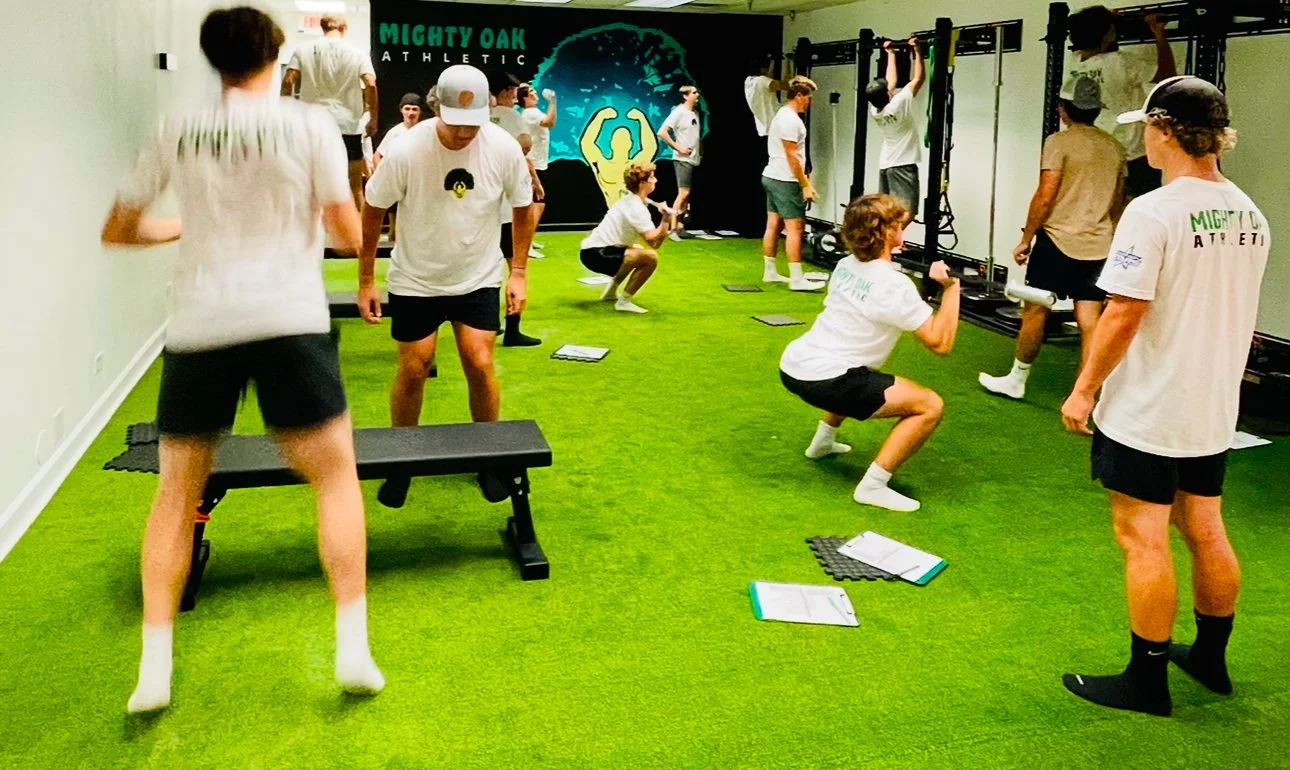
Based in the Chicago suburbs? We coach academy applicants and ROTC candidates in person at our Westmont facility. See the military prep program.
Can My Kid Pass the Service Academy CFA?
Most parents find out about the CFA about six weeks before their kid has to take it.
That's usually the phone call I get: a senior, a nomination in progress, a test date on the calendar, and a family that just discovered their three-sport athlete cannot do six pull-ups.
Good news: the CFA is one of the most trainable tests in existence. Bad news: only if you start early enough.
Here's what it is, where kids lose points, and what a real twelve-week runway looks like.
What the CFA actually is
The Candidate Fitness Assessment was developed jointly by the service academies to measure whether a candidate can handle the physical program at West Point, Annapolis, or the Air Force Academy. It's six events, administered consecutively in under 40 minutes, with specified start, finish, and rest times.
The events, in order:
Kneeling basketball throw — three attempts, throwing a men's basketball for distance from a kneeling position.
Cadence pull-ups — as many as possible in cadence. Women may substitute a flexed-arm hang if they cannot complete at least one pull-up.
Shuttle run — a 40-yard shuttle, run as four 10-yard segments with turnarounds.
Modified sit-ups (crunches) — maximum reps in two minutes.
Push-ups — maximum reps in two minutes.
One-mile run — for time.
Each event converts to a scale score from 0 to 100. Hitting the 100-point ceiling on any of the first five events means you stop — extra reps don't help.
Get the official standards from the source, not from a forum. The scoring tables and full administration instructions live on the academy admissions sites — West Point's CFA instructions and the Naval Academy's CFA page are the two I send families to. Standards get revised. Don't train off a number you found in a Reddit thread from 2019.
The part that gets kids
Read that phrase again: administered consecutively, sequenced to produce a cumulative loading effect.
That's not accidental. The test is designed so that fatigue from event two is still in your arms during event five, and everything you've done for 35 minutes is in your legs when you toe the line for the mile.
I have watched strong athletes post practice numbers that would score well — pull-ups on a fresh set, a solid mile on a fresh day — and then lose 15 points on test day because they had never once run the mile with 200 crunches and a max push-up set already in the tank.
Rehearse the full battery, in order, at least three times before test day. That's not extra training. That's the actual skill.
Get the free MOA Military Prep Guide The full breakdown of the CFA, USMC PFT, Army Fitness Test, and ROTC assessments — event standards, where candidates lose points, and the twelve-week progression above laid out week by week.
Where candidates lose the most points
Pull-ups. This is the biggest gap I see, and it's a pure strength problem. The average high school athlete — including varsity athletes in most sports — has never trained a vertical pull under load. Football, baseball, and soccer build nothing here. The fix isn't doing more pull-ups. It's building the pulling strength first: heavy rows, lat pulldowns, weighted negatives with a slow three-to-five-second descent, and band-assisted work at a rep range that actually accumulates volume. Kids who grind out singles to failure three times a week get sore and don't improve.
The basketball throw. This one is almost free points and almost nobody trains it. It's a power and technique event — the throw comes from the trunk and shoulder with a straight arm, more javelin than free throw, and the ball is gripped against the forearm rather than balanced on the palm. Five throws, twice a week, plus general rotational power work (med-ball throws, overhead throws) will move this event more than anything else in the battery per hour invested. Show up having never thrown from your knees and you'll leave a large number of points on the field.
The mile, on tired legs. Not because the kids can't run — because they've never run it eighth in line behind five other events.
The shuttle run, crunches, and push-ups are where most reasonably fit athletes already score acceptably. Those are the ones to maintain, not the ones to obsess over.
What twelve weeks looks like
This is the structure we use with academy applicants and ROTC candidates at Mighty Oak Athletic.
Weeks 1–4 — Build the base. Three strength days a week: squat, hinge, vertical pull, horizontal pull, press. Load progresses weekly. Add two easy aerobic days — 20 to 30 minutes, conversational pace. Pull-up work is volume-focused and sub-failure. Basketball throw practice starts now: five quality throws, twice a week. No full CFA rehearsals yet.
Weeks 5–8 — Convert strength to test performance. Strength work continues but drops to two heavy days. Add one interval running day: 400s and 800s at faster than mile pace. Pull-up work shifts toward cadence practice — the CFA is done on a count, not at your own tempo, and that difference is worth reps. Run your first full CFA rehearsal at the end of week 6. Record every number. That rehearsal is your real baseline.
Weeks 9–11 — Sharpen. Two CFA rehearsals, one week apart. Between them, attack the two lowest-scoring events specifically. Keep one heavy strength day so you don't detrain the thing that got you here. Mile pace work gets sharper and shorter.
Week 12 — Taper. Cut volume roughly in half, keep intensity. Full rest 48 hours out. Eat normally on test day — real food, at a normal time, nothing new, no pre-workout experiments.
Two things parents should know
First: the CFA is not the whole application. It feeds into the Whole Candidate Score alongside academics, class rank, leadership, and the nomination process. A great CFA doesn't rescue a thin file. But a poor CFA is one of the easiest ways to weaken a strong one — and it's the single most fixable component in the entire application.
Second: start before senior year if you possibly can. A junior who spends a year building real pulling strength walks into the CFA as a formality. A senior who starts in September is running a rescue operation. Both can work. One is a lot less stressful for everyone in the house.
The kids who do well on this test aren't the most gifted athletes. They're the ones who found out what the test was early enough to train for it.
Be strong to be useful.
-
The CFA is a six-event physical test required for admission to the United States Military Academy, Naval Academy, and Air Force Academy. The events — kneeling basketball throw, cadence pull-ups or flexed-arm hang, shuttle run, modified sit-ups, push-ups, and a one-mile run — are administered consecutively in under 40 minutes and scored on a 0-to-100 scale per event.
-
Kneeling basketball throw, cadence pull-ups (flexed-arm hang is the female alternative), 40-yard shuttle run, modified sit-ups for two minutes, push-ups for two minutes, and a one-mile run for time.
-
Pull-ups, followed by the basketball throw. Pull-ups are a strength deficit most high school sports don't address; the basketball throw is a technique event that candidates rarely practice. Both are highly trainable with a twelve-week runway.
-
Twelve weeks is a realistic runway to move from an untrained athlete to a competitive score. Six weeks can produce meaningful improvement in the technical events. Anything under three weeks is test familiarization, not physical preparation.
-
No. The CFA is one component of the Whole Candidate Score, alongside academics, class rank, leadership, and a congressional or service-connected nomination. A strong score supports an application; it does not replace the rest of the file.