Key Takeaways
High school ACL injury rates have grown roughly 26% since 2007 — and more than 32% for girls, who tear ACLs at multiples of the boys' rate in cutting and jumping sports.
Most non-contact ACL tears are preventable: neuromuscular warm-ups like FIFA 11+ have repeatedly cut ACL injuries substantially when done consistently.
The two missing pieces for most girls: a 12-minute pre-practice warm-up and two short strength sessions per week.
The one question every soccer parent should ask their coach: "What's your knee warm-up plan?"
Mighty Oak Athletic coaches ACL-protective strength for girls ages 6–18 in Westmont, IL — first session free.
Soccer Parents: Ask Your Coach This One Question
A New York Times Magazine story followed a girl who tore her ACL at 12, rehabbed for a year, came back — and tore the other one. It followed a second girl who tore hers, returned, and tore it again.
The most shocking part wasn't the injuries. It was how normal the adults around them said this has become.
It shouldn't be. This spring, the Associated Press reported what researchers have been shouting for years: ACL injury rates among high school athletes have grown roughly 26% since 2007 — and more than 32% for girls. Teen girls tear ACLs at multiples of the boys' rate in soccer and basketball. And when surveyed, most youth coaches admit they don't know the prevention programs exist, were never trained on them, or skip them to "get to the ball."
Here's the part every soccer parent in DuPage County needs to hear: a large share of these tears — especially the non-contact ones — are preventable. The research has existed for decades. As one biomechanics researcher put it, the real crime is that the answers have been out there for 25 years.
We can't control everything on the field. But we can control how athletes warm up, decelerate, land, cut, and build strength. That's the low-hanging fruit, and almost nobody is picking it.
What an ACL Tear Really Costs
An ACL injury isn't a broken wrist. It's usually surgery, months of rehab, and a return-to-play timeline that swallows a year. It raises the odds of future knee problems, including early osteoarthritis. And athletes who return after reconstruction carry a meaningful risk of tearing again — same knee or the other one.
For a teenager, it also hits identity: Who am I if I can't play?
That's what's at stake in a 12-minute warm-up.
Why Girls Are Tearing More
Three patterns show up over and over. Kids get less free play, so they log fewer childhood reps of climbing, scrambling, landing, and regaining balance — and ACL tears happen in the millisecond when the knee doesn't know where to go. Year-round specialization means thousands of identical cuts on tired legs. And strength training has lagged for girls: many boys get introduced to the weight room early while many girls never do — yet strong hips, hamstrings, and trunk control are exactly what keep a knee from collapsing inward on a cut or landing.
None of that is your daughter's fault. All of it is fixable.
The Biggest Win: Prevention Warm-Ups Actually Work
Neuromuscular warm-up programs — FIFA 11+ is the best-known — have repeatedly shown substantial reductions in ACL and overall injuries when teams do them consistently and correctly. The International Olympic Committee endorses them. This year, AYSO began rolling them out nationally because, in the words of its own programs director, the shock was that it didn't already exist.
So why doesn't your daughter's team do one? Because youth sports is busy, coaches feel pressure to get to the ball, and nobody hands them a simple plan.
Here's the plan.
Part 1: The 12-Minute Warm-Up (Before Every Practice and Game)
Jog + skip — 2 minutes. Easy pace. Wake up the body.
Leg prep — 2 minutes. Walking lunges x 10 steps. High knees x 20 yards. Butt kicks x 20 yards.
Single-leg balance + reach — 2 minutes. Stand on one leg; reach the other foot forward, to the side, and back, 3 each direction. Switch legs.
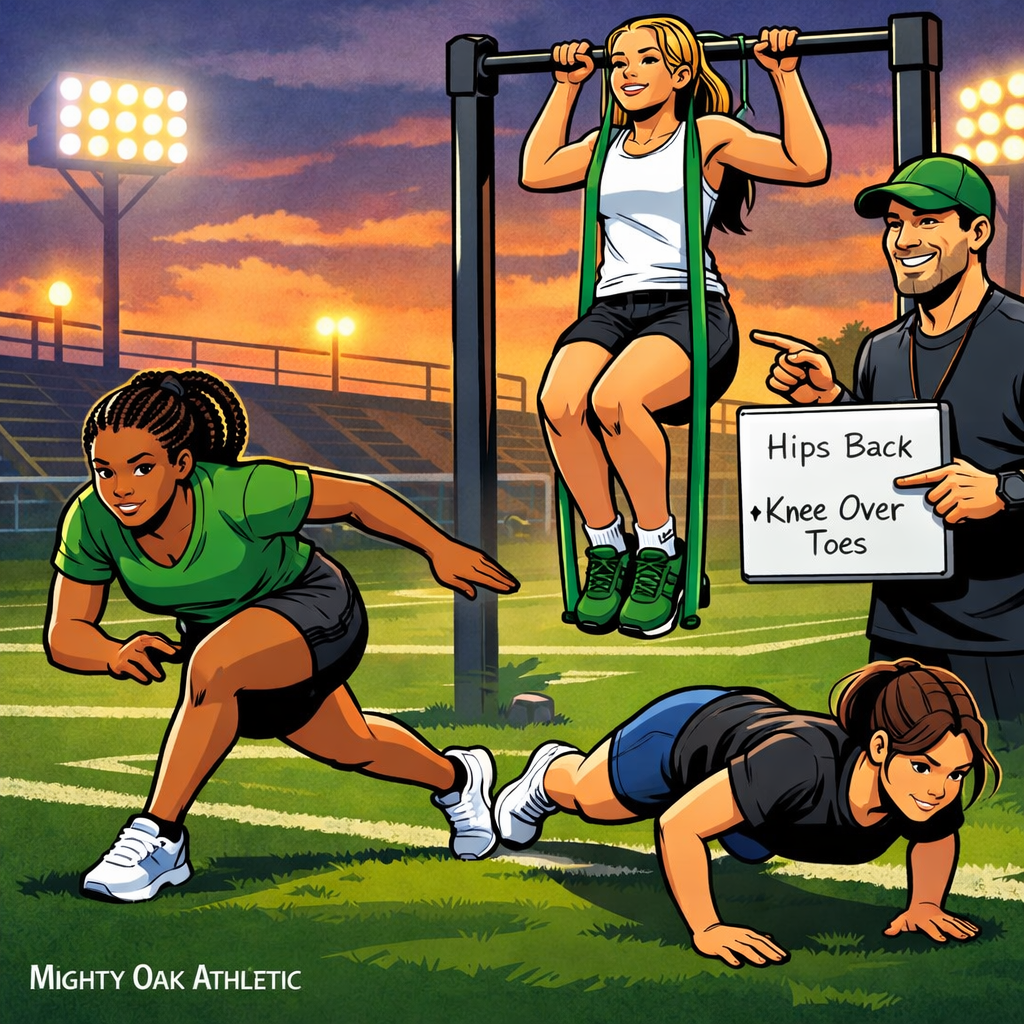
Landing mechanics — 2 minutes. Snap down to athletic position x 5. Small pogo jumps x 15. Stick a two-foot landing x 5. Cue: "Land quiet. Knees over toes. Hips back."
Deceleration + cut — 4 minutes. Sprint 10 yards into a hard stop in athletic position x 4. Shuffle 5 yards, plant, shuffle back x 4. Cue: "Drop your hips. Don't stay tall."
If you take one thing from this entire page, take the warm-up.
Part 2: Two Strength Sessions Per Week (The Knee Armor)
Thirty-five to forty-five minutes. Simple lifts. Perfect technique.
Day A: Goblet squat or front squat 3x5–8. Romanian deadlift 3x6–10. Split squat 2x8 per leg. Side plank 2x20–40 seconds per side.
Day B: Deadlift or hinge variation 3x5. Step-ups 2x8 per leg. Hamstring curls with a ball or sliders 3x8–12. Calf raises 2x12–20. Farmer carry 4x20–30 yards.
Why these? Because the ACL usually loses when hips are weak, hamstrings aren't doing their job, the athlete can't control deceleration, or the trunk collapses and the knee caves inward. These lifts attack all four.
Part 3: The Cues That Save Knees
Coaches, say these constantly: Hips back when you stop. Don't be tall — get low. Knee tracks over the middle toes. Land quiet. Control first, speed second. And the sneaky one: Show me the same perfect stop when you're tired. Most tears don't happen in the first five minutes. They happen when fatigue and focus drop.
What Parents Can Do (Without Becoming the Bad Guy)
You don't need to be the strength coach. You need to ask one question:
"Coach, what's your knee warm-up plan?"
If there isn't one, offer this: "We'll support you — can we run a 10–12 minute warm-up like FIFA 11+ before every session?"
That isn't overstepping. That's seatbelts.
The Mighty Oak Message
Girls' sports are booming, and that's worth celebrating. But we can't celebrate opportunity while accepting a system where torn ACLs feel normal. The next wave of great female athletes won't just be skilled — they'll be strong, coordinated, and trained to decelerate like pros.
That's the work we do every week at Mighty Oak Athletic in Westmont: barbell strength, landing mechanics, and deceleration training for girls and boys ages 6–18, coached identically, from Hinsdale, Clarendon Hills, Darien, Downers Grove, and across DuPage County. If your daughter plays a cutting sport, don't wait for the pop.
-
Most non-contact ACL tears are preventable with two components: a 10–12 minute neuromuscular warm-up (such as FIFA 11+) before every practice and game, and two weekly strength sessions targeting the hips, hamstrings, and trunk. Programs like these have repeatedly shown substantial reductions in ACL injuries when performed consistently and correctly.
-
Teen girls tear ACLs at multiples of the boys' rate in cutting and jumping sports. Contributing factors include less free-play movement development in childhood, year-round single-sport specialization, and a lag in strength training for girls — leaving weaker hips, hamstrings, and trunk control, which allows the knee to collapse inward during cuts and landings.
-
The most protective exercises build hip, hamstring, and trunk strength and teach controlled landing and deceleration: goblet or front squats, Romanian deadlifts, split squats, step-ups, hamstring curls, side planks, farmer carries, plus landing drills (stick a two-foot landing, "land quiet") and deceleration drills (sprint to a hard athletic-position stop).
-
Ask one question: "What's your knee warm-up plan?" If the team doesn't have one, offer support in running a 10–12 minute FIFA 11+ style warm-up before every session. The International Olympic Committee encourages neuromuscular warm-ups for youth athletes, and AYSO began rolling them out nationally in 2026.
Book a free training session — or if you coach a club team, invite Coach Mike to speak about building an ACL-prevention culture. Related reading: Jack's Arm Hurt. Mia's Knee Hurt. Here's What Fixed Both.