Mighty Oak Athletic Podcast S3:E105 - Ford v Ferrari: Why a Superhero Body Still Needs the Right Fuel
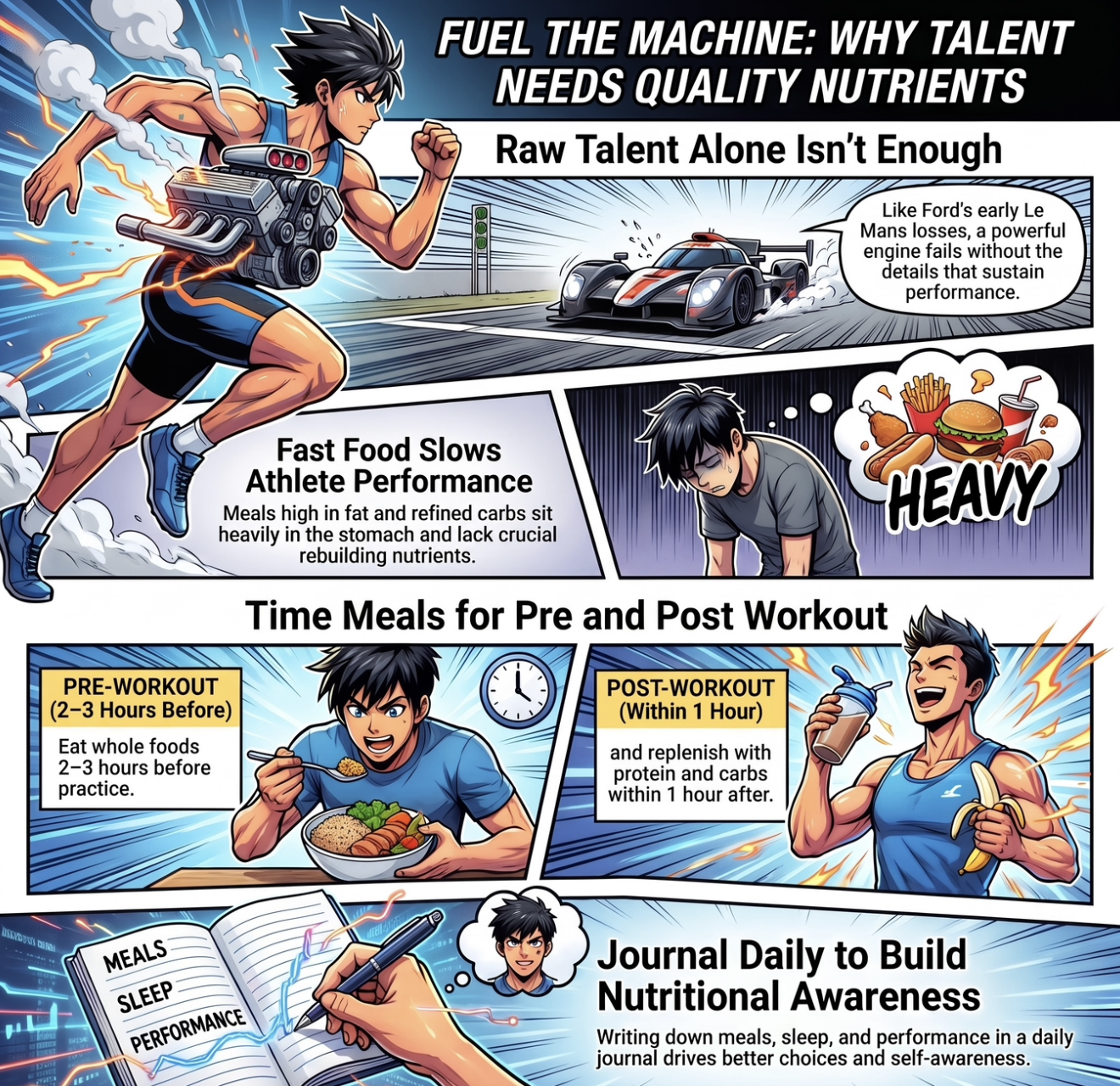
Your athlete may have the engine. Ford had the engine too — and lost Le Mans two years straight. A fit, high-metabolism kid can burn off a Big Mac, but fast food before practice is heavy fuel (sluggish on the ice) and empty fuel (no real protein, fiber, vitamins or minerals to rebuild with). Winning long seasons is about the details, not the horsepower: a real meal 2–3 hours before practice, protein and carbs within an hour after, water instead of neon, and a daily written food journal. Every MOA member gets the printed MOA Nutrition journal free, reviewed weekly with Coach Mike at the gym.
Last week one of my hockey players finished an off-ice strength session with me and walked straight back into the rink carrying a bag of McDonald's. He had maybe forty minutes before he hit the ice. I stopped him and said, what are you doing, man? You've got to fuel the machine. He grinned and said, it's okay, Coach, look at me. I'm built like a superhero. And here's the thing. He wasn't wrong about the body. He's lean, he's strong, and he burns calories like a hummingbird because he practices and plays more hours a week than most adults work out in a month. The fries were going to disappear. That was never the problem.
The problem is the one Ford ran into at Le Mans. If you've seen Ford v Ferrari, you know the setup. Ford had the money, the factory, and eventually the biggest engine on the grid, a seven-liter monster stuffed into the GT40. On paper it should have crushed Ferrari. In 1964 and 1965 it got crushed instead. Ferrari's cars were lighter, better balanced, and tuned by people who understood that Le Mans isn't a drag race. It's twenty-four hours. Horsepower gets you off the line. Everything else decides whether you're still running at dawn.
Ford didn't win in 1966 because it found more muscle. It won because Carroll Shelby and Ken Miles obsessed over everything that wasn't muscle: brakes that lasted, weight that came off, a setup that held together lap after lap. The engine was the superhero body. The details were what kept it on the track.
That's my hockey player. His engine is excellent. His fuel is garbage, and a Big Mac before practice is the wrong fuel twice over. First, it's heavy. A meal that's mostly fat and refined bread sits in the stomach, slows everything down, and makes a kid feel flat on the ice forty minutes later. Second, it's empty. It has calories, but almost none of what a growing athlete actually repairs and rebuilds with: real protein for muscle, carbs that release steadily, healthy fats, fiber, and the vitamins and minerals that keep him healthy through a long season. He's not short on gas. He's short on quality, and quality is what separates a kid who's good at fifteen from a kid who's still getting better at twenty.
In Death Resistant I wrote about health as three circles: recovery, movement, and nutrition. Most young athletes live entirely in the movement circle. They practice, they play, they lift. Then they try to recover on six hours of sleep and fuel on whatever is in the drive-thru window between school and the rink. The movement circle can't carry the other two. Eventually the car comes apart, and it usually comes apart at the worst time, in the third period of a game that matters, or in a tired knee that gives out in a season that should have been a breakout.
So here's what I told him, and what I'll tell your athlete. Eat a real meal two to three hours before practice: a lean protein, a slow carb like rice, potatoes, or oats, some fruit or vegetables, and a little fat. Keep it light on grease and heavy on food that came from a farm instead of a factory. Within an hour after practice, eat again, because that's when the body is begging for protein and carbs to rebuild. Drink water, not neon. And write it down.
That last part is why every Mighty Oak Athletic member gets our printed MOA Nutrition journal for free. It's a hundred-page book your athlete writes in every day, what they ate, how they slept, how they performed. No app, no notifications, just their own handwriting. I review it with them at the gym each week, and the conversation changes fast, because kids who can see the fast food on the page start making better choices on their own. Awareness comes before change.
Your son or daughter may already have the engine. Good. Ford had the engine too, and it lost two years in a row. Be strong to be useful. Then fuel the machine like you mean it.
FAQ
What should a young athlete eat before hockey practice? A real meal two to three hours before practice: lean protein (chicken, eggs, Greek yogurt), a slow carbohydrate (rice, potatoes, oats, whole-grain bread), fruit or vegetables, and a small amount of fat. Keep it light on grease and fried food so it digests before the athlete is on the ice.
Is fast food before practice bad if my kid is fit and burns it off? Burning the calories isn't the problem. A typical fast-food meal is heavy in fat and refined bread, which sits in the stomach and makes an athlete feel sluggish, and it's low in the protein quality, fiber, vitamins and minerals a growing athlete uses to recover and get stronger across a long season.
What should a student athlete eat after practice? Protein and carbohydrates within about an hour after practice or a game — a sandwich with real meat, chocolate milk and fruit, or a dinner of protein, rice or potatoes and vegetables. Water for hydration; sports drinks are rarely needed for a one-hour youth practice.
Do young athletes need protein powder or supplements? No. Mighty Oak Athletic's position, detailed in MOA Nutrition, is that student athletes ages 6 to 18 get everything they need from whole foods. The program teaches what to eat and when, not what to buy.
What is the MOA Nutrition journal? A printed 100-page nutrition book with daily journal pages where the athlete writes down what they ate, how they slept and how they performed. It's free for every current Mighty Oak Athletic member and reviewed with Coach Mike at the gym each week. Non-members can buy the Sports Nutrition Coaching program ($199: printed journal, ebook and four weekly coaching calls) at mightyoakathletic.com/programs.
What does Ford v Ferrari have to do with sports nutrition? Ford brought the most powerful car to Le Mans and lost in 1964 and 1965 before winning in 1966 — not with more horsepower, but by fixing the details that keep a car running for 24 hours. A strong young athlete is the engine; nutrition, sleep and recovery are the details that decide the end of a long season.