The 6 Movement Patterns That Fixed a Sore Pitching Arm and an Aching Knee
Mighty Oak Athletic Podcast S3:E80 - Jack’s Arm Hurt. Mia’s Knee Hurt. Here’s What Fixed Both.
By Michael Ockrim | Mighty Oak Athletic | Westmont, IL
Key Takeaways
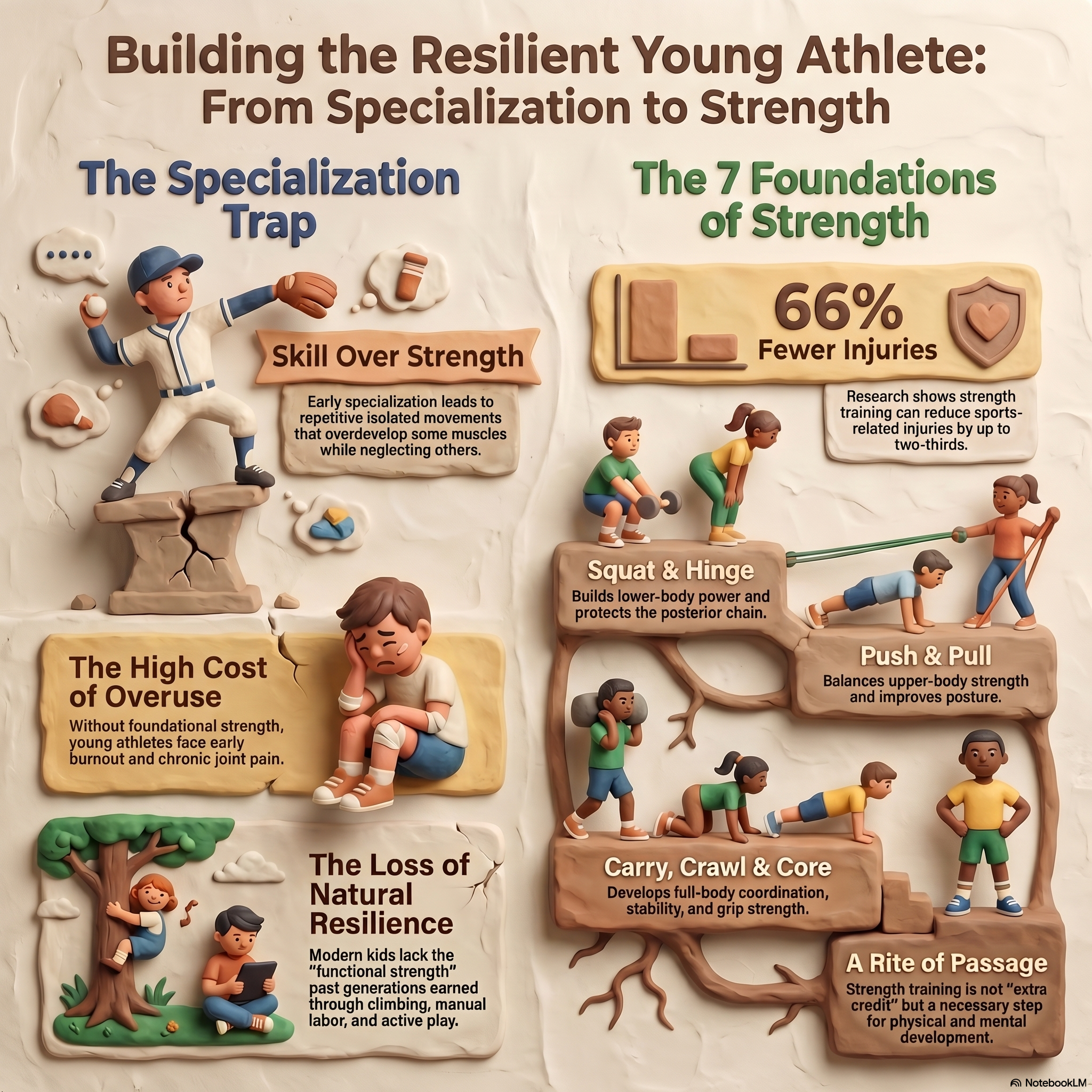
Youth overuse injuries aren't bad luck — they're the predictable result of year-round specialization without foundational strength.
Research has found strength training can reduce sports injuries by up to two-thirds, and the American Academy of Pediatrics confirms it does not stunt growth.
Six movement patterns build a resilient young athlete: squat, hinge, push, pull, core stability, and carry.
Jack's sore pitching arm and Mia's aching soccer knee were both fixed the same way — by strengthening what their sports never train.
Mighty Oak Athletic coaches these patterns for athletes ages 6–18 in Westmont, IL. First session free.
There was a time when kids didn't have to be told to get strong.
Strength was part of life — climbing trees, hauling buckets, playing rough-and-tumble games that built real-world resilience. Before year-round organized sports, kids developed natural strength through play, manual labor, and daily movement.
Fast forward to today, and the landscape has shifted. Young athletes are more specialized than ever — yet physically weaker than past generations. Instead of well-rounded movement, they grind year-round in a single sport, repeating the same motions over and over. A 10-year-old pitcher throws thousands of reps but never strengthens his legs or back. A young soccer player sprints and cuts for hours but never builds the foundational strength to absorb impact.
The result? Injuries, burnout, and kids walking away from sports long before they reach their potential.
What if we reframed strength training — not as an optional extra — but as a rite of passage?
Where We Went Wrong
Jack is 10. He's a pitcher. A talented one. Spring, summer, and fall baseball. Winter in the cages. His dad tells me, "His velocity is down and his arm is always sore."
Jack has been playing more than ever. But he's getting weaker.
Mia is 11. She plays soccer year-round — outdoor leagues, indoor leagues, extra skills sessions. She's had knee pain for months, but no one wants her to take time off. "She's afraid she'll fall behind," her mom tells me.
Jack and Mia aren't unique. Across the country, kids are playing sports harder than ever while training their bodies less than ever. Their overuse injuries aren't random bad luck. They're the predictable result of a culture that prioritizes skill work over fundamental strength.
We wouldn't build a house on a cracked foundation. Yet we expect young athletes to perform at high levels without first fortifying their bodies.
The Strength That Used to Be Built Naturally
Our grandparents didn't need structured strength training because life made them strong. They walked everywhere, carried heavy loads, climbed, ran, and played hard. Their strength was functional — earned through necessity.
Today's kids train differently. Single-sport specialization has robbed them of natural movement variety. Instead of playing different games, running, climbing, and lifting, they spend their time in repetitive, isolated movements that overdevelop some muscles while neglecting others.
The science backs this up. Research has found that strength training can reduce sports injuries by up to two-thirds. The NSCA confirms that strength training improves movement mechanics and helps young athletes tolerate the demands of sport. The American Academy of Pediatrics is clear: there is no evidence that strength training stunts growth or harms development.
Strength training doesn't damage young athletes. It protects them.
The Movements Every Young Athlete Needs
Building a resilient young athlete doesn't require a complicated program. It requires mastering a handful of fundamental movement patterns — the same ones humans have used to build strong bodies for centuries.
Squat. The foundation of lower-body power. Before a young athlete ever touches a barbell, they need to own their squat. Hips back, chest up, knees tracking over toes. This single pattern builds the leg strength that makes
Hinge. The hip hinge — deadlifts, Romanian deadlifts — is the most neglected movement in youth training and the most important. The posterior chain (hamstrings, glutes, low back) is the engine of every sprint, jump, and change of direction. A weak posterior chain is an injury waiting to happen.
Push. Push-ups first, then overhead pressing once the body is ready. Upper body pressing builds the shoulder stability that protects young throwers, swimmers, and volleyball players from the chronic overuse injuries that end careers early.
Pull. Every push needs a pull. Rows — floor rows, barbell rows — build the back strength that balances all the forward motion in sports. This is the movement most young athletes are missing entirely.
Core Stability. Not crunches. True midsection control. Planks, hollow holds, and anti-rotation work teach a young athlete to transfer force efficiently and protect their spine under load.
Carry. Walking with weight builds grip strength, posture, and full-body resilience in a way that nothing else replicates. It's simple, low-tech, and brutally effective.
What Happened to Jack and Mia
Jack's program focused on posterior chain work and pulling movements — the exact opposites of what his throwing arm demanded all year. Within weeks, his arm felt stronger. His velocity came back.
Mia built single-leg strength and hip stability. Her knee pain disappeared.
Neither stopped playing their sport. They just got strong enough to handle it.
Mia's story is part of a bigger pattern: girls' ACL injuries are climbing faster than boys' — and most non-contact tears are preventable. If your daughter plays a cutting sport, read our complete plan: Soccer Parents: Ask Your Coach This One Question.
Strength Is a Rite of Passage
For centuries, strength wasn't about aesthetics. It was about functionality, resilience, and self-sufficiency. It proved you could handle what life threw at you.
We don't live in a world where physical capability is required for daily survival anymore. But that doesn't mean we should discard it. Strength still matters. And for young athletes, learning to build and use their strength is a lesson that reaches far beyond the playing field.
Strength teaches discipline. Progress isn't instant — it's earned through consistency.
Strength builds resilience. Fewer injuries, and a better ability to bounce back when setbacks come.
Strength develops mental toughness. Pushing through discomfort to accomplish something hard changes how a kid sees themselves.
This is why strength training isn't optional at Mighty Oak Athletic. It's the foundation — the thing everything else is built on.
Start Now
If your child is playing sports year-round, they need to be strength training. Not for bulk. Not for aesthetics. For longevity, performance, and durability.
The window to build this foundation doesn't stay open forever. Every year of specialization without strength work is another year of compounding risk.
Jack still plays baseball. Mia still plays soccer. But now they have the strength to handle their sport — instead of being broken by it.
Every young athlete faces a choice: build strength now, or pay for its absence later.
Better to build it.
-
A sore pitching arm in a young athlete is usually an overuse pattern: thousands of throwing reps that overdevelop the front of the body while the posterior chain, upper back, and pulling muscles that decelerate the arm stay untrained. Strengthening those neglected areas — rows, hinges, and core work — typically resolves the soreness without giving up baseball. Persistent pain should always be evaluated by a physician.
-
Yes. Research has found strength training can reduce sports injuries by up to two-thirds, and the National Strength and Conditioning Association confirms it improves movement mechanics and helps young athletes tolerate the demands of their sport. It works by building the strength to produce and absorb force that repetitive sport practice never develops.
-
No. The American Academy of Pediatrics states there is no evidence that properly supervised strength training stunts growth or harms development in children and adolescents. The greater risk to a young athlete is year-round sport specialization without the strength foundation to handle it.
-
Six fundamental patterns: squat (lower-body power), hinge (the posterior chain behind every sprint and jump), push (push-ups progressing to overhead pressing), pull (rows to balance sport's forward motions), core stability (planks and anti-rotation work, not crunches), and carry (loaded walking for grip, posture, and resilience).
Start today. If you're near Westmont, Hinsdale, Clarendon Hills, Darien, or anywhere in DuPage County, book a free training session and we'll assess exactly which patterns your athlete is missing. Training at home? The free off-season baseball strength program builds every pattern in this essay with zero equipment, and our exercise video library demonstrates the movements.
The One Skill Every Parent Should Help Their Athlete Build
Mighty Oak Athletic Podcast S3:E79 - The One Skill Every Parent Should Help Their Athlete Build
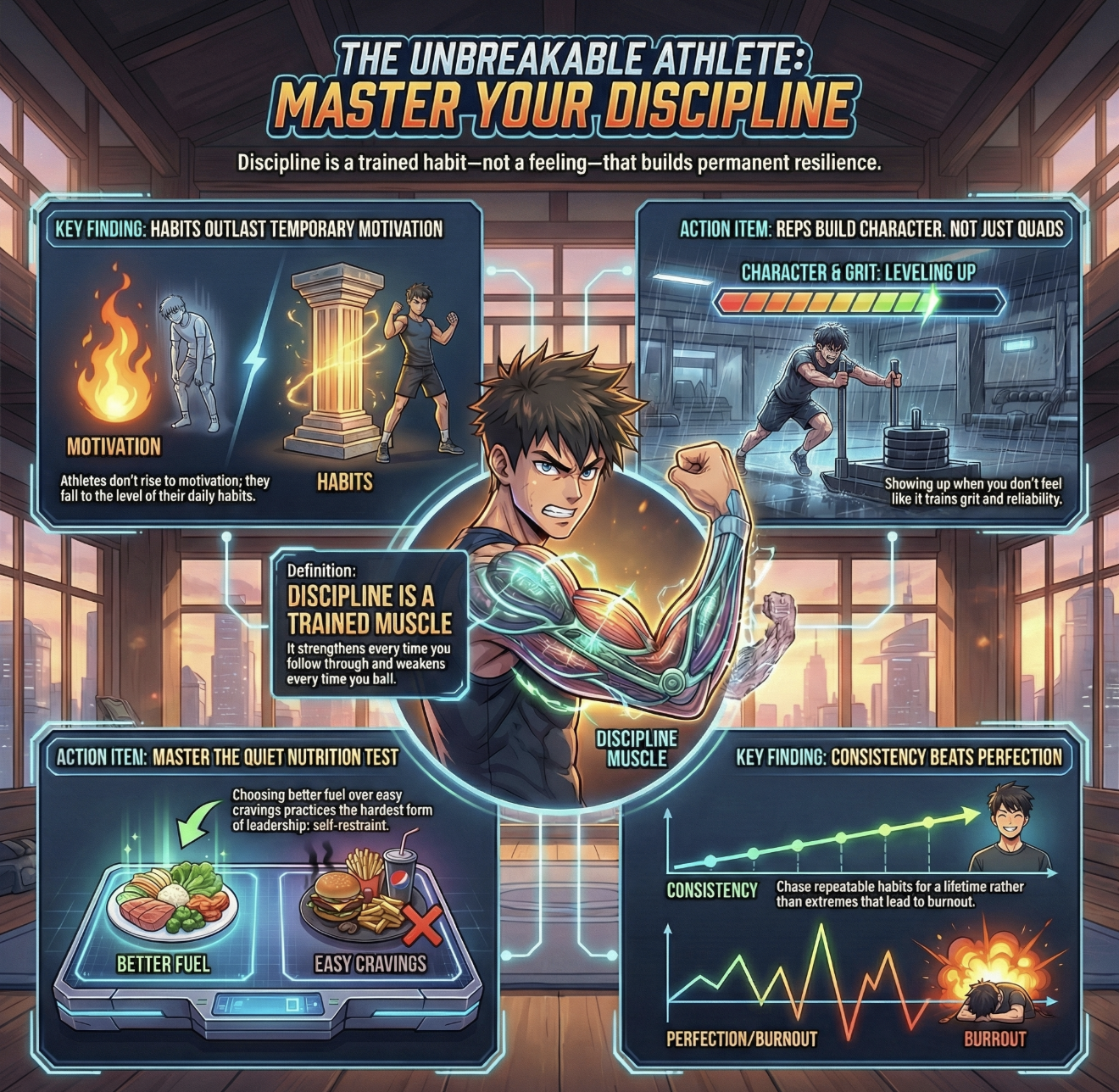
Discipline is not about weight on the bar. It never was. Discipline is about showing up — day after day, rep after rep, meal after meal — even when nobody is watching and nothing inside you feels like doing it. Every successful person you admire shares this one trait. They do the work when they don’t feel like it. They wake up, they prepare, and they follow through. There are rare exceptions in the world, people who seem to coast on raw talent, but even those exceptions had discipline first. No one becomes great by accident.
Discipline Comes Before Freedom
People love the idea of freedom. Freedom sounds fun and effortless, like some finish line you cross and then coast forever. But freedom is earned. Before freedom comes discipline. Before confidence comes consistency. Even the people who look carefree and relaxed at the top of their game trained relentlessly before they got there. They practiced when no one was watching. They repeated boring fundamentals until those fundamentals became automatic. That early discipline is what allows later freedom. You earn the right to improvise by first mastering the basics.
This applies to everything — school, sports, careers, relationships. The kid who builds discipline in a strength facility at fourteen carries that skill into a college dorm room at eighteen and a boardroom at thirty. It compounds. It transfers. And it never expires.
Training Builds More Than Muscles
Walk into Mighty Oak Athletic on any given afternoon and you will see young athletes grinding through barbell squats, deadlifts, overhead presses, power cleans from the floor, and floor rows. None of it is glamorous. None of it goes viral. But every single rep is building something deeper than muscle.
Training on a consistent schedule teaches reliability. When you commit to three sessions a week and you actually show up for all three — even the one on a rainy Tuesday when your friends are on the couch — you are training your character just as much as your quads. When you push through discomfort on a heavy set of squats instead of bailing early, you are learning grit in real time. Strength training rewards effort over time. It does not reward shortcuts. You cannot cram for a deadlift PR the night before. You earn it across weeks and months of showing up and doing the work.
This is exactly why training carries over into school, work, and life. You are learning to keep promises to yourself. That is a skill most adults still struggle with, and you are practicing it now.
Nutrition Is the Daily Discipline Test
If training is the big, obvious discipline challenge, nutrition is the quiet one that tests you every single day. Nutrition is not dramatic. It is repetitive. Every morning, every lunch break, every late-night craving — you face small choices that feel insignificant in the moment. But those small choices add up faster than you think.
Nutrition teaches delayed gratification better than almost anything else. You want the easy thing now. You choose the better thing for later. That one decision, repeated hundreds of times, strengthens your discipline just like adding five pounds to the bar strengthens your back. You are practicing restraint. You are practicing awareness. You are practicing leadership over yourself — and that is the hardest kind of leadership there is.
Nobody is asking you to be perfect. Eat real food. Drink water. Fuel your training. Skip the garbage most of the time. That is the whole plan. It is simple, but simple is not the same as easy, and the gap between those two words is where discipline lives.
Discipline Is a Muscle
Here is the part most people miss: discipline is not a personality trait you either have or you don’t. Discipline is a muscle. It grows with use and it weakens when you ignore it. Every time you follow through on a commitment, your discipline gets a little stronger. Every time you bail, it gets a little weaker.
You do not need perfection. You need consistency. One missed training session does not matter. Quitting does. One imperfect meal does not matter. Giving up does. The goal is never extremes. The goal is repeatable habits you can sustain for years. Chase perfection and you burn out in a month. Chase consistency and you build something that lasts a lifetime.
Why This Matters for Young Athletes
Athletes do not rise to the level of their motivation. They fall to the level of their habits. Read that again. Motivation is temporary. It spikes after a big win and disappears after a bad practice. Habits are permanent infrastructure. They hold you up when motivation checks out.
Discipline protects athletes from burnout because it removes emotion from the equation. You don’t train because you feel inspired. You train because it is Tuesday and Tuesday is a training day. Consistent training reduces injury risk. Consistent nutrition supports recovery. These are not opinions — they are observable, repeatable outcomes that play out in every serious strength facility in the country.
More importantly, these habits build confidence that carries into adulthood. The young athlete who learns discipline at fifteen does not suddenly lose it at twenty-five. It becomes part of who they are. This is how athletes become resilient people — not through motivation posters, but through thousands of reps and thousands of meals done right.
The Mighty Oak Way
At Mighty Oak Athletic, we do not chase quick results. We build strong roots. We focus on habits that last decades, not weeks. We train the body and the mind together because you cannot separate the two and expect either one to hold up.
Discipline is not punishment. Discipline is freedom in disguise. And the athletes who figure that out early have an advantage that no amount of talent can replace.
What High-Level Athletes Do Early That Others Don’t
Start Early or Fall Behind
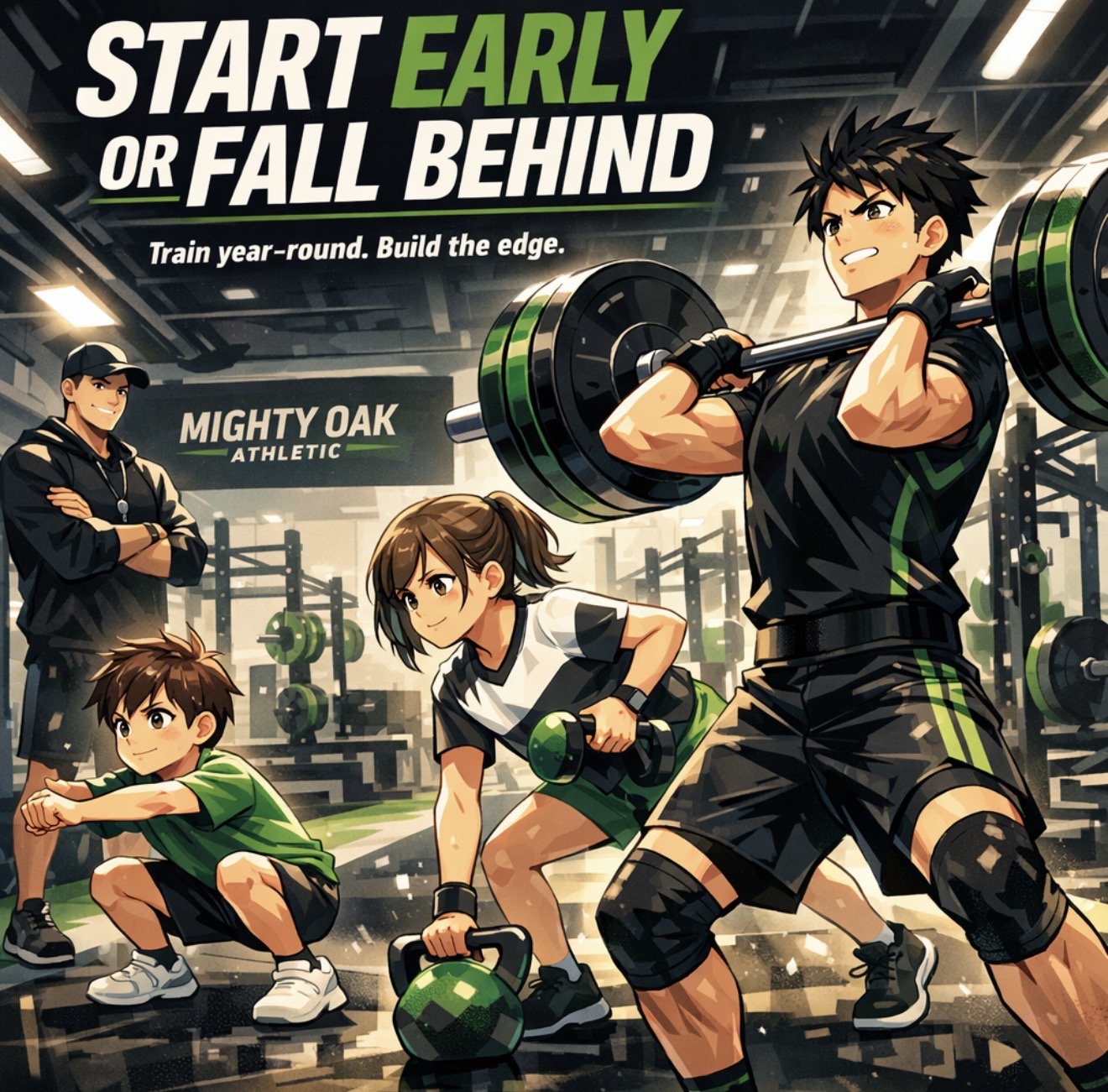
Here is a hard truth that a lot of families do not hear soon enough: if an athlete wants to stand out, they cannot treat strength training like a last-minute fix. They need to train year-round. They need a plan. And they need to start early.
By the time most athletes get serious about training in junior year, they are already trying to make up for years they cannot get back. That is usually the moment scouts start paying attention, so the urgency finally hits. But strength and power do not appear overnight. They take years to build. That is why more athletes are starting in seventh or eighth grade now, and in many cases, even earlier with simple, safe, age-appropriate training and good coaching. The key is not rushing kids into heavy lifting. The key is building the foundation early.
Stronger Earlier Changes Everything
When a young athlete starts training the right way, they gain a huge advantage over the athlete who waits. They learn how to move. They build body control, posture, and coordination. They develop confidence. And they get stronger year by year instead of trying to cram progress into one season.
That is how you get a 12-year-old who can squat impressive weight with great technique and total control. That is how that same athlete walks into freshman year already moving like an upperclassman. Meanwhile, other kids are just getting started. That gap matters. And in competitive sports, the gap usually gets bigger, not smaller.
High-Level Sports Require High-Level Strength
At the higher levels of sports, strength is not a bonus. It is the baseline. Powerful cleans, strong squats, explosive jumps, and the ability to absorb contact are common traits in college athletes. Even positions people think of as skill positions require real strength and power.
The mistake many athletes make is assuming they can turn it on later. They think they will get serious next summer or catch up once recruiting starts. But it takes years to build strength, power, and durability. There is no shortcut for that kind of development.
The Clock Is Always Ticking
Here is what athletes and parents often miss: there is very little true development time in a year. During the season, athletes are practicing and playing games. That is great for competition, but it is not the best window for major strength gains. Then preseason, spring sports, travel seasons, camps, and tournaments fill whatever is left.
When you really look at it, there is often less than half the year available for focused strength and power work. Every post-season window matters. If an athlete does not start a structured plan right after their season ends, they lose one of the best chances they had to improve.
And here is the part most people miss: every other athlete in their grade is also getting older, maturing, and getting stronger. So the real question is not whether your athlete improved. The real question is whether they improved faster than the athletes they are competing against. Waiting to start is not neutral. Training inconsistently is not neutral. Those things cost time. And in youth sports, time is one of the biggest advantages an athlete can have.
Early Start Does Not Mean Extreme Training
Starting early does not mean turning a 7-year-old into a powerlifter. It means teaching kids how to move well and train smart. For younger athletes, that might mean squatting and hinging with bodyweight, pushing and pulling with control, learning how to land and jump, basic medicine ball work, and light resistance with excellent form. The goal is fun, structured training that builds confidence.
As they grow, the plan grows with them. The best long-term athletes are not built with random hard sessions. They are built with years of smart progress. That is what good coaching does.
Year-Round Training Wins
A well-planned year-round program is how athletes keep moving forward, even when the sports calendar gets crowded. Post-season is for building strength and fixing weaknesses. Preseason is for maintaining strength while adding speed and conditioning. In-season is about staying strong, staying fresh, and reducing injury risk. Off-season is where you push progress again.
When training is planned this way, athletes stop starting over every few months. They keep building. That is the real goal. Not just having a good month or maxing out once in a while. The goal is stacking years of progress on top of each other.
The Time to Start
If your athlete is in high school and has not started a serious strength training plan yet, start now. If your athlete is in middle school, this is the perfect time to begin with proper coaching and a clear plan. If your athlete is younger, the focus should be movement, coordination, and fun, but yes, they can absolutely start building a foundation now.
The athletes who separate themselves are usually not the ones who suddenly get motivated late. They are the ones who started early, trained consistently, and followed a plan. That is how athletes stand out, build confidence, and give themselves a real chance to play at a higher level.
At Mighty Oak Athletic, we believe in year-round training, smart progression, and starting before everyone else thinks it matters. Because by the time everyone else realizes it matters, the leaders are already gone.
Soccer Parents: Ask Your Coach This One Question Before the Season Starts
Key Takeaways
High school ACL injury rates have grown roughly 26% since 2007 — and more than 32% for girls, who tear ACLs at multiples of the boys' rate in cutting and jumping sports.
Most non-contact ACL tears are preventable: neuromuscular warm-ups like FIFA 11+ have repeatedly cut ACL injuries substantially when done consistently.
The two missing pieces for most girls: a 12-minute pre-practice warm-up and two short strength sessions per week.
The one question every soccer parent should ask their coach: "What's your knee warm-up plan?"
Mighty Oak Athletic coaches ACL-protective strength for girls ages 6–18 in Westmont, IL — first session free.
Soccer Parents: Ask Your Coach This One Question
A New York Times Magazine story followed a girl who tore her ACL at 12, rehabbed for a year, came back — and tore the other one. It followed a second girl who tore hers, returned, and tore it again.
The most shocking part wasn't the injuries. It was how normal the adults around them said this has become.
It shouldn't be. This spring, the Associated Press reported what researchers have been shouting for years: ACL injury rates among high school athletes have grown roughly 26% since 2007 — and more than 32% for girls. Teen girls tear ACLs at multiples of the boys' rate in soccer and basketball. And when surveyed, most youth coaches admit they don't know the prevention programs exist, were never trained on them, or skip them to "get to the ball."
Here's the part every soccer parent in DuPage County needs to hear: a large share of these tears — especially the non-contact ones — are preventable. The research has existed for decades. As one biomechanics researcher put it, the real crime is that the answers have been out there for 25 years.
We can't control everything on the field. But we can control how athletes warm up, decelerate, land, cut, and build strength. That's the low-hanging fruit, and almost nobody is picking it.
What an ACL Tear Really Costs
An ACL injury isn't a broken wrist. It's usually surgery, months of rehab, and a return-to-play timeline that swallows a year. It raises the odds of future knee problems, including early osteoarthritis. And athletes who return after reconstruction carry a meaningful risk of tearing again — same knee or the other one.
For a teenager, it also hits identity: Who am I if I can't play?
That's what's at stake in a 12-minute warm-up.
Why Girls Are Tearing More
Three patterns show up over and over. Kids get less free play, so they log fewer childhood reps of climbing, scrambling, landing, and regaining balance — and ACL tears happen in the millisecond when the knee doesn't know where to go. Year-round specialization means thousands of identical cuts on tired legs. And strength training has lagged for girls: many boys get introduced to the weight room early while many girls never do — yet strong hips, hamstrings, and trunk control are exactly what keep a knee from collapsing inward on a cut or landing.
None of that is your daughter's fault. All of it is fixable.
The Biggest Win: Prevention Warm-Ups Actually Work
Neuromuscular warm-up programs — FIFA 11+ is the best-known — have repeatedly shown substantial reductions in ACL and overall injuries when teams do them consistently and correctly. The International Olympic Committee endorses them. This year, AYSO began rolling them out nationally because, in the words of its own programs director, the shock was that it didn't already exist.
So why doesn't your daughter's team do one? Because youth sports is busy, coaches feel pressure to get to the ball, and nobody hands them a simple plan.
Here's the plan.
Part 1: The 12-Minute Warm-Up (Before Every Practice and Game)
Jog + skip — 2 minutes. Easy pace. Wake up the body.
Leg prep — 2 minutes. Walking lunges x 10 steps. High knees x 20 yards. Butt kicks x 20 yards.
Single-leg balance + reach — 2 minutes. Stand on one leg; reach the other foot forward, to the side, and back, 3 each direction. Switch legs.
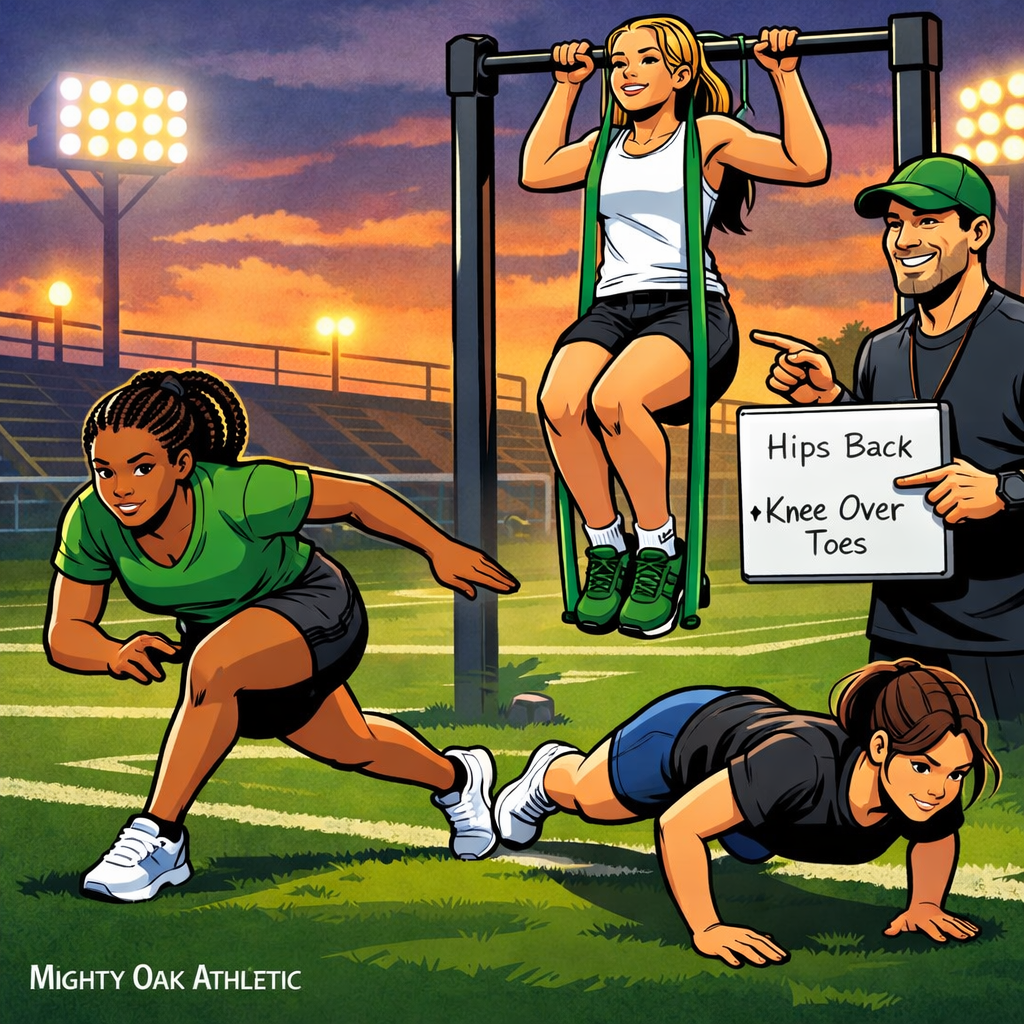
Landing mechanics — 2 minutes. Snap down to athletic position x 5. Small pogo jumps x 15. Stick a two-foot landing x 5. Cue: "Land quiet. Knees over toes. Hips back."
Deceleration + cut — 4 minutes. Sprint 10 yards into a hard stop in athletic position x 4. Shuffle 5 yards, plant, shuffle back x 4. Cue: "Drop your hips. Don't stay tall."
If you take one thing from this entire page, take the warm-up.
Part 2: Two Strength Sessions Per Week (The Knee Armor)
Thirty-five to forty-five minutes. Simple lifts. Perfect technique.
Day A: Goblet squat or front squat 3x5–8. Romanian deadlift 3x6–10. Split squat 2x8 per leg. Side plank 2x20–40 seconds per side.
Day B: Deadlift or hinge variation 3x5. Step-ups 2x8 per leg. Hamstring curls with a ball or sliders 3x8–12. Calf raises 2x12–20. Farmer carry 4x20–30 yards.
Why these? Because the ACL usually loses when hips are weak, hamstrings aren't doing their job, the athlete can't control deceleration, or the trunk collapses and the knee caves inward. These lifts attack all four.
Part 3: The Cues That Save Knees
Coaches, say these constantly: Hips back when you stop. Don't be tall — get low. Knee tracks over the middle toes. Land quiet. Control first, speed second. And the sneaky one: Show me the same perfect stop when you're tired. Most tears don't happen in the first five minutes. They happen when fatigue and focus drop.
What Parents Can Do (Without Becoming the Bad Guy)
You don't need to be the strength coach. You need to ask one question:
"Coach, what's your knee warm-up plan?"
If there isn't one, offer this: "We'll support you — can we run a 10–12 minute warm-up like FIFA 11+ before every session?"
That isn't overstepping. That's seatbelts.
The Mighty Oak Message
Girls' sports are booming, and that's worth celebrating. But we can't celebrate opportunity while accepting a system where torn ACLs feel normal. The next wave of great female athletes won't just be skilled — they'll be strong, coordinated, and trained to decelerate like pros.
That's the work we do every week at Mighty Oak Athletic in Westmont: barbell strength, landing mechanics, and deceleration training for girls and boys ages 6–18, coached identically, from Hinsdale, Clarendon Hills, Darien, Downers Grove, and across DuPage County. If your daughter plays a cutting sport, don't wait for the pop.
-
Most non-contact ACL tears are preventable with two components: a 10–12 minute neuromuscular warm-up (such as FIFA 11+) before every practice and game, and two weekly strength sessions targeting the hips, hamstrings, and trunk. Programs like these have repeatedly shown substantial reductions in ACL injuries when performed consistently and correctly.
-
Teen girls tear ACLs at multiples of the boys' rate in cutting and jumping sports. Contributing factors include less free-play movement development in childhood, year-round single-sport specialization, and a lag in strength training for girls — leaving weaker hips, hamstrings, and trunk control, which allows the knee to collapse inward during cuts and landings.
-
The most protective exercises build hip, hamstring, and trunk strength and teach controlled landing and deceleration: goblet or front squats, Romanian deadlifts, split squats, step-ups, hamstring curls, side planks, farmer carries, plus landing drills (stick a two-foot landing, "land quiet") and deceleration drills (sprint to a hard athletic-position stop).
-
Ask one question: "What's your knee warm-up plan?" If the team doesn't have one, offer support in running a 10–12 minute FIFA 11+ style warm-up before every session. The International Olympic Committee encourages neuromuscular warm-ups for youth athletes, and AYSO began rolling them out nationally in 2026.
Book a free training session — or if you coach a club team, invite Coach Mike to speak about building an ACL-prevention culture. Related reading: Jack's Arm Hurt. Mia's Knee Hurt. Here's What Fixed Both.
In an AI World, Strong Kids Still Win
Mighty Oak Athletic Podcast S3:E77 - In an AI World, Strong Kids Still Win
AI is changing the world our kids are growing up in.
It can help them study faster, organize their thoughts, and even get through homework with less stress. Used the right way, it’s a powerful tool.
But AI still can’t do the part that matters most for a student athlete.
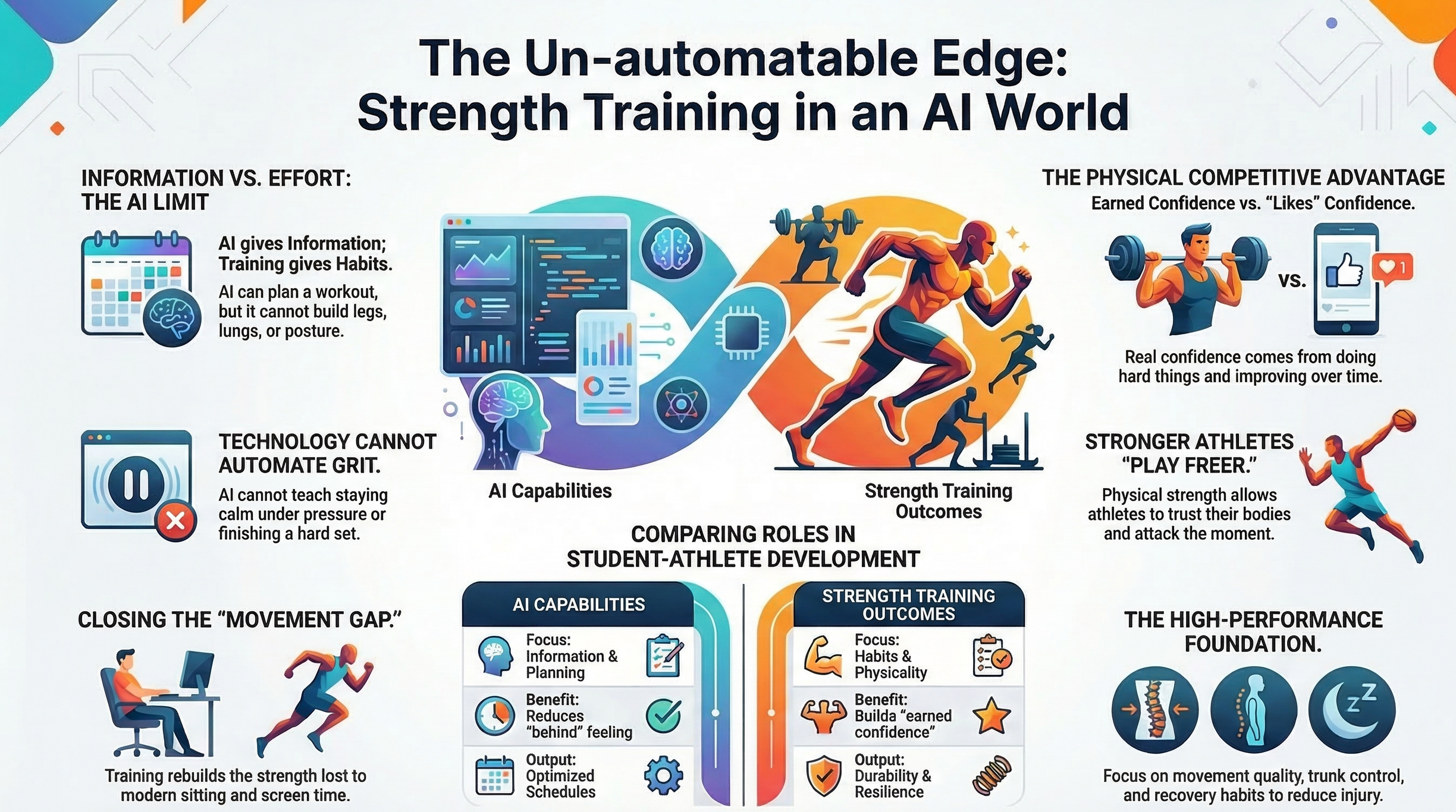
It can’t build your child’s legs. It can’t build their lungs. It can’t build their posture, balance, or grit. It can’t teach them what it feels like to stay calm under pressure, finish a hard set, or show up on a day when they don’t feel like it.
AI can support the process. It can’t replace it.
And that’s why strength training matters more than ever.
At Mighty Oak Athletic, we believe the future will reward kids who can do hard things in the real world. In a time when more tasks happen on screens, the ability to move well, train consistently, and build real confidence becomes a bigger advantage—not a smaller one.
AI Can Help a Student Athlete, But It Can’t Replace Effort
AI can absolutely be useful for young athletes.
It can help them plan their week, break down a concept from class, or learn a new skill faster. It can help parents create simple meal ideas, manage busy schedules, and reduce the “we’re behind” feeling that hits so many families.
That’s the good side of it.
But the improvement that shows up on the field, court, rink, or track still comes from effort and repetition. Stronger hips. More control. Better mechanics. More stamina. More confidence. Those outcomes are earned through training and coaching.
In other words: AI can give your child information, but it can’t give them habits.
The New Advantage: Strength, Discipline, and Coachability
As AI becomes more common, a lot of kids will have access to the same tools. That means “having information” won’t separate them the way it used to.
What will separate them is what they do with that information.
The kids who stand out will be the ones who can stay consistent, listen and apply coaching, handle discomfort without shutting down, work hard even when it isn’t exciting, recover well and take care of their body, and lead and communicate under pressure.
That’s not just an athlete list. That’s a life list.
And strength training is one of the best ways to teach it because it gives kids a simple, honest scorecard. You either showed up or you didn’t. You either stayed focused or you didn’t. You either improved your form or you didn’t. The weights don’t care about excuses, but they reward effort.
That’s a powerful lesson for a teenager.
Sports Are Still Physical, No Matter How Smart the Tech Gets
No matter how advanced technology becomes, sports still come down to the body.
A soccer player still needs strong hips, resilient legs, and the ability to change direction safely. A basketball player still needs power and control to jump, land, and absorb contact. A hockey player still needs strength through the trunk and legs to create force, hold position, and skate with balance. A flag football player still needs acceleration, coordination, and confidence in space.
AI can help with film, planning, and learning. But it can’t make a kid faster, stronger, or more durable.
Training can.
When athletes build a solid strength foundation, you often see the benefits everywhere. They move with more control. They sprint and cut with more confidence. They hold better positions in contact. They recover better from practices and games. They improve performance while reducing injury risk.
And one of the biggest changes is subtle but important: stronger kids usually play freer. They don’t hesitate as much. They trust their body. They attack the moment instead of avoiding it.
The Hidden Problem: Modern Life Makes Kids Move Less
Most kids today aren’t lazy. They’re just living in a world that pulls them toward sitting.
Between school, homework, phones, gaming, and long car rides, a lot of young athletes simply don’t move as much as kids used to. Even sporty kids can spend most of the day in a chair.
That matters because the body adapts to what it does most.
Too much sitting can quietly chip away at posture and trunk control, hip strength and mobility, coordination and balance, and basic work capacity.
Then a kid goes from sitting all day to sprinting, cutting, and taking contact at full speed. That jump is part of why we see so many overuse issues and nagging pains in youth sports.
Smart strength training helps close that gap. It rebuilds strength, improves movement, and prepares the body for the real demands of sport.
Parents: This Is Bigger Than Sports
It’s easy to view training as something that only matters for kids chasing varsity or college sports.
But the bigger value is confidence and capability.
Strength training gives kids something rare today: earned confidence.
Not “likes” confidence. Not social media confidence. Real confidence that comes from doing something hard, sticking with it, and improving over time.
That confidence carries into school, friendships, and the moments that matter most—tryouts, big games, hard classes, tough conversations, and stressful days.
AI may change how our kids learn and work, but it won’t change the value of discipline, resilience, and personal responsibility.
If anything, those traits will become more valuable as the world gets more automated.
The Mighty Oak Athletic Way
At Mighty Oak Athletic, we’re not anti-technology. We want kids to learn tools and use them well.
But we also want them to build the one thing no machine can give them: a strong body and a strong mindset.
That’s why we focus on consistent training, good coaching and movement quality, gradual progress over time, recovery habits that support growth, and accountability and effort.
We’re not just training athletes for next season.
We’re helping kids become capable young people who can handle a fast-changing world—on the field and off it.
Final Thought
AI is here, and it’s going to keep improving. That’s not a reason to panic. It’s a reason to prepare.
Let your kids learn technology. Let them use smart tools.
But make sure they’re also building what can’t be automated: a strong body, real confidence, and habits that last.
In an AI world, strong kids still win.
And that’s exactly what we’re building at Mighty Oak Athletic.
The First Step to Success That Most People Skip
Mighty Oak Athletic Podcast S3:E76 - The First Step to Success That Most People Skip
Someone once told me not to include things like diet, exercise, and energy in a post about success. Another group said those ideas were too obvious, that everyone already knows them.
But if everyone really understood this, the evidence would be obvious. Walk down almost any street in America and you would see people full of energy, standing tall, moving with confidence and purpose. Instead, you often see the opposite—exhaustion, slumped shoulders, short patience, and low motivation.
Your Body Is Your First Tool
Here is the part most people skip: your body is your first tool.
Before your brain can focus, before your emotions can regulate, before your confidence can grow, and before your discipline can show up, your body has to work. When your body works, everything downstream works better. You think more clearly, you sleep more deeply, you handle stress with more control, and you show up with more presence and purpose.
This shows up in every area of life. Your social life improves, not because you are trying harder, but because your energy is different. Your work improves because you can concentrate longer, recover faster, and create with more consistency. Your opportunities improve, not because the world is shallow, but because posture, tone, and energy communicate before words ever do.
This is not about vanity. It is about function.
What We See Every Day at Mighty Oak Athletic
At Mighty Oak Athletic, we see this every day. A kid walks in tired, anxious, overstimulated, and low on confidence. They begin training. They move, breathe, carry load, jump, sprint, and sweat. Sixty minutes later, their face is different. Their posture is different. Their mood is different. Their belief in themselves is different.
Nothing about their school changed. Nothing about their family changed. Nothing about their schedule changed. Their body changed. And when the body changes, the mind follows.
That is why skipping physical development in any conversation about success is backwards. It is like trying to design a house by arguing about paint colors before pouring the foundation. The body is the foundation.
If you care about success and you have not taken care of your physical tool first, you are not even really trying yet. Not because you are lazy, broken, or unmotivated, but because you are ignoring the base of the pyramid.
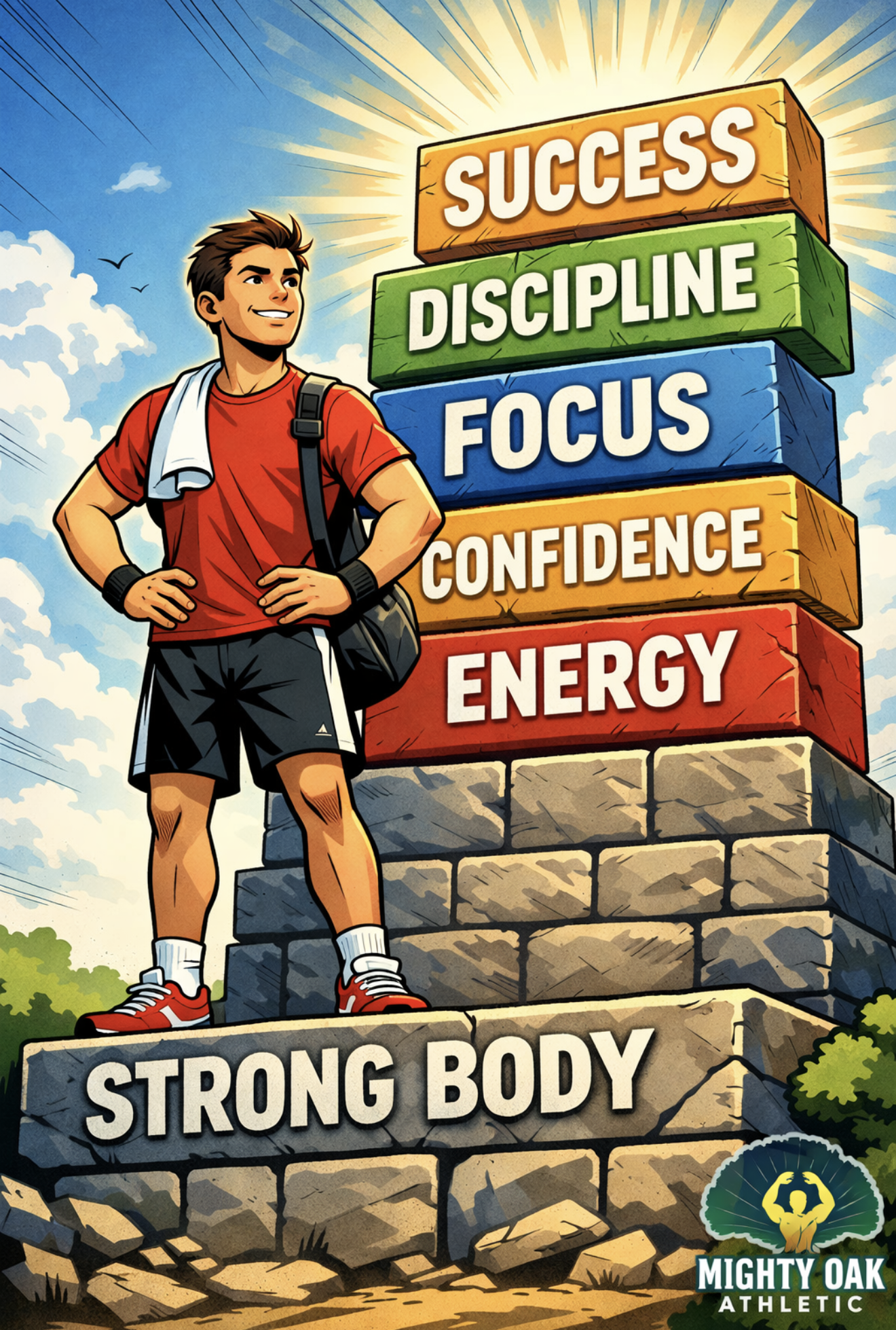
Strength builds confidence. Movement stabilizes mood. Training builds discipline. Consistency builds identity. And identity drives behavior.
At Mighty Oak Athletic, we do not train kids just to get strong. We train them to become capable, resilient, and calm under pressure. We train them to trust their bodies and, through that, to trust themselves.
Because when the body works, life works better. And when life works better, success finally has something solid to stand on.
Why Girls Quit Sports — And Why That’s About to Change
Mighty Oak Athletic Podcast S3:E75 - Why Girls Quit Sports — And Why That’s About to Change
I didn’t notice it at first.
When kids are young, everyone plays. Boys, girls—it doesn’t matter. They’re running around, laughing, chasing the ball, figuring it out as they go. Sports are simple. Sports are fun.
But then something changes.
Around middle school, the sidelines start to look different. Fewer girls. More empty spots. More “I used to play…”
And once you see it, you can’t unsee it.
The Drop-Off Nobody Plans For
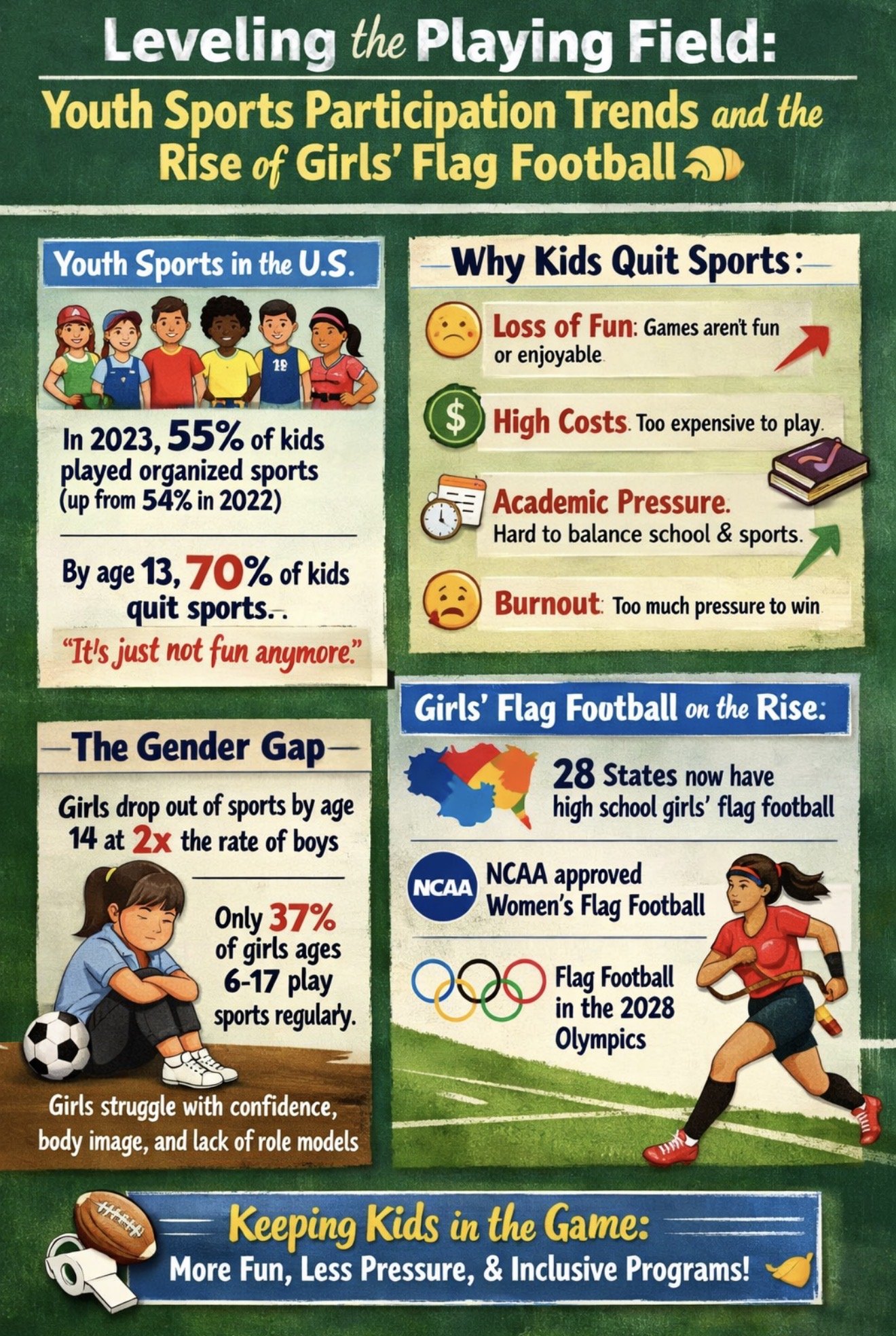
By the time girls reach their early teenage years, they’re dropping out of sports at twice the rate of boys.
Not because they stopped liking sports.
Because something about the experience changed.
It becomes less about playing and more about performing. Less about learning and more about comparing. Less about showing up and more about proving something.
And for a lot of girls, that shift is enough to walk away.
It’s Not One Reason—It’s a Pattern
Confidence dips right when sports start demanding more.
They become more aware of how they look, how they move, who’s watching. Playing time gets tighter. Mistakes feel bigger. The environment gets more serious.
At the same time, life gets busier. School ramps up. Social pressure increases.
And underneath all of it, one simple thing starts to disappear:
Fun.
When fun goes away, participation usually follows.
The System Isn’t Built to Keep Everyone In
Youth sports has quietly become an “all-in or all-out” model.
More travel. More cost. More time. More pressure to specialize early.
If you’re one of the top players, you stay in.
If you’re not, you start to feel like you don’t belong.
That’s how you end up with 70% of kids quitting sports by age 13.
Not because they don’t need sports—but because sports stopped working for them.
So What Actually Keeps Girls Playing?
If we want girls to stay in sports longer, we don’t need more pressure.
We need better environments.
We need sports to feel like they did when they were younger:
Fun. Supportive. Inclusive. Energizing.
We need places where girls can develop confidence before they’re asked to prove it.
We need opportunities where they can contribute early, improve steadily, and feel like they belong the whole time.
Because when a girl feels confident, she stays.
Where This Starts to Work
This is exactly what we’re trying to build.
At Sunday Funday Sports, the goal is simple: make sports something kids want to come back to.
One day a week. One game. No weeknight practices. No pressure to specialize.
Kids show up, play hard, laugh, compete, and go home wanting more.
That structure matters more than people think.
Because when you remove the pressure, you keep the player.
Girls don’t need more intensity. They need more positive reps, more confidence-building moments, and more chances to just play.
At Mighty Oak Athletic, we focus on what sits underneath all of it.
Strength. Movement. Confidence.
Not just to improve performance—but to change how kids feel about themselves.
Because when a girl feels strong, everything shifts.
She runs with more confidence. She’s more willing to try. She’s less afraid to fail.
And that changes whether she stays in sports or not.
This Is Where Opportunity Meets Environment
There are more opportunities for girls in sports right now than ever before.
New leagues. New teams. New pathways.
Flag football is one example of that growth—but it’s not the whole story.
Opportunity only matters if the experience keeps them coming back.
If the environment is right, girls stay.
If it’s not, they leave—no matter how many opportunities exist.
The Goal Isn’t Just More Sports
The goal is more girls staying in sports.
Girls who feel confident.
Girls who feel strong.
Girls who compete, lead, and enjoy it.
Girls who don’t say, “I used to play.”
Because when we get this right, we’re not just building better athletes.
We’re building something that lasts.
Are You a Parent… or Your Kid’s Sports Manager?
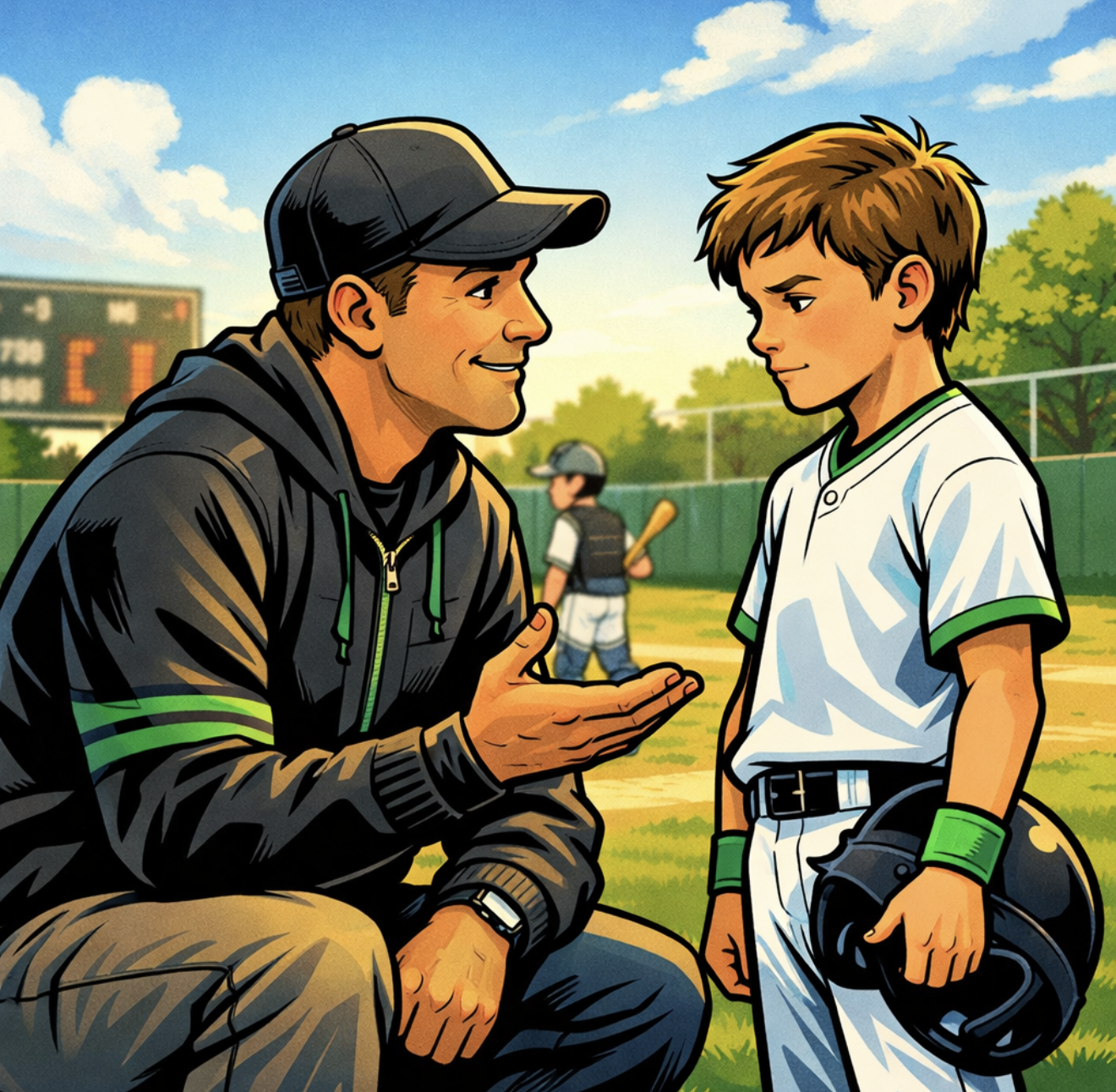
I don’t think I would have known how to be a parent without sports.
I would have been a dad either way, obviously. I love my kids. I would have shown up. I would have cared. But sports handed me something I didn’t know I needed: a toolbox.
It gave me real-life moments—small, emotional, high-stakes (to a kid)—where I could teach values without turning the kitchen table into a lecture hall. Because here’s the truth: most parenting “lessons” don’t land when you schedule them. They land when your child strikes out and wants to cry, when they miss the shot and feel embarrassed, when the ref makes a call they think is unfair, and when they’re tired, frustrated, and their emotions are right at the surface. Sports gives you those moments over and over, and if you handle them well, those moments become character training.
What matters (and what doesn’t)
This is one of the best parts of sports: it’s totally fine if you win or lose. It’s totally fine if you struck out or hit a home run. Those things matter in the game… but they don’t matter in the long game. What matters is how you respond.
It does matter if you threw your helmet. It does matter if you blamed your teammate. It does matter if you quit the second it gets hard. It does matter if you lied, pouted, or disrespected a coach.
Sports gives parents a clean way to talk about behavior without making it personal. You don’t have to say, “You’re being rude.” You can say, “We don’t throw helmets.” Now the standard is clear. It’s not about shame. It’s about expectations. That’s parenting gold.
Where it goes off the rails
Here’s where I feel conflicted. My family got a lot out of sports. A lot. But I’m not sure our experience is typical. Because I also see what happens when sports turns into a scholarship factory.
That’s when things start to break. When the message becomes: “You better be the best.” “You better specialize early.” “You better dominate or you’re falling behind.” “You better impress the right coach.” “You better turn your childhood into a résumé.”
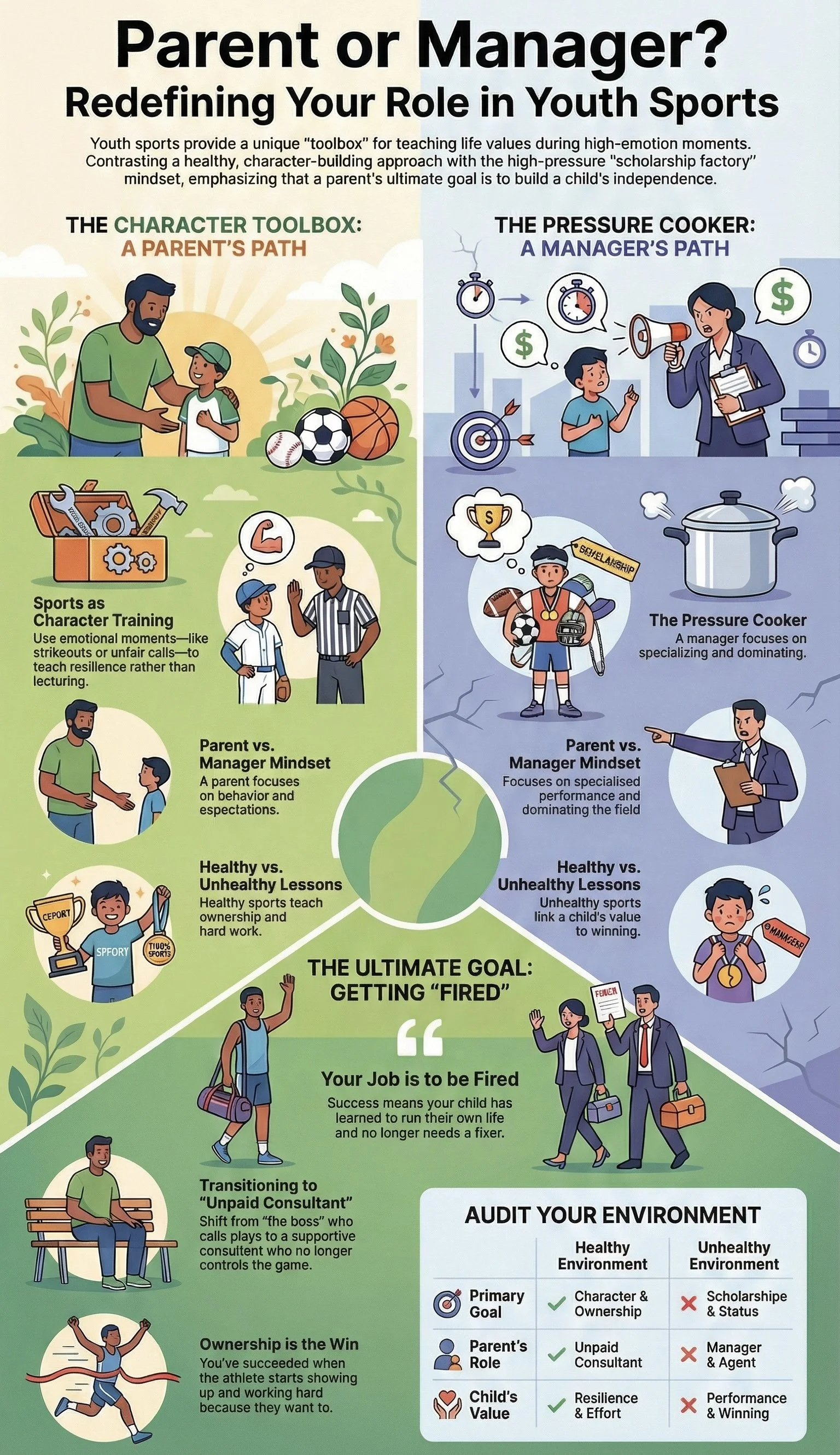
That’s when sports stops being a teacher and starts being a pressure cooker. And pressure changes the parent-child relationship. Now you’re not just Dad. You’re the manager. You’re the critic. You’re the agent. You’re the one who “knows what it takes.” And your kid feels it. Even if you never say it out loud, they can feel the weight.
The hardest parenting truth I’ve ever heard
Here’s the line that hits like a brick: “Your job is to be fired.”
If you’re doing it well, your child eventually doesn’t need you to run the show. They don’t need you to solve every problem. They don’t need you to fight every battle. They don’t need you to be the voice in their head. They need your help less because they’ve learned to help themselves more. That’s the goal.
And it’s hard—because being needed feels good. Being Dad-Coach feels important. You’re the helper. The driver. The fixer. The planner. The “we’ve got this” guy. Then one day, without warning, you get demoted. Not because they hate you. Because they’re growing up.
The “unpaid consultant” phase (and the valet phase)
At some point, parenting changes shape. You go from being “the boss” to being “the consult.” You’re still on the team. But you’re not calling the plays anymore.
You’re an unpaid consultant. And sometimes… you’re a valet. You still show up. You still support. But you don’t control.
And this is where a lot of parents panic. Because control feels like love when you’re afraid. But control is not love. Love is building a kid who can stand on their own two feet.
How to know if sports is helping your family
Here’s a quick check.
Sports is healthy when it teaches your child: How to work hard. How to handle disappointment. How to be coachable. How to be a great teammate. How to manage emotions. How to take ownership. How to bounce back.
Sports is unhealthy when it teaches your child: “I’m only valuable if I win.” “Mistakes mean I’m a failure.” “Adults’ approval is everything.” “My parent’s mood depends on my performance.” “I can’t stop, even if I hate it.”
The difference isn’t the sport. It’s the environment.
The Mighty Oak Athletic message
At Mighty Oak Athletic, we use training to build athletes. But even more, we use training to build people.
Because training is one of the best places on earth to practice the skills that parenting is trying to build: discipline, confidence, resilience, self-control, responsibility, leadership.
And the best part? When the system works, the athlete starts owning it. They start showing up because they want to. They start working because they care. They start improving because they take pride in it.
That’s when you know you’re doing it right. Not because they won. Because they’re growing.
A simple goal for parents
If you want one job description that’s actually useful, here it is: Build a kid who can run their own life.
Sports can help. Training can help. But only if we keep the mission clear: Not scholarships. Not status. Not “keeping up.”
Character. Ownership. Confidence. And yes—eventually, getting fired.
Because if your child can “fire” you in a healthy way… it means you built something strong. Something that can stand.
Run Like a Super Bowl MVP: The Real Reason Kenneth Walker III Is So Hard to Tackle
Mighty Oak Athletic Podcast S3:E72 - Run Like a Super Bowl MVP: The Real Reason Kenneth Walker III Is So Hard to Tackle
Running is one of the most natural things athletes do.
You put on your shoes, lean forward, and go.
Because it feels simple, many athletes assume that if they just run more, they’ll become faster, more explosive, and harder to stop.
But that assumption is where most athletes get stuck.
If running alone were enough, distance runners would dominate football fields.
They don’t.
The athletes who look fast in games aren’t just moving their legs quickly—they’re producing and controlling force with every step.
That difference comes from strength.
What We’re Really Watching on Sundays
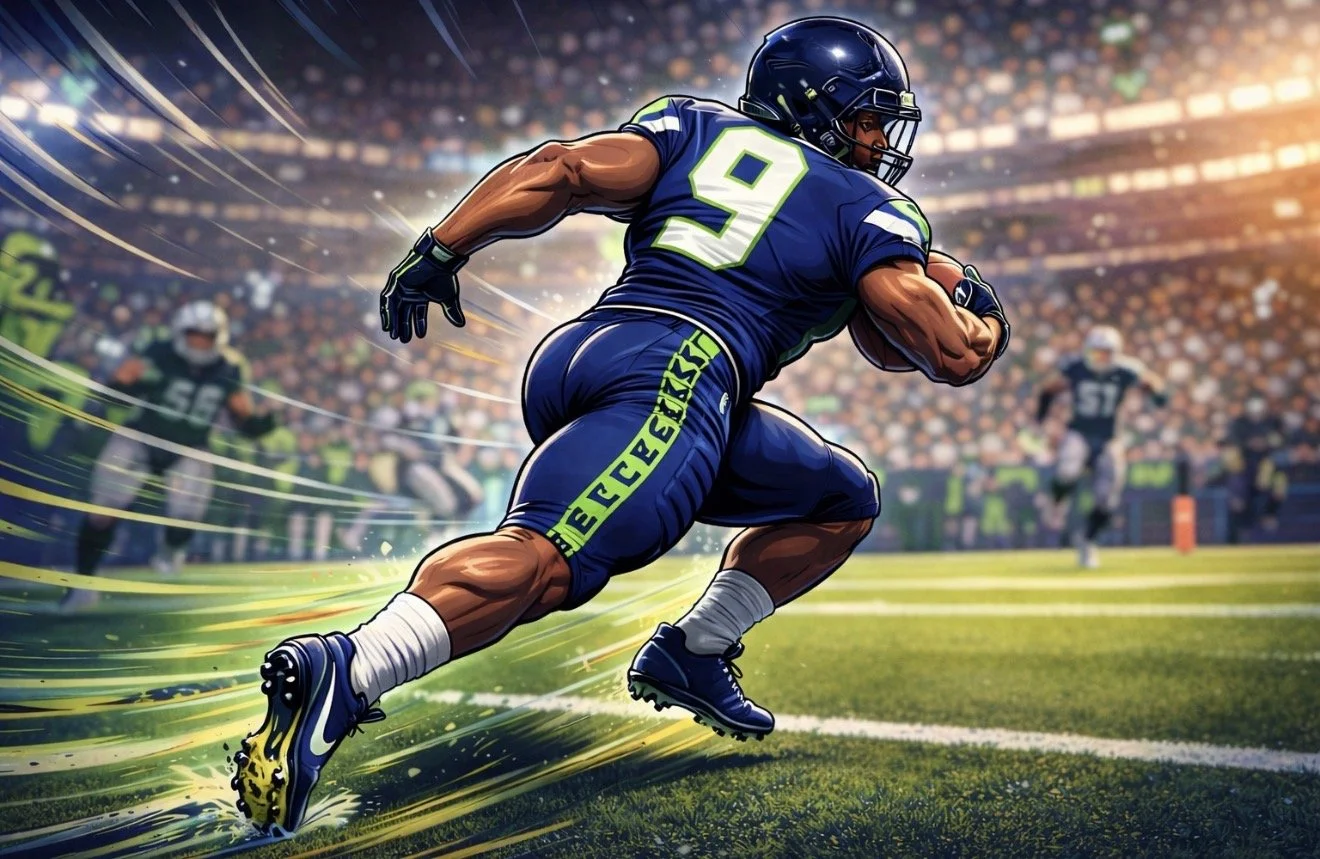
When you watch a Super Bowl MVP-level running back like Kenneth Walker III, you’re not just watching speed.
You’re watching power expressed through movement.
His running style is calm, violent, and efficient all at once.
He doesn’t waste steps.
He doesn’t lose balance through contact.
He explodes out of cuts and keeps his legs driving when defenders reach him.
That kind of running is not built by conditioning alone.
It’s built by strong hips, powerful legs, and training that prepares the body for chaos.
The Engine Matters More Than the Gas
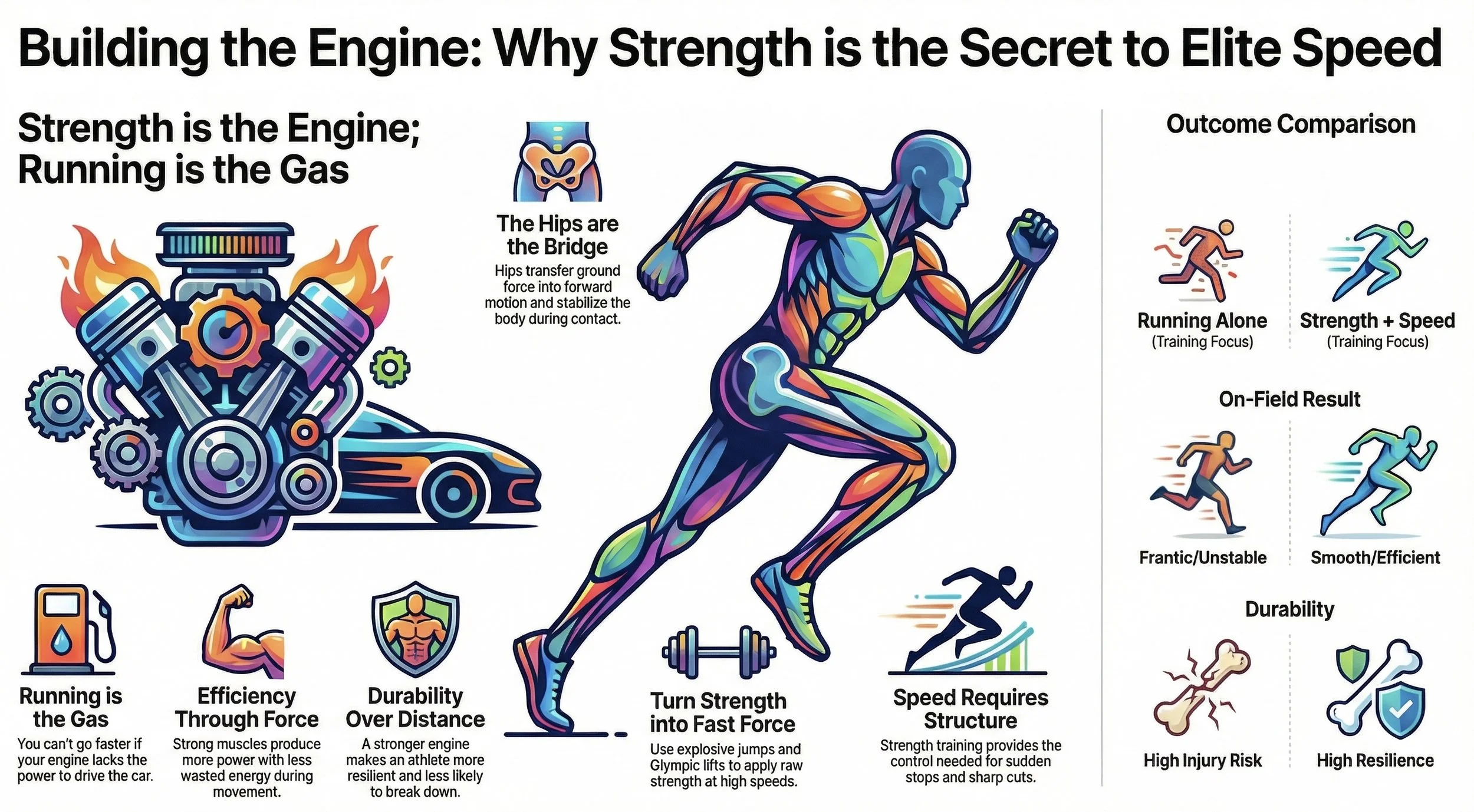
Think about the body like a car.
Running is the gas pedal.
Strength training is the engine.
You can press the gas harder and harder, but if the engine is weak, the car won’t go faster—and it will break down sooner.
A stronger engine doesn’t just make the car quicker.
It makes it more efficient, more reliable, and more durable over long distances.
Strong muscles work the same way.
They produce more force with less wasted energy.
They allow athletes to sprint, cut, and absorb contact without leaking power or losing control.
That’s why elite runners don’t look frantic.
They look smooth.
Why Hip Strength Changes Everything
Elite running starts at the hips.
The hips are the bridge between the upper and lower body, and they are responsible for transferring force from the ground into forward motion.
At Mighty Oak Athletic, we prioritize hip strength through movements like deadlifts, squats, and lunges.
These aren’t just “leg exercises.”
They teach athletes how to produce force, control force, and redirect force—exactly what happens during a game.
When hips are strong, athletes stay upright through contact.
They decelerate under control.
They reaccelerate without hesitation.
That’s how speed becomes usable.
Turning Strength Into Speed
Strength alone isn’t enough.
It has to show up quickly.
That’s why explosive training is a major part of how we train athletes.
Movements like box jumps, jump lunges, sumo jumps, cleans, snatches, and clean and jerks teach the body to apply force fast.
Fast force is speed.
Fast force with control is game speed.
This is where you see the difference between athletes who can run fast in a straight line and athletes who can run fast when it matters.
Why “Just Running” Falls Short
Running is predictable.
Games are not.
Sports demand sudden stops, sharp cuts, awkward contact, and constant changes of direction.
Without strength, athletes lose energy, lose balance, and eventually lose availability.
That’s when injuries show up.
Not because athletes weren’t tough enough—but because they weren’t prepared enough.
Strength training doesn’t slow athletes down.
It gives their speed structure.
It helps reduce injury risk by making the body more resilient under stress.
The Mighty Oak Athletic Philosophy
We don’t choose between running and strength.
We build both.
We train athletes to move well, get strong, express power, and stay durable over the long term.
That’s how speed lasts past halftime.
That’s how confidence shows up on game day.
That’s how athletes start to look less like joggers in pads and more like Super Bowl-level runners.
Final Thought
If you want to run better, don’t just run more.
Build the engine.
Strength turns effort into output.
Power turns strength into speed.
That’s how you run like a Super Bowl MVP.
Strength Training for Baseball: The Off-Season Program College Coaches Wish Every Kid Had Done
TRAINING PROGRAM & EXERCISE VIDEOS BELOW

Key Takeaways
Baseball players are built in the off-season — not in games, showcases, or endless cage sessions.
This complete, free strength program requires no gym: bodyweight, a loaded backpack, a detergent jug, a towel, a wall, and a floor.
The program targets bat speed, throwing velocity, sprint speed, shoulder health, hip stability, and injury reduction.
Ages 7–11 train two full-body days per week; ages 12–18 train three.
Video demonstrations for key movements are free in the Mighty Oak Athletic exercise library, with more demos on the way.
The Free Off-Season Baseball Program That Needs Zero Gym Equipment
The off-season is where baseball players are built.
Not in games. Not in showcases. Not in the batting cage, swinging the same swing on the same tired legs for the ninth straight month.
Players are built in the months when a young athlete can get stronger, move better, and lay the physical foundation that makes next season feel easier instead of harder. The 12-year-old who spends the off-season building leg drive and shoulder strength shows up in spring with a faster bat, a livelier arm, and a body that holds up through July. The one who only hits? He shows up with the same swing and a sorer elbow.
At Mighty Oak Athletic in Westmont, Illinois, we believe every kid should have access to high-quality strength training — even if the only gym they have is a bedroom floor. So here it is: a complete, free off-season strength program for baseball players that requires little to no equipment.
Everything you need: bodyweight, a backpack filled with books, a laundry detergent jug, a towel, a wall, and a floor.
Simple tools. Powerful results.
This program improves bat speed, throwing velocity, sprint speed, core strength, shoulder health, and hip stability — while reducing injury risk. And it builds something just as important: confidence.
Warm-Up (5–7 Minutes)
Jumping Jacks – 2 x 30 seconds
High Knees – 2 x 20 seconds
Arm Circles – 10 each direction
Around the Clock – 3 each leg. Opens the hips in every direction a fielder moves.
Toe-Squat-Sky – 8 reps. Hinge, squat, and overhead press in one flow — the perfect full-body primer.
Deep Squat Hold – 30 seconds
Strength Block A – Lower Body & Core
Backpack Goblet Squat — 3 sets x 8–12 reps. Builds leg drive for hitting and throwing. Master the bodyweight squat on video first, then hug the backpack.
Reverse Lunge — 3 sets x 6 each leg. Develops single-leg strength for sprinting and base running.
Wall Sit — 2 sets x 30–60 seconds. Improves leg endurance and posture.
Front Plank — 3 sets x 20–45 seconds. Creates core stiffness for powerful rotation. When 45 seconds is easy, progress to Shoulder Taps.
Strength Block B – Upper Body Push & Pull
Push-Ups — 3 sets x 6–15 reps. Builds pressing strength and shoulder stability.
Backpack Bent-Over Row — 3 sets x 8–12 reps. Strengthens the upper back to support throwing mechanics.
Face Pull with Towel — 3 sets x 12–15 reps. Protects the shoulders and improves posture.
Wall Angels — 2 sets x 10. Restores shoulder mobility and control.
Strength Block C – Power & Rotation
Squat Jumps — 3 sets x 5. Develops explosive lower-body power for sprinting and hitting.
Rotational Chop — 3 sets x 6 each side. Builds core rotation for bat speed. No-equipment variation on video: Seated Cross Punch.
Side Jump (Ice Skater) — 2 sets x 5 each side. Lateral power and single-leg landing control for fielding and base running.
Single-Leg Balance Reach — 2 sets x 6 each leg. Improves ankle, knee, and hip stability for cutting and fielding.
Conditioning Finisher (Optional)
Mountain Climbers – 20s on / 40s off x 4
Bear Crawl – 3 x 20 yards
Farmer Carry – 3 x 30 seconds
Jump Lunges – 2 x 5 each leg (advanced athletes only)
Learn the Movements
Video demonstrations for key movements — linked throughout the program above — are free in the Mighty Oak Athletic exercise library, with more demos on the way, plus training content on our YouTube channel.
-
An effective off-season program trains the full body two to three days per week with a warm-up, a lower-body and core block (squats, lunges, planks), an upper-body push-pull block (push-ups, rows, face pulls), and a power block (jump squats, rotational chops). Mighty Oak Athletic publishes a complete free version requiring no equipment beyond a loaded backpack and household items.
-
Ages 7–11 should train two full-body days per week; ages 12–18 should train three. More is unnecessary during the off-season and can interfere with recovery, especially for athletes still practicing their sport.
-
Bat speed and throwing velocity come from the ground up: squats and lunges build leg drive, planks and rotational chops transfer force from the legs through the core into the bat or ball, and rows and face pulls strengthen the upper back and rear shoulder so young throwers can produce and decelerate arm speed safely.
-
No. A complete off-season program can be performed with bodyweight, a backpack filled with books, a laundry detergent jug, a towel, a wall, and a floor. Load can progress by adding books to the backpack; ffree video demonstrations for key movements are available in the Mighty Oak Athletic exercise library.
Want the next level? MOA's training programs take athletes from backpack squats to the barbell — and if you're near Westmont, Hinsdale, Darien, or anywhere in DuPage County, your player's first coached session is free. For the fuel side of performance, grab Mighty Oak Athletic Nutrition on Amazon.
Nothing Can Ruin Your Day Quite Like Two Teenage Daughters - And How Training Fixes It

Mighty Oak Athletic Podcast S3:E71 - Nothing Can Ruin Your Day Quite Like Two Teenage Daughters
I wake up ready to attack the day with a clear head, good energy, a positive mood, and a strong body.
I am a morning person. I train. I hydrate. I sleep. I move.
I have built systems that set me up to feel good and start the day with momentum.
Then my two teenage daughters wake up.
Doors slam. Voices rise. Arguments explode. Tears appear. Logic disappears.
And somehow, in a matter of minutes, the calm, centered, happy guy turns into an anxious, irritated, frustrated version of himself.
Nothing can ruin your day quite like two teenage daughters.
Not because they are bad kids.
Not because they are trying to be difficult.
But because emotions are contagious, and stress spreads fast.
This is something we see every day at Mighty Oak Athletic.
Athletes walk in carrying the weight of their world: school pressure, social drama, expectations, fatigue, anxiety, frustration, low confidence, and big emotions.
Some are bouncing off the walls. Some are shut down. Some are angry. Some are overwhelmed.
But something powerful happens when they start moving.
Electronics go away. Distractions fade. Breathing gets heavy. Heart rates rise. Muscles work. Focus sharpens. Their bodies change, and their minds follow.
Because the fastest way to change your mental state is to change your physical state.
Movement is a reset button.
I have learned this the hard way at home.
When the house turns into a battlefield, I can feel my nervous system spike, my patience shrink, and my tone sharpen. In that moment, I have a choice: react or reset.
If I pause, take a breath, acknowledge what I am feeling, and get to my training, everything changes.
An hour of lifting, pushing, pulling, sweating, and focusing burns off the stress. The anger drains out. The mind clears. The body settles.
I walk out calmer, more patient, more grounded. Now I can be a better husband, a better dad, a better coach, a better friend, and a better human. Now I can help my daughters instead of reacting to them.
This is the heart of what we do at Mighty Oak Athletic.
Yes, athletes get stronger.
Yes, they get faster.
Yes, they reduce injury risk.
Yes, they perform better on the field.
But more importantly, they learn how to regulate themselves. They learn how to use movement to process emotion. They learn that when life feels overwhelming, their body can lead their mind back to calm.
They learn that strength is not just muscle.
It is composure.
It is confidence.
It is control.
Training builds better athletes.
But it also builds better humans.
And almost all of the time, that matters even more than the scoreboard.
How Kids Get Strong: The Hidden System
Mighty Oak Athletic Podcast S3:E70 - The Hidden System Behind How Kids Get Strong
Every great coach is a pattern expert.
Not just with numbers and sets.
But with people.
With movement.
With confidence.
With habits.
With how kids grow.
At Mighty Oak Athletic, everything we do is built on three ideas:
Recognizing patterns.
Using patterns.
Creating patterns that shape who a young athlete becomes.
Pattern Recognition: Seeing What Repeats
When you coach long enough, you start to see the same things over and over.
The same tight hips in soccer players.
The same rounded shoulders in swimmers and baseball players.
The same lack of confidence in kids who have been cut before.
The same fear of failing in kids who have only been praised for winning.
You also see positive patterns:
Kids who show up consistently get stronger.
Kids who master the basics move better.
Kids who experience small wins build belief.
Great coaching starts with seeing these patterns early.
Before pain becomes injury.
Before frustration becomes quitting.
Before “I’m not good at this” becomes identity.
At Mighty Oak, we look for patterns in how kids move, think, and respond to challenge.
Because you can’t help what you can’t see.
Pattern Utilization: Training With the Way Humans Adapt
Once you recognize patterns, you can design training that works with the body and mind instead of against them.
Strength grows in waves.
Confidence grows through mastery.
Focus improves through structure.
Consistency beats intensity.
That’s why we use:
Progressions.
Levels.
Repeated fundamentals.
Structured warm-ups.
Planned recovery.
We don’t randomize for the sake of variety.
We repeat what works because the nervous system learns through repetition.
We build gradually because tissues adapt gradually.
We layer skills because confidence stacks like bricks.
This is pattern utilization.
Using biological and psychological rhythms to help kids:
Move better.
Get stronger.
Reduce injury risk.
Feel capable in their bodies.
The system isn’t accidental.
It’s designed around how humans actually grow.
Pattern Creation: Building Identity, Not Just Muscles
The highest level of coaching is not just seeing patterns or using them.
It’s creating new ones.
This is where Mighty Oak Athletic lives.
We are not just teaching squats, pushes, pulls, and jumps.
We are creating patterns of:
Showing up.
Trying hard.
Finishing what you start.
Supporting teammates.
Recovering well.
Respecting the process.
Over time, those become identity.
“I am someone who trains.”
“I am someone who gets stronger.”
“I am someone who doesn’t quit.”
“I am someone who takes care of my body.”
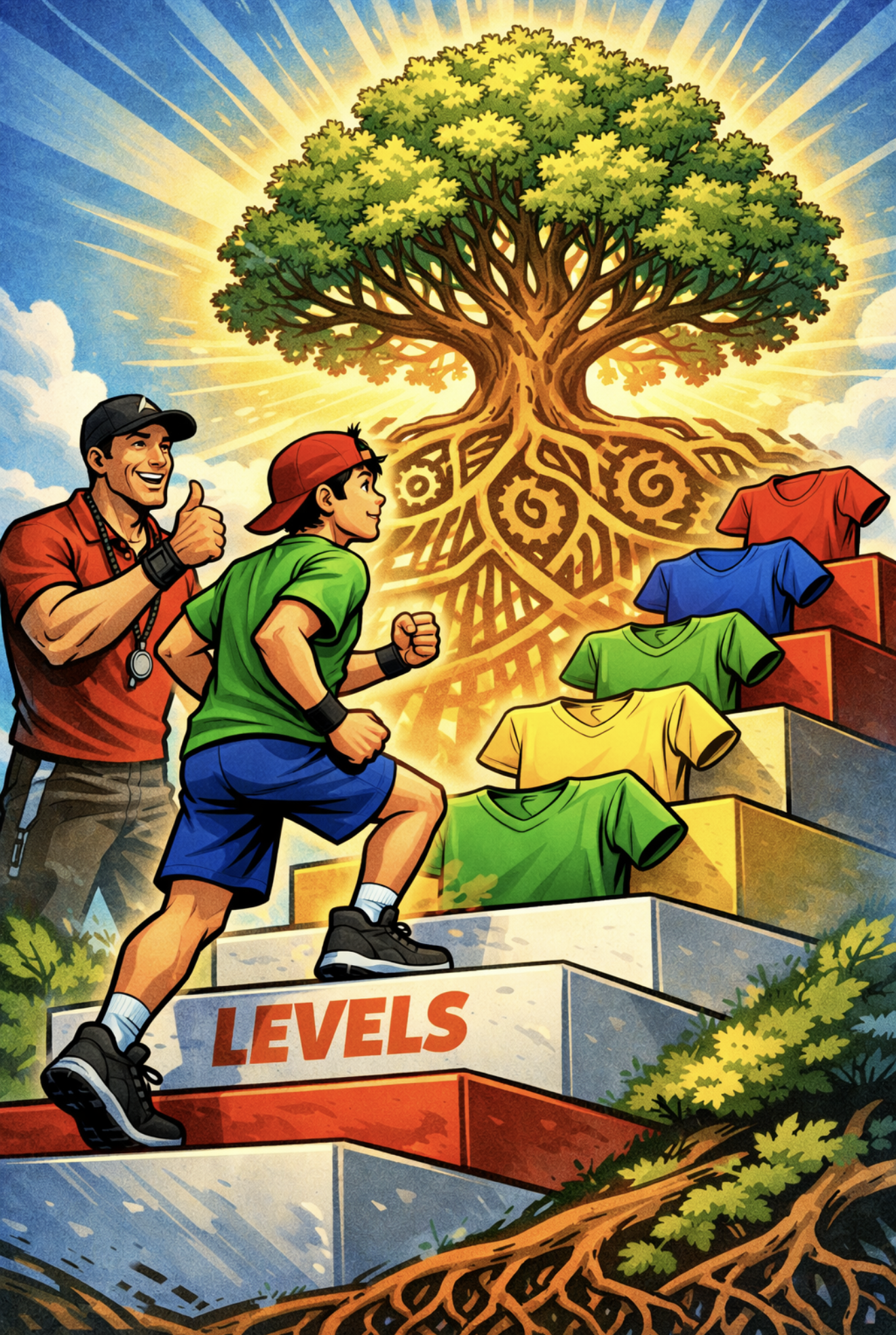
The leveling system isn’t just physical.
It’s psychological.
Each color, each milestone, each earned shirt tells a young athlete:
You are progressing.
You are capable.
You are becoming stronger in more ways than one.
That is pattern creation.
We are helping kids build life rhythms, not just fitness.
The Mighty Oak Way
At Mighty Oak Athletic, we don’t just run training sessions.
We design development systems.
We recognize the patterns that hold kids back.
We use the patterns that help them grow.
And we create new patterns that follow them into school, sports, relationships, and adulthood.
Strong bodies are the tool.
Strong patterns are the outcome.
And strong patterns, repeated over time, build strong people.
The Terrifying Cost of a Perfect Life
Mighty Oak Athletic Podcast S3:E69 - When Life Gets Too Easy, Kids Need Challenges
In the 1960s, a scientist named John Calhoun ran a famous experiment with mice.
He gave them everything they could ever want.
Unlimited food.
Unlimited water.
No predators.
Perfect temperature.
Safe shelter.
The only limit was space.
At first, the mice thrived.
The population exploded.
Then something strange happened.
Even though their physical needs were met, their behavior began to fall apart.
They stopped parenting well.
They stopped competing.
They stopped exploring.
Some became overly aggressive.
Some completely withdrew.
Many just groomed themselves and avoided all challenge.
Calhoun called it a “behavioral sink.”
The body was safe.
But the mind and social system collapsed.
The lesson is uncomfortable but important.
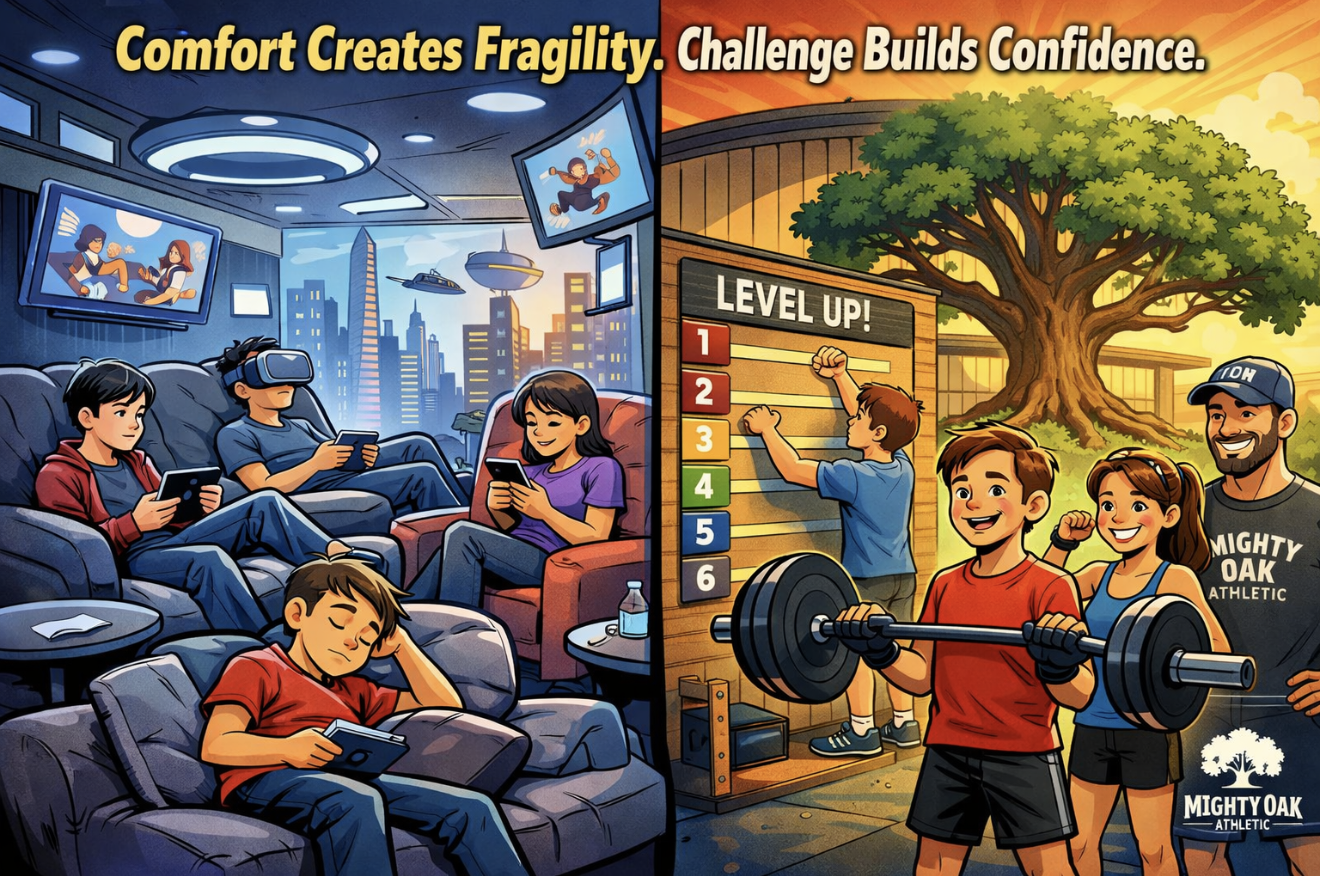
Living without challenge doesn’t create peace.
It creates fragility.
Now look at modern kids.
Food is everywhere.
Entertainment is endless.
Comfort is instant.
Screens remove boredom.
Technology removes friction.
And more technology is coming.
AI.
Automation.
Virtual worlds.
Less need to move.
Less need to struggle.
Less need to solve real problems with the body.
We are not raising mice.
But we are raising humans in an environment of unprecedented ease.
And the risk is the same:
When effort disappears, confidence disappears.
When confidence disappears, identity weakens.
When identity weakens, anxiety rises.
This is where training matters.
Not as punishment.
As purpose.
At Mighty Oak, progress is tracked.
Levels are earned.
Skills are built.
Weights go up.
Movement gets cleaner.
Work capacity improves.
Effort becomes visible.
Progress becomes measurable.
Success becomes real, not virtual.
A kid who adds 10 pounds to their squat didn’t imagine it.
They did it.
A kid who earns a new level didn’t get a participation badge.
They earned competence.
That changes the nervous system.
That changes posture.
That changes how they walk into school.
Confidence is not taught.
It is built through repeated proof:
“I can do hard things.”
“I can improve.”
“I am not fragile.”
This is how we counter a world that is getting softer.
We don’t remove comfort.
We add challenge.
We don’t fight technology.
We build bodies and minds strong enough to use it wisely.
In Calhoun’s world, the mice had everything except a reason to strive.
In our system, training gives kids something priceless:
A reason to show up.
A reason to work.
A reason to progress.
A reason to believe in themselves.
That is not just strength training.
That is civilization training.
That is how you build kids who don’t sink when life gets easy.
That is how you build kids who are strong enough to be useful.
That is how you build Death Resistant humans.
Shotgun a Pint and Wake Your Brain Up
Mighty Oak Athletic Podcast S3:E68 - Shotgun a Pint and Wake Up Your Brain
Personally, drinking a pint of water first thing in the morning is one of the biggest health upgrades I’ve ever made.
It costs nothing.
It takes about ten seconds.
And the return is massive.
Clearer thinking.
Better mood.
More stable energy.
Less dependence on stimulants.
By this time of year, most New Year’s resolutions are already fading.
The gym gets quieter.
The meal plans get looser.
Motivation dips.
That’s actually the perfect moment to add a habit.
Not a complicated one.
Not an expensive one.
Not a total life overhaul.
A simple one.
Drink a pint of water the moment you wake up.
Before your phone.
Before your coffee.
Before your kids.
Before your email.
Before anything.
Put a cup by the bathroom sink.
Wake up.
Grab it.
And shotgun it like a college frat boy.
It sounds silly.
But it might be one of the most powerful health habits you’ll ever build.
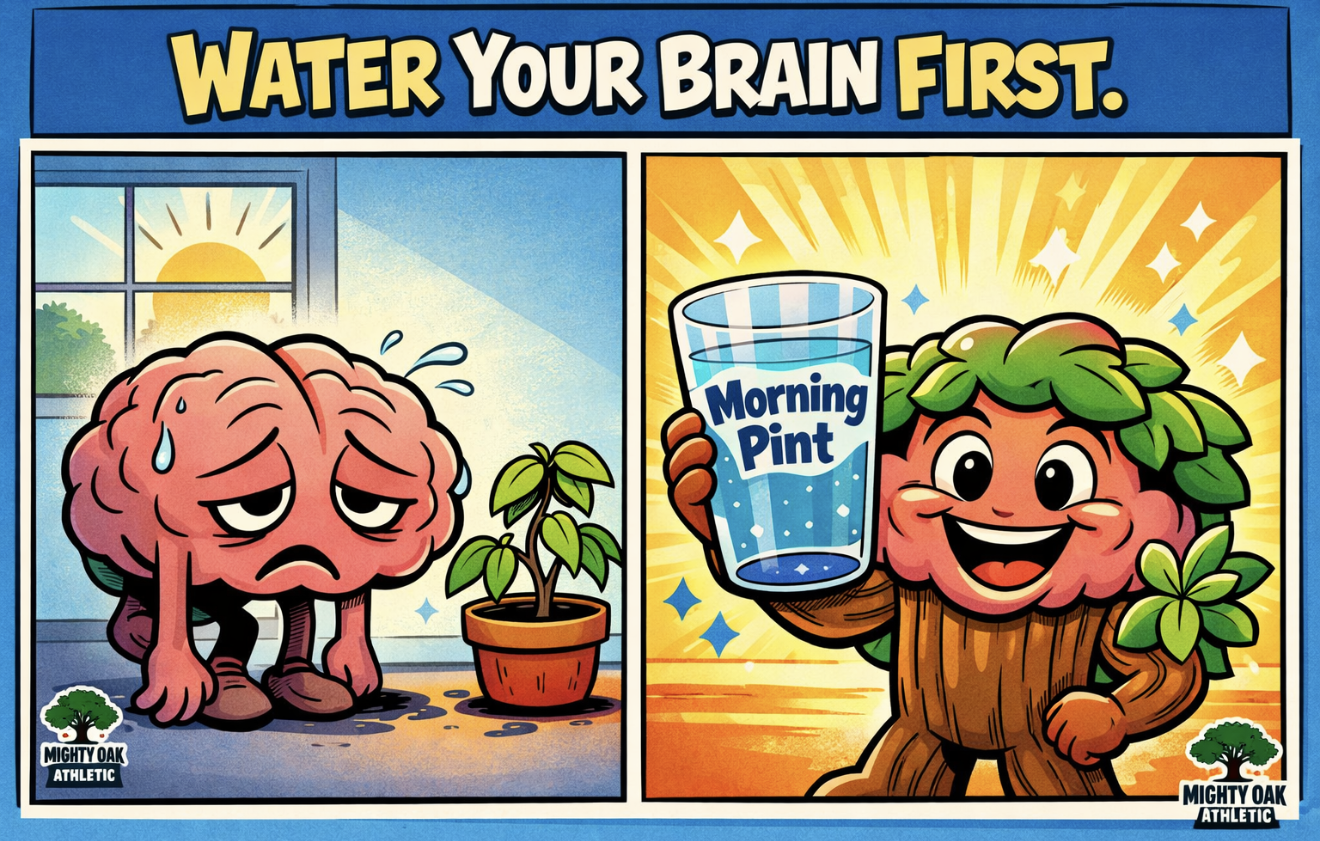
Think about a plant.
When it hasn’t been watered, it droops.
The leaves look tired.
The color fades.
It just looks “off.”
Then you water it.
And within minutes, it perks up.
Stems rise.
Leaves open.
Life comes back.
Your brain is no different.
During sleep, you go seven to nine hours without fluids.
You breathe.
You sweat.
You lose water.
You wake up mildly dehydrated.
Research shows that even 1–2% dehydration can reduce:
• Attention
• Memory
• Mood
• Reaction time
• Mental clarity
Studies in journals like Physiology & Behavior and The Journal of Nutrition show that mild dehydration can increase fatigue, headaches, and brain fog, even in healthy adults.
So in the morning, when your brain feels foggy, you think you need caffeine.
What you often need first is water.
Water increases blood volume.
Better blood flow means better oxygen delivery.
Better oxygen means better brain function.
MRI studies even show that hydration status affects brain tissue volume and neural efficiency.
In simple terms: a hydrated brain works better.
That first pint is like watering the plant.
Your nervous system wakes up.
Your circulation improves.
Your mental clarity sharpens.
Now here’s where it gets interesting.
We’re not saying quit coffee.
(Although we could make a strong case.)
What many people discover is this:
After they hydrate first, they don’t need coffee to feel human.
They simply enjoy it.
Instead of pounding three cups to feel alert, they sip half a cup because they like the taste.
And suddenly:
Sleep improves.
Anxiety drops.
The afternoon crash fades.
They escape the hamster wheel:
“I can’t wake up without coffee.”
“I can’t sleep because I had coffee.”
“I need coffee because I can’t sleep.”
Hydration breaks that loop.
From a performance standpoint, this matters.
Water regulates:
• Body temperature
• Joint lubrication
• Muscle contraction
• Nutrient transport
• Waste removal
Even mild dehydration can reduce strength and endurance.
For athletes.
For parents.
For coaches.
For anyone who wants energy that lasts all day.
You don’t need a new program.
You don’t need a supplement.
You don’t need more willpower.
You need a cup.
A sink.
And ten seconds of intention.
Water your brain.
Then go build your day.
Why the Best Young Athletes Don’t Specialize Early
Mighty Oak Athletic Podcast S3:E67 - Why the Best Young Athletes Don’t Specialize Early
There is a major disconnect in youth sports today.
Parents are often told that if their child does not specialize early, they will fall behind.
Meanwhile, college and professional coaches keep saying the opposite.
One of the clearest voices on this topic is Tom Izzo, who built elite programs around multi-sport athletes.
Not specialists.
Athletes.
Athletic Development Comes First
Coach Izzo has coached players who were standout football players, baseball players, tennis players, and track athletes.
Some of them could have played professionally in other sports.
None of them were hurt by playing multiple sports.
Many were helped by it.
Multi-sport athletes arrive with better movement skills.
They adapt faster.
They compete longer.
They are not locked into one pattern, one speed, or one way of thinking.
That matters more than early rankings or trophies.
Competitive Stamina Is More Than Conditioning
Every sport asks something different from the body.
Basketball requires repeated bursts of effort with quick mental resets.
Football demands short, explosive efforts followed by recovery.
Soccer demands continuous movement, pacing, and awareness.
Baseball demands patience, precision, and sudden power.
When kids play multiple sports, they learn how to:
Compete hard
Recover quickly
Reset mentally
Handle pressure
This is competitive stamina.
It is physical.
It is mental.
It is learned over time.
Why Strength Training Belongs in the Middle
Strength training should not replace sports.
It should support them.
At Mighty Oak Athletic, strength training is the common thread that connects every sport an athlete plays.
All athletes need to squat, hinge, push, pull, rotate, sprint, and change direction.
Strength training organizes these movements.
Sports apply them.
A stronger, more coordinated athlete transfers skills between sports more easily.
That is why multi-sport athletes often thrive in the weight room.
Multi-Sport Athletes Train Better
Kids who play multiple sports tend to:
Learn new skills faster
Respond better to coaching
Handle fatigue more effectively
Stay motivated longer
They are used to being uncomfortable.
They are used to learning.
They are used to competing in different environments.
That makes training more effective and more enjoyable.
The Problem With Early Specialization
Early specialization often benefits systems more than kids.
Year-round leagues.
Travel teams.
Private training pipelines.
These models promise short-term success.
They rarely talk about burnout, overuse injuries, or loss of motivation.
Repeating the same movements year-round increases wear and tear.
Strength training helps balance that stress, but variety in sports matters just as much.
What Coaches and Data Agree On
Across high-level sports, the trend is clear.
Most elite athletes played multiple sports growing up.
They developed broader athletic skills.
They built resilience.
They learned how to compete in different ways.
These benefits are hard to measure at age 10.
They become obvious at 16, 18, and beyond.
How Mighty Oak Athletic Approaches Training
We train athletes, not positions.
Our goal is to support:
Athletic development
Competitive stamina
Confidence
Coachability
Longevity
Strength training becomes the stable foundation.
Sports rotate around it.
This allows athletes to enjoy their seasons, recover properly, and come back stronger each year.
The Long-Term View
The goal is not to win youth sports.
The goal is to still be healthy, motivated, and improving years from now.
Multi-sport participation builds adaptable athletes.
Strength training builds durable bodies.
Together, they create young athletes who are prepared for whatever sport—or challenge—comes next.
That is the Mighty Oak Athletic way.
We build strong bodies.
We build adaptable athletes.
We build for the long term.
We Build Better Athletes.
Parents Hate Hearing This: Winning Isn’t the Point of Youth Sports…This Is
Mighty Oak Athletic Podcast S3:E66 - Parents Hate Hearing This: Winning Isn’t the Point of Youth Sports…This Is
Sports Are a Safe Place to Practice Becoming a Leader
At Mighty Oak Athletic, we believe youth sports are about more than wins and losses.
Sports are a low-risk place for kids to practice becoming strong, capable, resilient people.
Research continues to confirm what great coaches and parents have seen for generations.
Sports give young athletes a space to struggle, adapt, and grow without life-altering consequences.
That matters.
Because failure is not the enemy.
Avoiding failure is.
Why Youth Sports Matter Beyond the Scoreboard
One of the most powerful ideas in youth development is simple.
Sports are a safe place to practice virtue.
A child can miss a shot.
Lose a match.
Have a tough season.
And still be okay.
They are not risking their future.
They are building it.
In sports, kids experience disappointment and learn how to respond.
They learn how to work with teammates who frustrate them.
They learn how to feel bad for a moment and keep going anyway.
Those are life skills.
And they are best learned early, when the stakes are low and the support is high.
The Physical Side Still Matters
We don’t ignore physical development.
Strength matters.
Movement quality matters.
Confidence in the body matters.
At Mighty Oak Athletic, we coach young athletes to move well, train safely, and get stronger over time.
We take progress seriously.
But the deeper value of training shows up alongside the physical work.
The gym becomes a classroom.
Every training session becomes a lesson in effort, focus, and patience.
Where Strength and Failure Meet
In the gym, resistance is unavoidable.
The weight does not care how your day went.
Some days it moves well.
Some days it doesn’t.
That reality teaches something important.
Effort matters more than outcomes.
When progress is slow, kids learn patience.
When a movement feels awkward, they learn humility.
When they miss, they learn how to try again.
This is not failure as punishment.
This is failure as information.
And it is one of the safest environments in a young athlete’s life to experience it.
What This Means for Parents
The instinct to protect is natural.
It comes from love.
But growth requires friction.
A missed lift.
A tough training session.
A season that doesn’t go as planned.
These moments are not setbacks.
They are practice.
Practice for the challenges that will come later in life.
Our job is not to remove struggle.
It is to provide a safe, supportive place for kids to learn how to handle it.
The Mighty Oak Athletic Way
At Mighty Oak Athletic, we train the whole athlete.
We build strong bodies.
We build confident movers.
We build resilient minds.
We give young athletes a place to work hard, fail safely, and grow steadily.
Because youth sports are not just about today’s game.
They are about who your child becomes tomorrow.
We Build Better Athletes
I Learned This in a Fraternity… and It Explains Why Strength Training Changes Boys
Mighty Oak Athletic Podcast S2:E65 - I Learned This in a Fraternity...and It Explains Why Strength Training Changes Boys
When I was a junior in high school, I went on the college-tour circuit that so many teenagers experience on their way to the next chapter of life.
Large public schools.
Small private colleges.
Some close to home.
Others across the country.
It was February in Chicago — cold, gray, and miserable.
My friend Emily and I flew out to visit the University of Arizona in Tucson.
The first morning on campus, I walked down Greek Row.
The sun was warm on my face.
The sky was a perfect blue.
Students strolled past with an ease and energy that felt completely foreign to a Chicago kid in winter.
Girls walked by in Daisy Duke shorts, smiling and laughing under that desert sunshine.
Sold.
My college search was over in five minutes.
I applied, sent my deposit, reserved housing, and locked it all in before most kids had finished their essay drafts.
That fall, I joined Pi Kappa Alpha — PIKE — with a group of freshman “meatheads” from all over the country: Seattle, Phoenix, Chicago, Los Angeles, San Diego, Houston, Denver.
But you don’t join a fraternity at first.
You become a pledge — a membership candidate.
And in the mid-90s, pledging meant one thing:
Shared suffering.
Upperclassmen put us through a semester of hazing rituals that were exhausting, ridiculous, and honestly… sometimes miserable.
But we looked out for each other.
We stayed up late together.
We dodged upperclassmen on campus so we wouldn’t be forced to recite the frat credo in the middle of the cafeteria.
We were woken up in the middle of the night to help a pledge brother who got himself into a questionable situation.
It was terrible.
And it was amazing.
It bonded us.
The most fun I’d never want to have again.
We even found joy in the chaos — like the night before spring break when we covered the frat house in bags of flour and rotten fish, then piled into minivans and tore off toward Rocky Point, Mexico, like privileged vigilantes.
Sure, there was hell to pay when we got back.
But we suffered together.
Standing shoulder to shoulder built a brotherhood that still exists today — even though I may go years or decades without seeing some of those guys.
And that’s where the idea of this essay begins:
Boys and young men often build their strongest bonds not by talking face-to-face… but by standing shoulder to shoulder.
Why Boys Connect Side by Side
There’s an old observation about how boys communicate.
They don’t always want deep conversations or heart-to-heart talks.
They prefer doing something together.
Fishing.
Playing video games.
Shooting hoops.
Jogging.
Sitting next to each other in a car.
Activity creates connection.
Shared experience builds trust.
This is why the weight room works so well for young athletes — especially boys.
Shoulder-to-Shoulder Builds Camaraderie
Strength training puts athletes side by side.
They load the bar together.
Spot each other.
Cheer for each other.
Suffer through tough sets together.
Win small victories together.
No speeches needed.
No pressure to “open up.”
The bond forms naturally because they are moving in the same direction — literally and mentally.
Shared effort = shared respect.
Shared struggle = shared friendship.
This is the same dynamic I experienced during those chaotic fraternity nights.
You grow closer when you go through something with someone.
Competence Creates Confidence
Training shoulder to shoulder also builds something deeper: competence.
Every rep teaches skill.
Every session builds mastery.
Every cue from a coach helps an athlete do something he couldn’t do last week.
Competence becomes confidence.
Not fake swagger.
Not hype.
Not empty motivation.
Real confidence comes from knowing:
“I did this.
I earned this.
I can do it again.”
That strength carries into school, sports, friendships, and everyday life.
A Safe Place for Growth
Not every kid knows how to talk about stress or doubt.
But most kids can deadlift.
Most kids can push a sled.
Every kid can get one percent better.
Movement becomes the language.
Effort becomes connection.
Training becomes the safe place where kids can be themselves.
This is why quieter kids blossom here.
Why awkward middle-schoolers transform into confident high-school leaders.
They grow shoulder to shoulder.
Rep by rep.
Week after week.
The Mighty Oak Way
At Mighty Oak Athletic, we build athletes who are:
• strong
• confident
• competent
• connected
The weight room becomes their version of Greek Row — but healthier, safer, and more intentional.
A place where friendships form.
A place where they learn to show up for each other.
A place where confidence takes root.
We grow better athletes — and better young men — one rep at a time.
Side by side.
Shoulder to shoulder.
The Exact Meals Our Strongest and Fastest Athletes Eat at Home: Easy + Cheap + Kid Approved
Mighty Oak Athletic Podcast S2:E64 - The Exact Meals Our Strongest and Fastest Athletes Eat at Home: Easy + Cheap + Kid Approved

Feeding a student-athlete shouldn’t feel like a full-time job.
School, practice, homework, strength training, and games already push families to the limit.
So here’s the good news:
Eating for athletic performance does not require complicated meal plans, expensive supplements, or hours of prep.
It just requires repeatable recipes built on real ingredients.
That’s why Mighty Oak Athletic founder Michael Ockrim created the Easy Healthy Recipes Collection — simple meals for busy families who want strong, focused, confident athletes.
These recipes line up with the exact Mighty Oak Athletic Nutrition framework:
Prioritize protein.
Add healthy fats.
Eat veggies at most meals.
Choose whole ingredients over processed foods.
Be consistent — not perfect.
Below are the top athlete-approved recipes, grouped by category with direct links so you can start cooking today.
🥤 Smoothies
Smoothies are a fast way to hydrate and refuel before school or practice.
Classic Strawberry Banana Smoothie
Frozen fruit + spices + coconut oil for brain + hormones.
🍲 Chili, Soups & Stews
One-pot meals that feed the whole family for days.
Grass-fed beef + beans + kale for power and recovery.
A Coach Mike Family Favorite! Chicken + bok choy + white beans + citrus for immune support.
Slow-cooked beef + turmeric for anti-inflammatory benefits.
🍗 Big Protein Mains
Dinners that build muscle and support recovery.
Braised chicken thighs over polenta — high protein + carbs for training days.
Ground bison + veggies in a homemade sauce athletes love.
Simple cast-iron method for busy nights.
Healthy fats that support hormones and brain fuel.
Pasta + beef + veggies — perfect after practice.
A “clean” comfort food classic.
Gluten-Free & Dairy-Free Pancakes
GF/DF option that still tastes amazing.
🍳 Breakfast & Brunch
Morning, noon, or night — breakfast food is underrated performance fuel.
Whole-wheat pancakes served with eggs and veggies for stable energy.
Half a hot dog + fruit + nuts + veg — a perfect plate hack.
Kid-friendly curry tuna power bowl.
Sweet or savory — fast and cheap.
Whole-grain waffles with cinnamon and vanilla.
Classic breakfast done clean and athletic.
🍞 Breads, Grains & Sides
Carbs don’t slow athletes down — the right carbs power them up.
Whole Wheat Baking Powder Biscuits
The perfect dinner side for athletes with big appetites.
A great base for protein-heavy meals.
One-hour bread — easy weekly staple.
Pasta with clean ingredients for training days.
Why this matters
Strong bodies are built in the gym.
But great athletes are built in the kitchen.
These recipes help families fuel for:
Better performance.
Better focus.
Better confidence.
Better habits for life.
That’s what Mighty Oak Athletic Nutrition is all about — making healthy food simple and repeatable for kids who want to play better and feel better.
Call to action
If you want more tools like this — including grocery lists, athlete meal plans, and step-by-step performance nutrition — you can now download a FREE copy of the Student-Athlete Nutrition Book and a FREE copy of the 13 Pounds in 30 Days book written for parents.
Both books are included at no cost for subscribers to Mighty Oak Athletic.
Let’s Build Better Athletes — one meal at a time. 💪🍽

Why Kids Quit Sports — and How to Keep Them Playing for Life

Mighty Oak Athletic Podcast S2:E63 - Why Kids Quit Sports — and How to Keep Them Playing for Life
Kids don’t quit sports because they don’t like winning.
They quit because it stops being fun.
Most parents and coaches want to do the right thing.
They show up, cheer, and want kids to do their best.
But sometimes, without knowing it, the adults focus on the wrong things.
And when the focus is off, kids lose the joy that keeps them in the game.
A research team from George Washington University studied what actually makes sports fun for kids.
They interviewed athletes between the ages of 8 and 19.
They listed 81 “fun-determinants” — the exact things that young athletes said make them enjoy and stick with sports.
The results were surprising.
For years, many people believed that girls play for friendships and boys play for competition.
But that wasn’t true.
Boys and girls gave almost the exact same answers about what makes sports fun.
So what do kids actually want?
The top three reasons that make sports fun were clear and powerful:
1. Trying hard.
Kids love working hard, sweating, improving, and giving their best.
2. Positive team dynamics.
They want teammates who support each other, play as a unit, and treat each other with respect.
3. Positive coaching.
They want coaches who encourage, teach, and respect the athletes — even when mistakes happen.
Do you see the pattern?
The top sources of fun are not trophies, rankings, travel, or highlight reels.
They are effort, relationships, and encouragement.
Winning did not make the top three.
It didn’t even make the top ten.
That doesn’t mean winning is bad.
Winning is great.
It just can’t be the only thing that matters.
If the only goal is winning, eventually kids stop having fun — and when the fun drops, participation drops too.
Here’s the big takeaway for parents and coaches:
We don’t need to make sports easier — we need to make them better.
Kids love being challenged.
They love getting stronger.
They love learning new skills.
They just need a positive environment where they feel confident, supported, and respected.
That’s exactly what we focus on at Mighty Oak Athletic.
We train athletes to:
Work hard
Earn their progress
Support their teammates
Build confidence through effort
Learn to get better step by step
When sports feel fun, kids play longer.
When they play longer, they develop more.
When they develop more, they perform better and reduce injury risk.
Everybody wins.
If we want kids to build lifelong strength and healthy habits, we need to grow what the research calls the “Youth Sport Ethos”:
Try hard.
Be a good teammate.
Coach with respect and encouragement.
When those three things are in place, kids thrive.
Not just in sports — but in school, friendships, and life.
Sports should not break kids down.
Sports should build them up.
That is our mission.
That is our standard.
That is why we build better athletes.
New Year. New Energy. Same Kid — Stronger You.

Your kid isn’t just getting stronger from workouts.
They’re learning what commitment looks like — from watching you.
They see if you show up.
They see if you make time.
They see if you live the lessons you preach.
So this year, what if they saw you right there beside them?
For $49/month, parents can train alongside their kids at Mighty Oak Athletic.
Same program. Same structure. Same community.
You’ll build strength, energy, and a shared sense of pride — one rep at a time.
It’s not about keeping up with them.
It’s about showing them growth doesn’t stop at 18… or 50.
Need a reboot first?
Start with our free 13 Pounds in 30 Days Program — a 30-day reset to drop holiday weight, boost energy, and get back in control.
Two choices:
Keep watching from the lobby — or step in and show them what doing the work looks like.
Coach Mike
Mighty Oak Athletic
We Build Better Athletes — and Stronger Families
